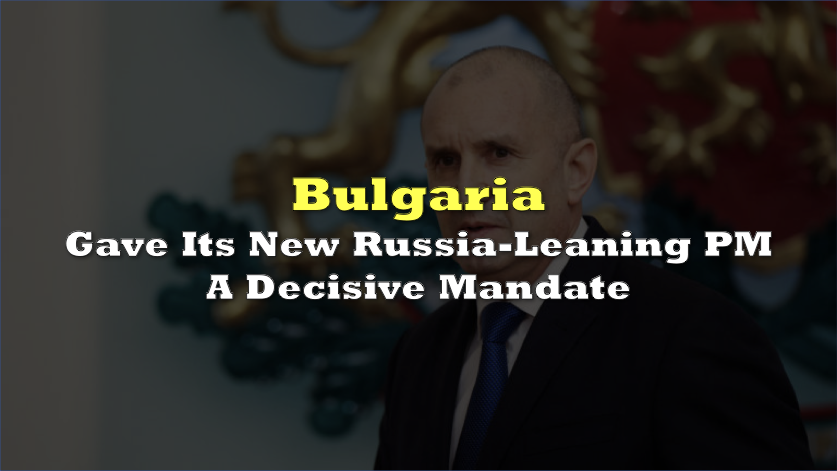

Bulgaria’s recent parliamentary election produced the country’s strongest political mandate in years, with former president Rumen Radev’s Progressive Bulgaria taking 44.7% of the vote after 91.68% of ballots were counted.
The win trails the runners-up GERB at 13.4% and the reformist We Continue the Change-Democratic Bulgaria bloc at 12.9%.
Sunday’s vote is the latest in a cycle of eight elections in five years, with the result possibly producing the country’s first absolute parliamentary majority since 1997. After years of fragmented legislatures, weak coalitions, and short-lived cabinets, voters handed one bloc the kind of room to govern that Bulgarian politics has not recently allowed.
 Sponsored · Altamira Gold Corp.
Radev previously stepped down from the presidency in January to run for parliament after protests helped force out the previous government in December. He campaigned on anti-corruption, institutional repair, and a break from the veteran parties that had dominated Bulgarian politics for decades.
The domestic backdrop was economic as much as political. Bulgaria adopted the euro on January 1, 2026, becoming the euro area’s 21st member, but households still entered the election under price pressure. The National Statistical Institute said March consumer inflation was 0.9% month over month and 4.1% year over year under the national CPI measure, with transport prices up 7.2% on the month and food and non-alcoholic beverages up 0.5%. Under the harmonized EU measure, annual inflation was 2.8% and monthly inflation 1.0%.
Radev is also described as pro-Russian and eurosceptic, noted his opposition to military support for Ukraine, and said he has argued for improved ties with Moscow and the restoration of Russian oil and gas flows into Europe. The Kremlin said it was encouraged by his stated desire to resolve issues with Russia through pragmatic talks.
Bulgaria remains an EU and NATO member, and Reuters reported that Radev had signaled willingness to work with pro-European parties on judicial reform. Still, after a result this large, Brussels will have to pay attention to how much of his campaign rhetoric becomes governing policy, particularly on energy, sanctions, and military support related to Ukraine.