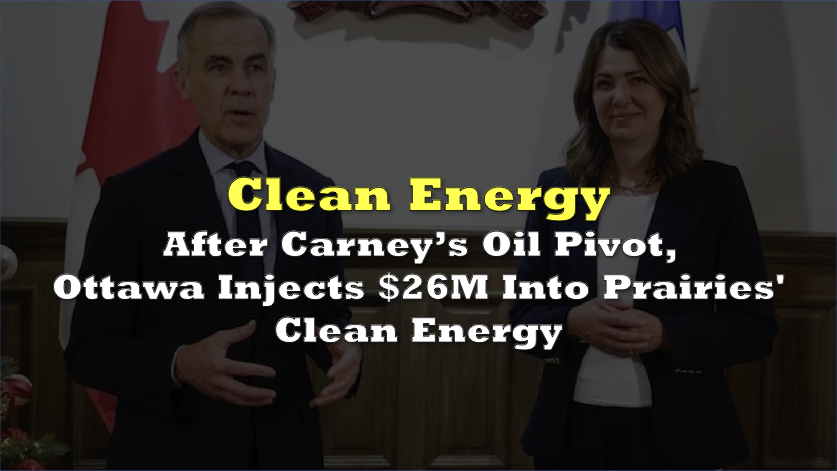

Energy and Natural Resources Minister Tim Hodgson announced a $26 million clean energy push in Alberta and Saskatchewan, putting federal money behind 17 projects across the Prairies. The projects cover energy storage, wind, solar, transmission planning, Indigenous-led power development, methane reduction, renewable natural gas, low-emissions cement, and building efficiency.
It came days after Prime Minister Mark Carney acknowledged that Canada’s emissions will be higher over the next few years than projected under the previous government’s plan, while recasting oil and gas growth as necessary for affordability, exports, energy security, and national unity.
Carney said the old plan was “not sustainable over the long term” and too divisive for the country.
 Sponsored · Selkirk Copper Mines
That creates the new Carney energy formula: more room for oil and gas now, more clean-energy spending beside it, and a promise that lower emissions will still arrive later.
The federal release leaned into that dual identity. Natural Resources Canada described Canada as a “clean and conventional energy superpower,” a phrase that captures the government’s attempt to avoid choosing between Alberta’s oil economy and Canada’s climate brand.
The largest piece of the new package is $14.9 million for 10 projects tied to energy storage, solar and wind development, interprovincial electricity transmission planning, Indigenous-led clean energy projects, and workforce development.
Another $5.9 million will fund engineering and design work for two waste biomass-to-renewable natural gas facilities with carbon capture.
 Sponsored · Altamira Gold Corp.
Ottawa also committed $3.5 million for two projects aimed at methane emissions from upstream oil and gas operations and low-emissions cement alternatives that permanently store carbon.
A further $2.3 million will support three projects tied to higher energy-efficiency building codes.
The details show a government trying to thread several constituencies at once. The University of Calgary will receive $4.22 million for work on interprovincial transmission expansion in Western Canada. Clean Communities Corp. will receive $3.9 million for a 5-MWh battery system at the SunRISE Solar Facility in Cardston. Kainai Pe-na-koyim Renewable Energy Centre GP Corp. will receive $2 million for capacity-building tied to a proposed 300-MW wind farm near Lethbridge.
Indigenous-led energy projects are central to the package. Neyaskweyahk Group of Companies Inc. will receive about $1.48 million for feasibility work on a 112-MW solar power plant with a 30.2-MW battery storage system. Samson Cree Nation, Saddle Lake Cree Nation, Bigstone Cree Nation, and other Indigenous or community-linked recipients are also included in the backgrounder.
The oil-and-gas bridge is equally visible. Prabhu Energy Alberta Ltd. will receive $3 million to develop an exhaust treatment device designed to eliminate methane and volatile organic compound emissions from stationary combustion engines used in upstream oil and gas.
The timing sharpened the contrast. Canada and Alberta recently announced plans for a new west coast oil pipeline that would carry 1 million barrels per day from Alberta to the Pacific coast, expanding access to Asian markets and reducing reliance on the US. Alberta said construction could begin as early as September 2027.
Reuters reported that the proposed pipeline would be built by government-owned Trans Mountain Corp. with Pembina Pipeline Corp. holding a 10% construction stake and an option for up to another 10% after operations begin.
Hodgson framed the funding in economic terms, saying energy is “the backbone of our economy” and that modernizing existing systems can catalyze investment, generate jobs, stabilize energy costs, reduce emissions, and support long-term growth.
The government’s own quick facts tie most of the money to the Smart Renewables and Electrification Pathways Program, a $4.5 billion federal program for grid modernization, energy storage, and renewable energy technologies. Indigenous Services Canada contributed $649,000 to Indigenous-led electricity projects for solar pre-development work.
The announcement also links the projects to Canada’s National Electricity Strategy, which aims to double grid capacity by 2050. It says the July 4 funding builds on June 26 support for transmission interties connecting Yukon and BC, Alberta and BC, Alberta and Saskatchewan, and Saskatchewan and Manitoba.