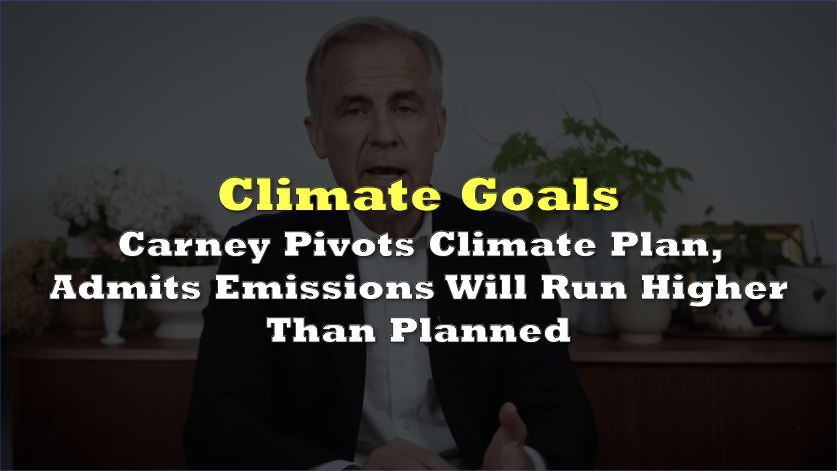

In a video address, Prime Minister Mark Carney says the climate plan inherited from the previous government was “well intentioned” and suited to its time, but argues that the assumptions behind it no longer hold. He says Canada cannot “restrain the growth” of oil and gas to meet a short-term goal and plans must change, but also acknowledges that emissions will be higher in the next few years than projected under the previous plan.
“The changes we have made will mean that our emissions will be higher in the next few years than they were projected to be under the previous government’s plan,” Carney said. “But in my judgment, that plan was not sustainable over the long term. It would have been too expensive for Canadians.”
That is the sharpest policy tension in the speech. Carney does not renounce climate action, saying the climate crisis remains real and that the commitment to fighting it is “absolute.” But he also recasts the path to lower emissions as one that must allow near-term oil and gas growth, a shift that places affordability, exports, national unity, and US dependence ahead of the old near-term emissions trajectory.
 Sponsored · Selkirk Copper Mines
The pivot lands awkwardly because Carney’s public brand was built partly around climate finance. He is credited, then as UN Special Envoy on Climate Action and Finance, for launching the Glasgow Financial Alliance for Net Zero (GFANZ), an independent, private-sector-led initiative to accelerate the transition to a net-zero global economy, along with the COP26 presidency. GFANZ is described as a Carney-chaired alliance uniting more than 160 firms with more than US$70 trillion in assets to accelerate net zero by 2050.
Now Carney is making a different argument.
“The goal remains the same,” he said. “But as times have changed, we must change our plan to get there. We can’t afford to restrain the growth of an important part of our energy mix, oil and gas, to meet a short term goal.”
The numbers explain why Carney is reaching for a sovereignty frame. Canada remains deeply tied to the US as an energy customer. The Canada Energy Regulator said that in 2023, Canada exported 3.9 million barrels per day of crude oil, with 97% going to the US, valued at $130 billion. The same regulator said all 7.8 billion cubic feet per day of Canadian natural gas exports went to the US that year.
 Sponsored · Altamira Gold Corp.
That makes Carney’s argument less about whether Canada will use oil and gas and more about who captures the value while the world still uses them.
“The truth is, nobody knows how long the global economy will rely on conventional energy,” he added. “Well, it does, as much of that energy is possible, should come from Canada, produced responsibly and with a clear focus on lowering emissions over time.”
The policy problem is that “over time” is not the same thing as a target. Canada’s official 2030 Emissions Reduction Plan still says the country aims to cut emissions by 40% below 2005 levels by 2030 and reach net-zero emissions by 2050. Canada’s climate indicators page also states that the country has a 2035 target of 45% to 50% below 2005 levels.
Carney’s speech therefore creates a measurable gap between destination and route. The destination remains net zero. The route now appears to tolerate higher emissions in the next few years, betting that looser constraints on oil and gas can preserve affordability, attract investment, reduce dependence on the US, and keep Alberta inside the national project.
That bet was already visible in federal policy before this latest message. In November 2025, Carney’s government signed an agreement with Alberta to eliminate a planned oil and gas emissions cap and drop clean electricity rules, while Alberta would strengthen industrial carbon pricing and support the Pathways Plus carbon capture project.
The deal opened a path for a new oil pipeline to British Columbia’s northwest coast, drawing opposition from BC Premier David Eby and Indigenous groups.
The Prime Minister’s Office described the same Alberta agreement as part of a Climate Competitiveness Strategy built around industrial carbon pricing, methane regulations, and investments in nuclear, hydro, wind, storage, and grid infrastructure. Carney’s speech on the agreement said the strategy was meant to “drive growth while lowering our emissions,” while also highlighting tax incentives and competitiveness against the US.
That is the core Carney doctrine now: climate policy must survive contact with geopolitics. His office has repeatedly framed Canada as an “energy superpower,” citing the country’s large oil reserves, natural gas production, and clean electricity grid. In an October 2025 address, Carney said Canada had the third-largest oil reserves and fourth-largest natural gas reserves in the world, alongside an 85% clean electricity grid.
The contradiction is not subtle. Carney’s government is still selling electrification as the long-term path to affordability, competitiveness, and net zero. In May 2026, the prime minister launched the forthcoming $1-trillion National Electricity Strategy that would aim to double grid capacity by 2050, potentially delivering up to $15 billion in total energy savings by 2050 and lowering total energy costs for 7 in 10 households. But that same announcement said the plan would require flexibility, including natural gas, to keep power reliable and affordable.
Critics from the climate side see a retreat dressed up as realism. Climate Action Network Canada called the Canada-Alberta agreement a blow to one of the last major pillars of Canada’s climate plan, arguing that Carney had given more room to fossil fuel expansion.
The oil and gas side is not fully satisfied either. Pundits on social media argued that if Carney believed conventional energy should come from Canada, the government should move faster on pipelines, LNG export capacity, potash, and power exports.
The most consequential line in the transcript may be the one accusing the old plan of creating an opening for those who want to pull Canada apart “both at home and from abroad,” recording the issue as a national unity and security risk. The phrase shifts the argument away from emissions accounting and into the politics of fragmentation.
At home, the most immediate example is Alberta, where separatist politics have moved from online grievance to formal referendum maneuvering. In May 2026, Alberta Premier Danielle Smith added a question to a provincial referendum process that would ask voters whether Alberta should begin legal proceedings for a future independence vote, a move Carney reportedly called a “dangerous bluff.”
Abroad, the obvious example is US, where President Donald Trump has repeatedly revived the idea of Canada becoming the 51st state, including during tariff disputes and meetings with Carney, forcing the Canadian prime minister to answer that Canada is “not for sale.” The continued energy dependence gives a tricky trade to balance for Ottawa as it negotiates with Washington amid its president’s rhetoric.
What we’re left with is not just a climate reversal. It is Carney trying to rebuild Canadian federalism around energy exports at the exact moment his earlier climate-finance identity makes the pivot harder to sell.