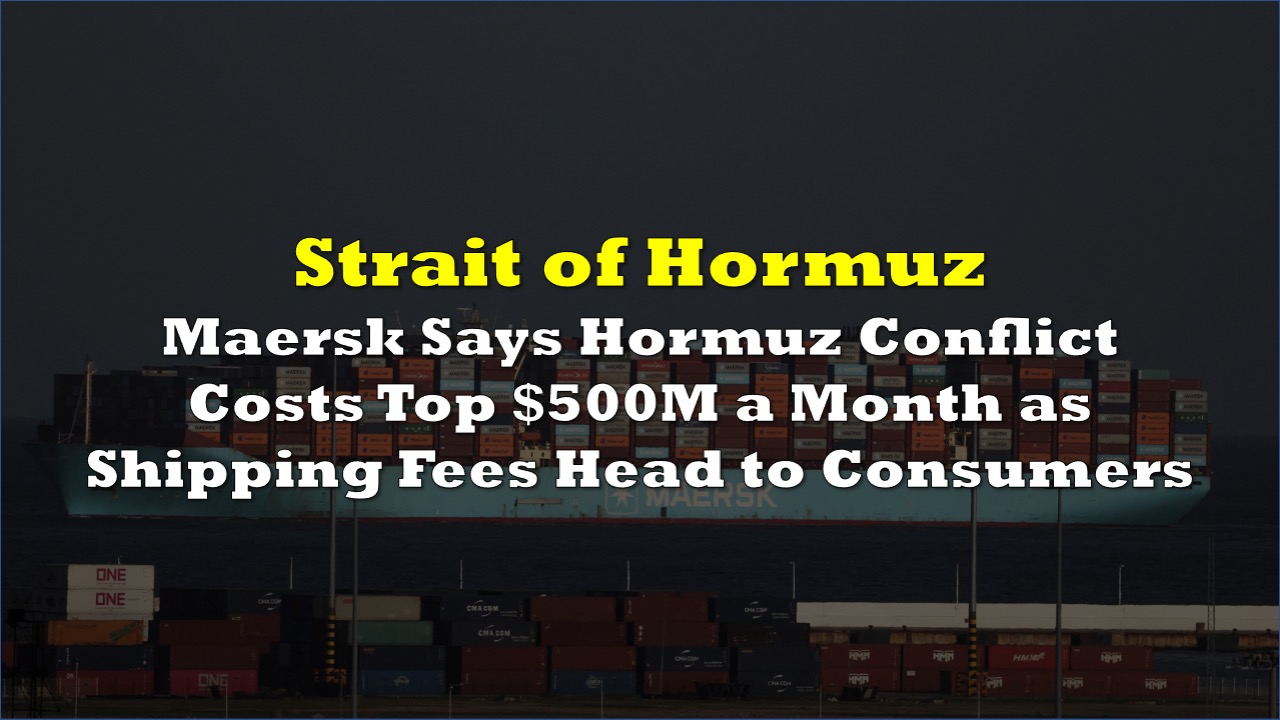

Maersk‘s chief commercial officer Karsten Kildahl warned Wednesday that the ongoing suspension of Strait of Hormuz transits has pushed the Danish shipping giant’s incremental costs above $500 million a month — and that customers and consumers will absorb what the company cannot.
The Hormuz suspension traces to February 28, when US and Israeli forces launched strikes on Iran. The Strait had effectively closed within 48 hours. Maersk, MSC, Hapag-Lloyd, and CMA CGM all suspended transits, rerouting vessels around the southern tip of Africa and adding weeks to transit times. The Strait carries roughly 20% of global petroleum liquids daily, according to the US Energy Information Administration. Its closure — now in its fourth month — marks the most severe maritime supply chain disruption in modern history, with both the Hormuz and the Red Sea simultaneously restricted for the first time.
CEO Vincent Clerc told the BBC that costs will ultimately pass to customers and “on to the consumers,” putting the incremental expense at roughly $200 per standard 20-foot container — a 15% to 20% increase on some freight rates. Kildahl’s Wednesday remarks cited the same $500 million monthly figure Clerc disclosed at Maersk’s first-quarter earnings on May 7, when the company beat EBITDA expectations but flagged prolonged conflict as a meaningful downside risk.
 Sponsored · Selkirk Copper Mines
Hapag-Lloyd imposed a war risk surcharge of $1,500 per 20-foot container. CMA CGM set an emergency conflict surcharge of $2,000. Maersk implemented its own emergency freight increases on cargo moving to and from the UAE, Qatar, Saudi Arabia, Bahrain, Kuwait, Iraq, and Oman.
Oil prices surged above $120 per barrel at the peak of the conflict before retreating. Brent crude traded around $97 on Wednesday — roughly 50% above pre-conflict levels of around $65 — with markets tracking ceasefire negotiations closely.
Goldman Sachs analysts have cautioned that persistent supply chain disruptions could keep prices elevated into 2027. The IEA now projects global oil demand to contract by 80,000 barrels per day in 2026, a sharp reversal from its earlier growth forecast, and Clerc has warned that demand destruction at the consumer level could weigh on total container volumes in the second half of the year.
The situation has shifted significantly since the closure began. A conditional ceasefire between the US and Iran took effect April 7-8 and has since been extended. Iran, now led by Mojtaba Khamenei following his father’s death in the February strikes, had been operating what analysts described as a toll booth system — charging over $1 million per ship for approved passage. After the Islamabad Talks collapsed on April 11, the US imposed a naval blockade on Iranian ports from April 13, creating a dual blockade that redirected 115 commercial ships before it ended.
On May 29, Trump announced the US was lifting the blockade amid reports of progress toward a potential $300 billion peace and reconstruction framework. “Ships caught in the Strait due to our amazing and unprecedented Naval Blockade, which will now be lifted, may start the process of ‘heading home!'” he posted on Truth Social. Iranian officials have since said the underlying memorandum of understanding is not yet finalized.
Read: Trump Lifts Hormuz Blockade After Striking Proposed Deal With Iran
Maersk’s latest Middle East advisory continues to describe conditions as “highly volatile” and “deeply dynamic.” Until the Strait fully reopens, the costs accumulate — and increasingly, they do not stay in the shipping industry.
Information for this story was found via the sources and companies mentioned. The author has no securities or affiliations related to the organizations discussed. Not a recommendation to buy or sell. Always do additional research and consult a professional before purchasing a security. The author holds no licenses.