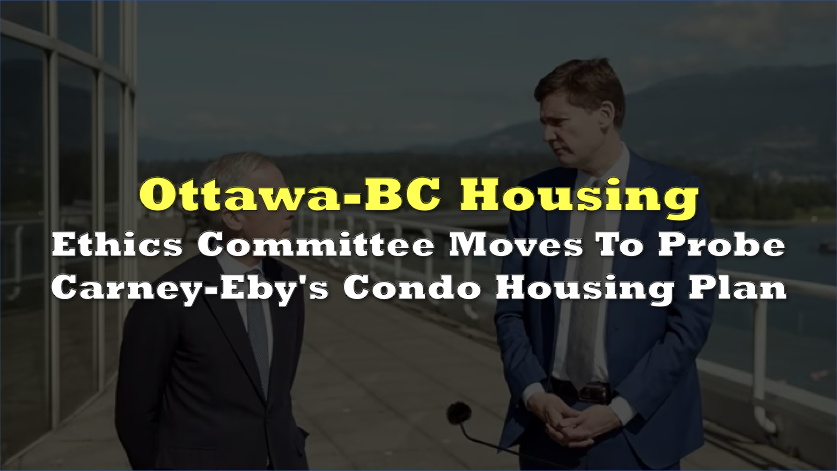

Prime Minister Mark Carney’s plan to help convert more than 2,200 vacant BC condos into affordable homes is heading into a political test before the public has seen the most important number in the deal: the acquisition price.
The House of Commons ethics committee is scheduled to meet July 7 on committee business tied to a June 26 request from Conservative Leader Pierre Poilievre, who wants MPs to examine whether the federal-provincial condo plan creates conflicts of interest or protects developers from taking losses, The Bureau reported.
The meeting does not automatically mean a full investigation will proceed, since the committee’s Liberal majority can determine whether the matter becomes a study.
 Sponsored · Altamira Gold Corp.
Ottawa and Victoria announced the Canada-British Columbia Partnership on Condo Conversion on June 18. The Prime Minister’s Office said Build Canada Homes and BC Housing would use “innovative financing tools” to convert more than 2,200 vacant condo units in priority growth areas into affordable homes.
Carney later said the federal government would cover about 10% of the overall dollar value being contemplated, which he estimated at roughly $1.4 billion. Canadian Press reporting carried by Yahoo Finance put the federal share at about $145 million, with BC covering the rest.
READ: Breaking Down Carney And Eby’s Condo-To-Housing Plan
The political opening for Conservatives is the gap between the headline housing goal and the undisclosed transaction terms.
 Sponsored · Selkirk Copper Mines
Poilievre has described the plan as a “bailout” and asked the ethics committee to investigate potential conflicts of interest. Global News reported that Poilievre pointed to Carney’s statement that developers did not ask him “directly” for the program, then questioned whether another minister had been lobbied.
Carney has rejected the bailout framing, saying the initiative was not designed for industry and defended it as an affordability measure. The government’s argument is that empty units can be moved into affordable use faster than new housing can be built from scratch.
The market backdrop gives both sides ammunition. CMHC’s May 2026 data shows Vancouver had 5,317 unabsorbed condo units and 6,149 total unabsorbed homeowner and condo units. Completed but unsold homes and condos in Metro Vancouver reached 6,149 in May 2026, with condo apartments making up the bulk of the inventory and rising 76% from a year earlier.
That inventory overhang creates a rare opening for public buyers. If governments can acquire finished units below replacement cost, keep them out of speculative resale, and attach long-term affordability rules, the public sector could turn a private market correction into a housing supply win.
But the same conditions create the ethics risk. If units are bought at prices that protect developers, lenders, or investors from losses they would otherwise take, affordability becomes the packaging and market support becomes the substance.
The committee fight could therefore become a price-discovery fight. Conservatives want the issue framed as Liberal-connected developers being rescued from a cooling condo market. Liberals want it framed as governments buying housing faster and cheaper than they could build it.
Both claims are incomplete until the receipts are public.