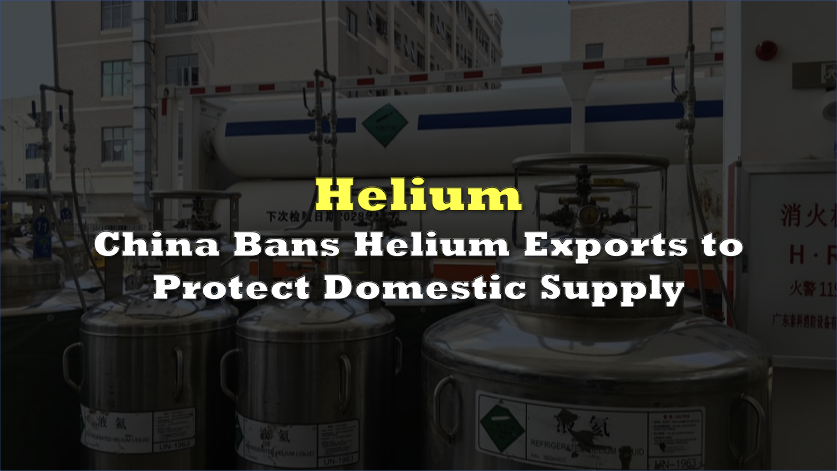

The Chinese Ministry of Commerce and General Administration of Customs imposed the temporary ban on helium exports with immediate effect, invoking provisions of China’s Foreign Trade Law. Authorities did not provide an end date or disclose how much helium would be removed from international markets but they said subsequent policy adjustments would be announced separately.
However, China’s decision to halt exports seems to be less a display of commodity dominance than an attempt to close a leak in its own vulnerable supply chain.
Industry estimates indicate China still imports more than 85% of the helium it consumes. Domestic production stands at roughly 4.6 million cubic metres annually, equivalent to less than 15% of estimated demand. Before Middle East shipping disruptions, Qatar supplied more than half of China’s imports, while Russian deliveries had reportedly reached about 38 million cubic feet per month.
 Sponsored · Selkirk Copper Mines
The ban therefore appears designed to keep imported and domestically processed volumes inside China rather than preserve a large export-oriented production industry.
China had been importing more Russian helium than its domestic market consumed and redirecting some of those volumes abroad as Moscow cannot freely sell into several Western markets following sanctions imposed over its invasion of Ukraine, increasing the value of intermediary trade routes.
Closing that channel could tighten availability for buyers that had begun using China as an alternative source during the Middle East supply shock. However, the Russian connection might be closer to moot after Moscow placed temporary export controls on helium through the end of 2027 earlier this year.
The government did not specify whether the prohibition covers all helium grades, including the ultra-high-purity material required by semiconductor manufacturers, or whether exports already under contract can proceed. It also did not quantify China’s recent re-export volumes.
 Sponsored · Cambria Gold Mines
Helium is used for cooling, leak detection, and precision processes in semiconductor fabrication. It is also essential for superconducting magnets, optical-fibre production, aerospace systems, and specialized welding.
The global market entered 2026 with unusually concentrated supply risk. Qatar, which produces close to one-third of the world’s helium, suffered production and transport disruption during the Middle East conflict.
Some suppliers and manufacturers sought alternative sources in the US, while companies considered slowing production or prioritizing higher-value products. Helium’s transport constraints intensified the problem because liquid helium requires specialized cryogenic containers and cannot be moved through conventional gas infrastructure.
The worst forecasts did not fully materialize. The Wall Street Journal reported in late June that major semiconductor manufacturers maintained output using diversified suppliers, stored inventories, and helium caverns. The report indicated that Taiwan Semiconductor Manufacturing Co., Samsung Electronics, SK Hynix, Infineon Technologies, and STMicroelectronics had avoided significant operational disruption.
China’s intervention now tests that resilience again by removing a separate source of internationally traded supply.
Prices were already moving higher before the ban. Nippon Sanso Holdings announced an average increase of more than 30% for its helium products beginning in July, while industry reports said Asian spot prices had doubled during the broader supply disruption.
The reason for the ban might be chips. China’s semiconductor expansion requires increasingly large volumes of electronic-grade helium. Guangzhou Guanggang Gases & Energy, described as China’s largest domestic helium supplier, has said it supplies 11 Chinese fabrication plants producing 12-inch wafers and can purify imported feed gas to electronic-grade standards.
The company is also working with the Chinese Academy of Sciences on China’s first underground helium storage project. The plan reflects a structural problem exposed by the Middle East disruption. China has built extensive strategic reserves for crude oil and other commodities, but its helium storage and domestic extraction capacity remain comparatively limited.
Beijing has announced plans to add about 250 million cubic feet of annual domestic helium capacity, according to gasworld. That expansion will take time and will not immediately eliminate dependence on Qatar, Russia, and other suppliers.
Until more domestic production and storage become available—or if semiconductor export bans to China loosen—the helium export ban functions as an emergency conservation measure. It protects China’s fabs and strategic industries by shifting part of the shortage outward.