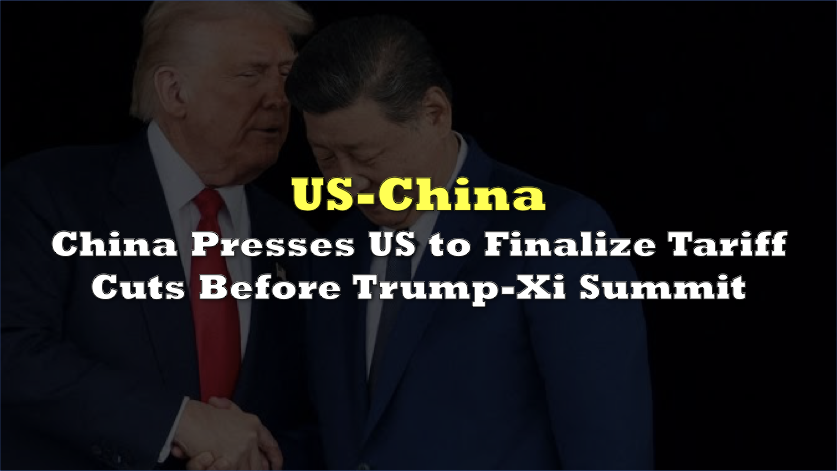

China is pressing to turn a months-old framework for reciprocal tariff reductions into a concrete agreement ahead of an expected late-September summit between President Donald Trump and Chinese President Xi Jinping, shifting the trade discussion from product selection toward execution.
Chinese Commerce Ministry spokesperson Huang Ling said Thursday that negotiators are working to implement reciprocal tariff reductions covering $30 billion worth of goods from each country “at an early date,” according to the AP News.
The framework itself is not new. China’s state-run Xinhua said on July 23 that both sides were exploring tariff reductions covering $30 billion of products from each country and were still discussing the structure of a US-China Board of Trade.
 Sponsored · Selkirk Copper Mines
USTR had already opened a public consultation on June 2 seeking input on “non-sensitive” products that could qualify for tariff modifications. Comments closed July 10, followed by a July 27 deadline for responses.
Beijing is now publicly emphasizing implementation as the two governments prepare potential deliverables for Xi’s expected Washington visit.
Trump has said Xi will visit Washington on September 24. Reuters reported Thursday that China has not publicly confirmed the date, so the meeting remains expected rather than formally confirmed by both governments.
Any agreement would be targeted rather than a broad tariff reset. USTR has framed the mechanism around non-sensitive goods, while separate Section 301 and sectoral tariffs remain in place.
The immediate question before the summit is whether negotiators can convert the existing $30 billion framework into an announced product list and actual tariff reductions.