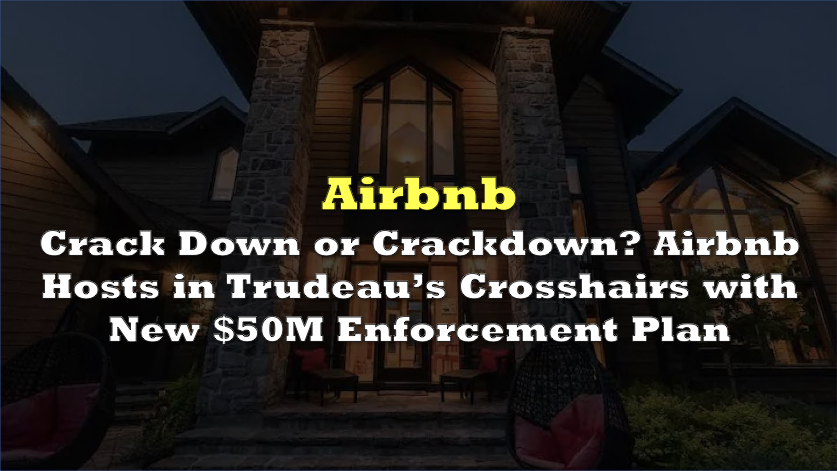

Prime Minister Justin Trudeau has announced a federal initiative targeting short-term rental platforms like Airbnb (NASDAQ: ABNB) and Vrbo. The $50-million Short-Term Rental Enforcement Fund, unveiled this week, aims to provide municipalities with resources to regulate and reintegrate short-term rental units into the long-term housing market.
“There are more than 200,000 short-term rentals across the country—like Airbnbs or Vrbos—that could be turned into housing,” Trudeau stated in a post. “So we’re giving cities more resources to crack down on those rentals and unlock more homes for Canadians.”
The fund will help municipalities hire enforcement staff, manage complaints, and conduct inspections to ensure compliance with existing regulations. According to Housing Minister Sean Fraser, the initiative is designed to “make sure that short-term rentals don’t contribute to Canada’s housing crisis.” Eligible recipients of the funding include municipalities, Indigenous communities, and, in some cases, provinces and territories. However, strict preconditions apply—jurisdictions must already have robust short-term rental regulations in place, including rules limiting rentals to principal residences.
Canada’s short-term rental sector is vast, with an estimated 235,000 units listed on platforms like Airbnb and Vrbo. Critics argue that these rentals remove much-needed housing from the long-term market, contributing to soaring rents and limited availability in urban centers.
 Sponsored · Selkirk Copper Mines
A report by the Urban Reform Institute revealed that in cities like Toronto and Vancouver, the proliferation of short-term rentals has coincided with declining rental vacancy rates. Municipalities, often underfunded and understaffed, have struggled to enforce regulations, allowing non-compliant rentals to flourish.
What it means for Airbnb hosts?
For hosts, it means stricter oversight, higher compliance costs, and potential fines for non-compliance, alongside the risk of new tax liabilities if properties used for short-term rentals are reclassified as commercial. These changes may deter new hosts and push existing operators to reconsider their business models or exit the market entirely.
Trudeau’s announcement comes on the heels of a significant ruling by the Tax Court of Canada that could reshape the economics of short-term rentals in the country. The court ruled that properties used consistently for short-term rentals are classified as commercial properties, making them subject to sales taxes.
In Ontario, this means such units are subject to a 13% Harmonized Sales Tax (HST) upon sale. Traditionally, residential property sales in Canada are exempt from HST, but this ruling has clarified that consistent short-term rental use changes a property’s tax status.
“People must be absolutely careful if they want to use short-term rental platforms for their property consistently,” said John Zinati, a Toronto-based real estate lawyer. “If they sell their unit for $1 million, they have to pay $130,000 in tax.”
This decision has sparked alarm among Airbnb hosts, many of whom were unaware of the potential tax implications. Ron Butler, a prominent mortgage expert, warned that this could spell the end of Airbnb’s golden age in Canada: “Who would risk exposure to $40K, $60K, $100K of tax on the sale of a condo?”
Cities like Toronto and Vancouver have already enacted stringent rules to curb the impact of short-term rentals on housing availability. Toronto’s regulations, for instance, limit short-term rentals to primary residences and require hosts to register their properties. Violations can result in steep fines, with enforcement efforts bolstered by public complaints and digital tracking.
Despite these measures, non-compliance remains a challenge. A recent investigation found that many listings on platforms like Airbnb fail to meet municipal requirements, including the primary residence rule. With federal funding now available to enhance enforcement, cities may finally have the tools to close these gaps.
Canada’s move to tighten controls on short-term rentals mirrors a global trend. Major cities worldwide, from New York to Barcelona, have implemented strict rules to address similar concerns. “Airbnb without the owner living in the property started to be banned…not just in Canada but all over the world,” Butler noted, emphasizing the growing backlash against unregulated short-term rentals.
In New York City, for example, regulations require hosts to be present during stays and limit the number of guests to two. Violations can lead to hefty fines, effectively discouraging commercial-scale operations.
The combination of federal funding, municipal enforcement, and tax liabilities presents a formidable challenge for Airbnb’s Canadian operations. While the platform remains popular in tourist hotspots, the economic model for hosts is increasingly under strain. Rising operational costs, legal risks, and the potential loss of tax exemptions may deter homeowners from listing their properties on short-term rental platforms.
Airbnb has yet to issue a statement regarding Trudeau’s announcement or the Tax Court ruling. However, industry experts predict that stricter regulations could lead to a decline in available listings, forcing the platform to adapt its business model.
Information for this story was found via the sources and companies mentioned. The author has no securities or affiliations related to the organizations discussed. Not a recommendation to buy or sell. Always do additional research and consult a professional before purchasing a security. The author holds no licenses.