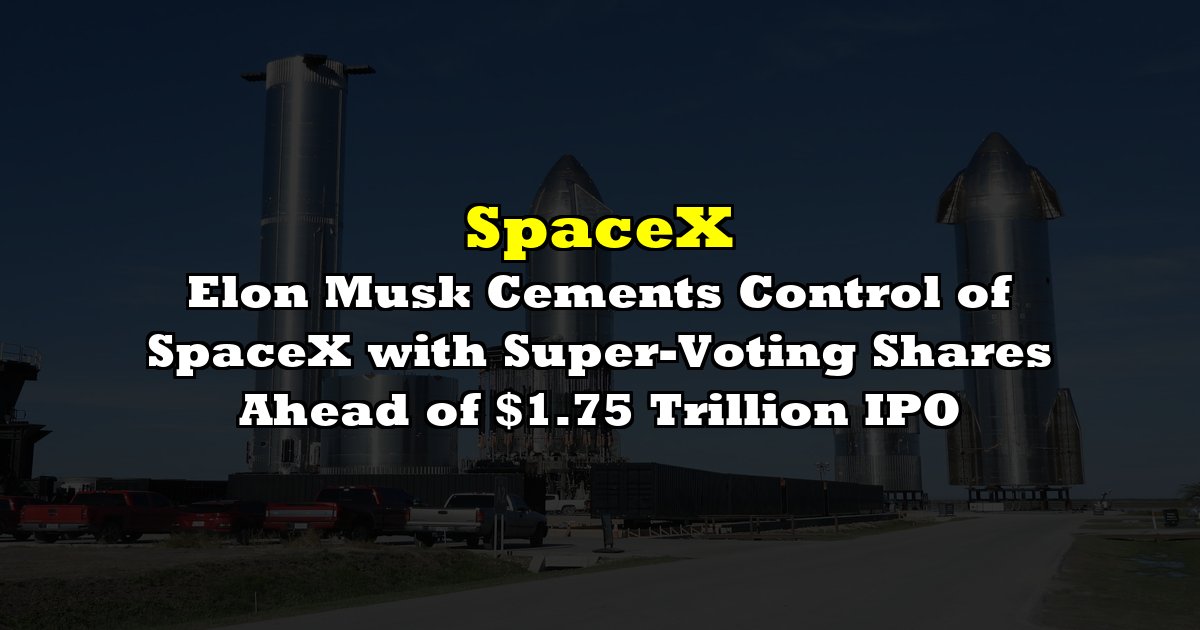

Elon Musk is set to tighten his grip on SpaceX as the company prepares for a historic initial public offering valued at $1.75 trillion, with a dual-class share structure granting him and a select group of insiders super-voting power. The IPO, targeting a $75 billion raise, will be the largest in history, according to confidential filing excerpts.
Under the proposed structure, Class B shareholders, including Musk, will hold 10 votes per share, while Class A shares offered to public investors carry just one vote each. This setup concentrates decision-making authority with Musk, who will remain CEO, chief technical officer, and chairman of the nine-member board, alongside a handful of loyal insiders. Provisions in the filing also restrict shareholders’ ability to influence board elections or pursue legal claims, funneling disputes into arbitration with limited jurisdictional options.
Financially, SpaceX presents a mixed picture as it merges with Musk’s xAI, a social media and AI venture. The combined entity reported a $4.94 billion loss in 2025 on revenue of $18.67 billion, a sharp reversal from a $791 million profit on $14.02 billion in revenue the prior year. Heavy investments in AI infrastructure, with capital expenditure soaring to $20.74 billion—more than half on xAI—drove the red ink, despite Starlink’s satellite internet business generating a robust $4.42 billion in operating profit.
 Sponsored · Selkirk Copper Mines
Musk’s personal stake in SpaceX also grew last year with a $1.4 billion purchase of shares from current and former employees through his trust. Additionally, a plan approved last month could award him 60 million more shares if the company’s market capitalization scales from $1.1 trillion to as high as $6.6 trillion, tied to ambitious goals like building space-based data centers for AI developers.
The company ended 2025 with $24.8 billion in cash, total assets of $92 billion, and liabilities of $50.8 billion. While Starlink subsidizes much of the AI spending, the segment’s capex alone jumped to $12.7 billion from $5.6 billion the year before.
Wall Street analysts are getting a closer look this week with three days of meetings at SpaceX’s Starbase facility in Boca Chica, Texas. Meanwhile, executive compensation figures highlight the disparity within the C-suite: President and COO Gwynne Shotwell earned $85.8 million last year, while CFO Bret Johnsen received $9.8 million, dwarfing Musk’s modest $54,080 salary.
As SpaceX gears up for its market debut, the dual-class structure ensures Musk’s vision will face little resistance, even as the company balances Starlink’s profitability against xAI’s $12.7 billion capital drain in 2025.
Information for this story was found via the sources and companies mentioned. The author has no securities or affiliations related to the organizations discussed. Not a recommendation to buy or sell. Always do additional research and consult a professional before purchasing a security. The author holds no licenses.