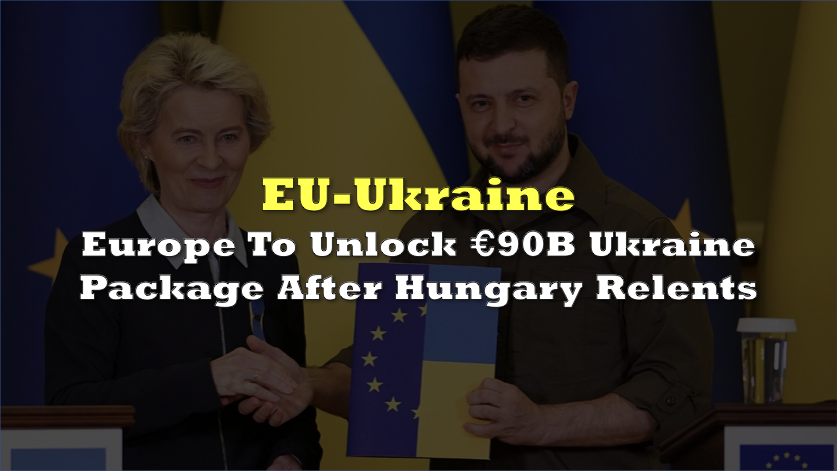

EU ambassadors approved on Wednesday the release of a €90 billion, or roughly $106 billion, loan package for Ukraine after Hungary lifted its veto, unblocking one of Kyiv’s most important financing channels for 2026 and 2027. The EU’s 27 member states are expected to formally sign off by Thursday afternoon.The European leaders had already agreed in December 2025 to provide the support, with the amount representing about two-thirds of Ukraine’s projected €135.7 billion financing need for the period. What changed this week was that the stalled money finally cleared the political bottleneck that had kept it frozen.
Of the €90 billion total, €45 billion is slated for 2026 and another €45 billion for 2027. On an annual basis, €28 billion is intended for military needs and €17 billion for general budget spending.
The Council’s legal framework further splits the overall package into €60 billion for defence industrial capacity and military procurement and €30 billion for macroeconomic support delivered through macro-financial assistance or the Ukraine Facility.
 Sponsored · Selkirk Copper Mines
The Council also said the legal framework was adopted through enhanced cooperation with 24 member states, while Hungary, Slovakia and Czechia secured opt-outs from the joint borrowing arrangement.
Ukrainian president Volodymyr Zelenskyy said the unblocking of the package is “the right signal under the current circumstances.”
“Russia must end its war. And the incentives for that can arise only when both support for Ukraine and pressure on Russia are sufficient,” he wrote.
The financing terms are unusually favorable because the EU plans to lend through joint borrowing on capital markets, backed by EU budget headroom, with interest costs covered by the EU budget. Ukraine is not expected to repay the principal from its own resources unless and until Russia pays war reparations after the war.
 Sponsored · Cambria Gold Mines
Around €210 billion in frozen Russian central bank assets in the EU sit in the background as the financial logic behind that repayment design, though the bloc stopped short of outright confiscation because of legal risk.
The immediate trigger for the breakthrough was the end of Hungary’s blockade. Budapest had held up the package during a dispute over Russian oil transit via the Druzhba pipeline after damage that Kyiv said was caused by a Russian strike. On Wednesday, Hungarian oil group MOL said it had been informed that crude transit to Hungary and Slovakia would resume, with first shipments expected by Thursday at the latest. That removed the last practical obstacle to release.
The shift can also be attributed to Viktor Orban’s election loss, as incoming Hungarian leader Peter Magyar has indicated he would no longer block EU funds for Kyiv.
It is worth noting that the EU loan covers only around two-thirds of Ukraine’s financing needs for 2026 and 2027, and Brussels still needs partners to cover the remaining one-third for 2027. European Economic Commissioner Valdis Dombrovskis said countries that could fill that gap include Canada, Japan, Britain, Norway and others.
Disbursements will also be tied to continued Ukrainian reforms as Kyiv aligns its laws with EU standards.
Ukraine is not yet a member of the EU but it is officially a candidate country and its accession negotiations have formally started.
Information for this story was found via the sources and companies mentioned. The author has no securities or affiliations related to the organizations discussed. Not a recommendation to buy or sell. Always do additional research and consult a professional before purchasing a security. The author holds no licenses.