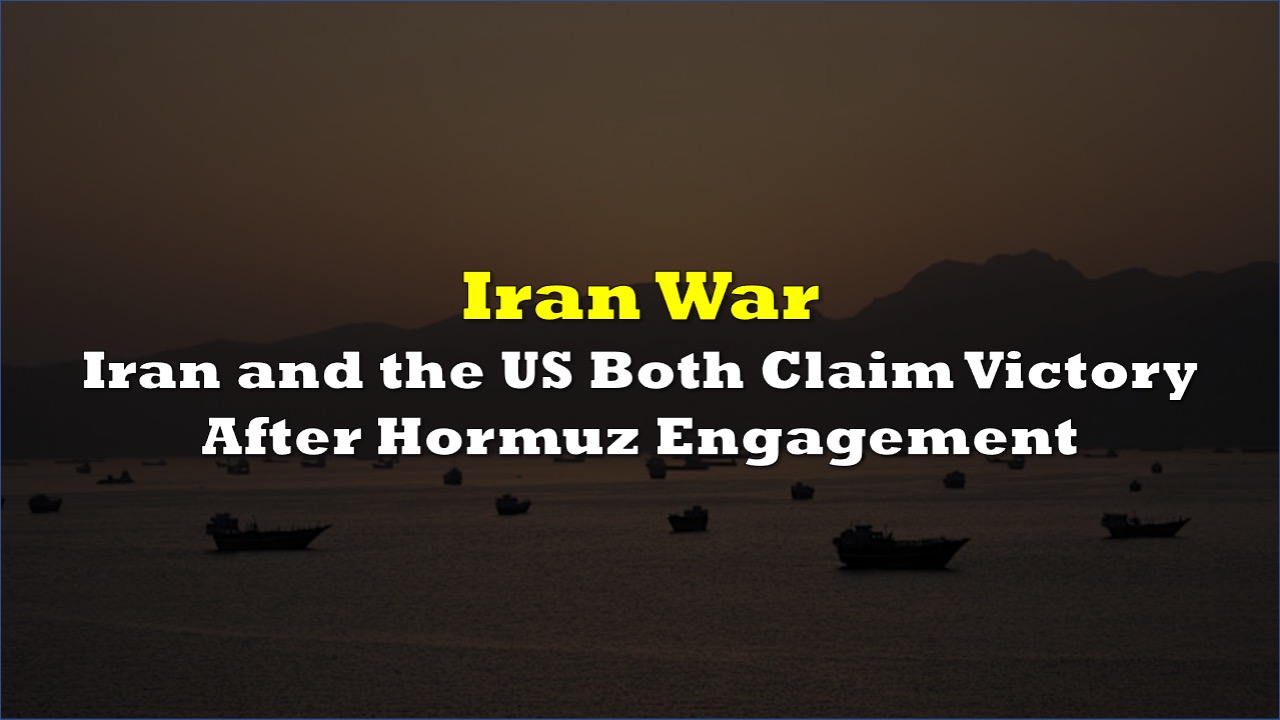

Three US Navy destroyers transited the Strait of Hormuz under fire Thursday, triggering the most serious military exchange since the ceasefire took hold in April. What happened next depends entirely on who you ask — and there is documented reason to be skeptical of both answers.
US Central Command said the USS Truxtun, USS Rafael Peralta, and USS Mason successfully transited the strait, that Iranian missiles, drones, and small boats were all intercepted, no US assets were struck, and American forces responded with self-defense strikes on Iranian launch sites, command and control facilities, and surveillance nodes — hitting the ports of Bandar Abbas and Qeshm specifically, according to US officials.
Trump told reporters: “Every missile was knocked down, every drone was knocked down, and the people that shot it are no longer with us.”
Iran’s Islamic Revolutionary Guard Corps Navy said its forces conducted a “highly extensive and precise combined operation” using anti-ship ballistic missiles, cruise missiles, and explosive drones. Intelligence monitoring confirmed “significant damage” to US naval assets, the IRGC said, forcing all three destroyers to flee toward the Sea of Oman. Tehran warned any further aggression would be met with a “powerful and unconditional response.”
NASA FIRMS satellite data recorded a fire ignition at 22:21 UTC in the Strait of Hormuz off Oman’s Musandam peninsula — roughly where the engagement took place. The data confirms something burned. It cannot confirm what.
That ambiguity reflects a documented pattern of both governments controlling — and distorting — the information environment around this conflict.
 Sponsored · Power Metallic Inc.
Related: ‘Project Freedom’ Set To Resume As Saudi Arabia, Kuwait Lift US Military Restrictions, Says WSJ
A Washington Post analysis of satellite imagery published Wednesday found Iranian strikes damaged or destroyed at least 228 structures and pieces of equipment at 15 US military sites across Kuwait, Bahrain, Qatar, Jordan, Saudi Arabia, and the UAE since the war began on February 28 — significantly more than the US government has acknowledged.
Hangars, barracks, fuel depots, aircraft, radar systems, and air defense assets were all hit. Several bases became too dangerous to staff at normal capacity, forcing commanders to evacuate personnel early in the conflict.
A CNN investigation separately identified at least 16 damaged US military sites across eight countries, including a destroyed THAAD radar battery in Jordan and a US Air Force E-3 Sentry destroyed at a Saudi base. Pentagon comptroller Jules Hurst told Congress last week he does “not have a final number for what the damage is to our installations overseas.” Defense Secretary Pete Hegseth declined to say whether the $25 billion official war cost includes repairs.
Two of the largest commercial satellite providers — Vantor and Planet — have complied with US government requests to limit or withhold regional imagery since early in the conflict, foreclosing independent verification.
Iran’s account of Thursday’s engagement deserves equal scrutiny. The IRGC is a state military apparatus with every institutional incentive to overstate battlefield success. Iran has not provided independently verifiable evidence of damage to the three destroyers. Its stated trigger — a US attack on an Iranian tanker near Jask — has not been confirmed by any third-party source.
Iranian state media has throughout the conflict published satellite imagery claiming to document US base damage; the Washington Post found that imagery checks out on base damage when independently verified. As of this writing, no equivalent independent verification exists for Thursday’s claim that the destroyers were hit.
Seven US service members have died in strikes on US facilities since the war began — six in Kuwait and one in Saudi Arabia — with more than 400 troops injured as of late April.
Information for this story was found via the sources and companies mentioned. The author has no securities or affiliations related to the organizations discussed. Not a recommendation to buy or sell. Always do additional research and consult a professional before purchasing a security. The author holds no licenses.