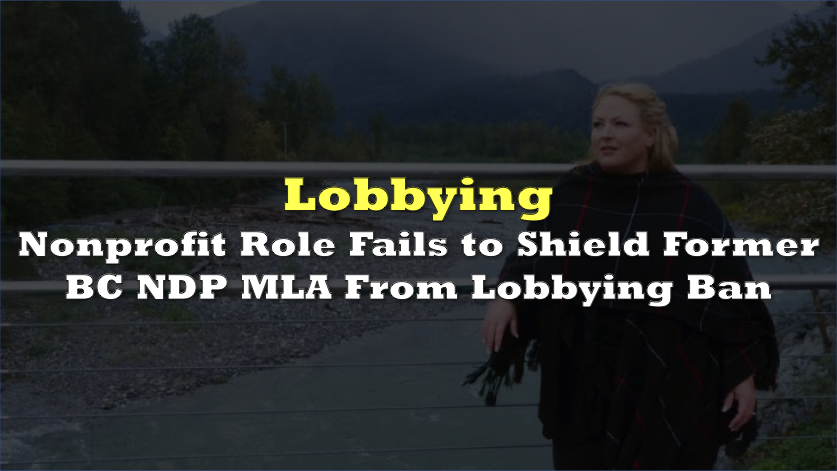

BC’s lobbying regulator has refused to treat nonprofit advocacy as a shortcut around the province’s revolving-door restrictions, keeping former NDP parliamentary secretary Kelli Paddon from directly lobbying the provincial government until November 18, 2026.
Registrar Michael Harvey denied Paddon’s request for a public-interest exemption on May 13. Paddon had sought permission to lobby as executive director of the Board Voice Society of BC, an umbrella organization representing boards and senior staff at community-based social-service nonprofits.
The decision does not prevent Paddon from running the organization or performing duties that fall outside the statutory definition of lobbying. It also does not prevent Board Voice from advocating through other eligible employees or registered consultants.
 Sponsored · Selkirk Copper Mines
What it blocks is Paddon’s personal use of direct government communications to influence provincial policies, programs, funding arrangements, legislation, or contracting decisions during the remainder of her cooling-off period.
Paddon represented Chilliwack-Kent in the legislature from 2020 until the 2024 election. She was appointed parliamentary secretary for gender equity on December 7, 2022, and remained in the position until Premier David Eby appointed a new cabinet on November 18, 2024.
BC’s Lobbyists Transparency Act does not impose its two-year ban on every former MLA. Section 2.2 specifically covers former cabinet members, parliamentary secretaries, certain political staff, and senior government or provincial-entity officials. The registrar can waive the restriction only when satisfied that an exemption would serve the public interest.
The rule is intended to prevent former officials from converting relationships, access, or information obtained in public office into an immediate lobbying advantage.
 Sponsored · Power Metallic Inc.
Paddon argued that lobbying was connected to her ability to lead Board Voice.
“As the incoming executive director for Board Voice, it is important that I am able to support volunteer boards in advocating to government,” she told the registrar in her application, reported by Investigative Journalism Foundation.
Harvey rejected the idea that the organization’s nonprofit structure automatically made an exemption beneficial to the public. The decision states that “not everything a non-profit does is in the public interest,” and notes that Paddon’s planned advocacy would operate in a sector connected to her previous government responsibilities.
Board Voice’s registered lobbying objectives include the development of a provincial social-policy framework and changes to procurement and contracting practices affecting nonprofits that deliver government-funded social services. Those objectives could influence how provincial programs are designed, how contracts are awarded, and how public funding is distributed.
The organization has remained active in government advocacy through other channels. BC’s registry records lobbying activity involving Board Voice in 2025 and 2026, including work attributed to consultant lobbyist Jody Paterson.
The ruling also sets a firm boundary for other former officials entering the nonprofit sector. A public-facing mandate, charitable purpose, or claim of social benefit does not by itself erase the access advantage that BC’s cooling-off law was designed to contain.