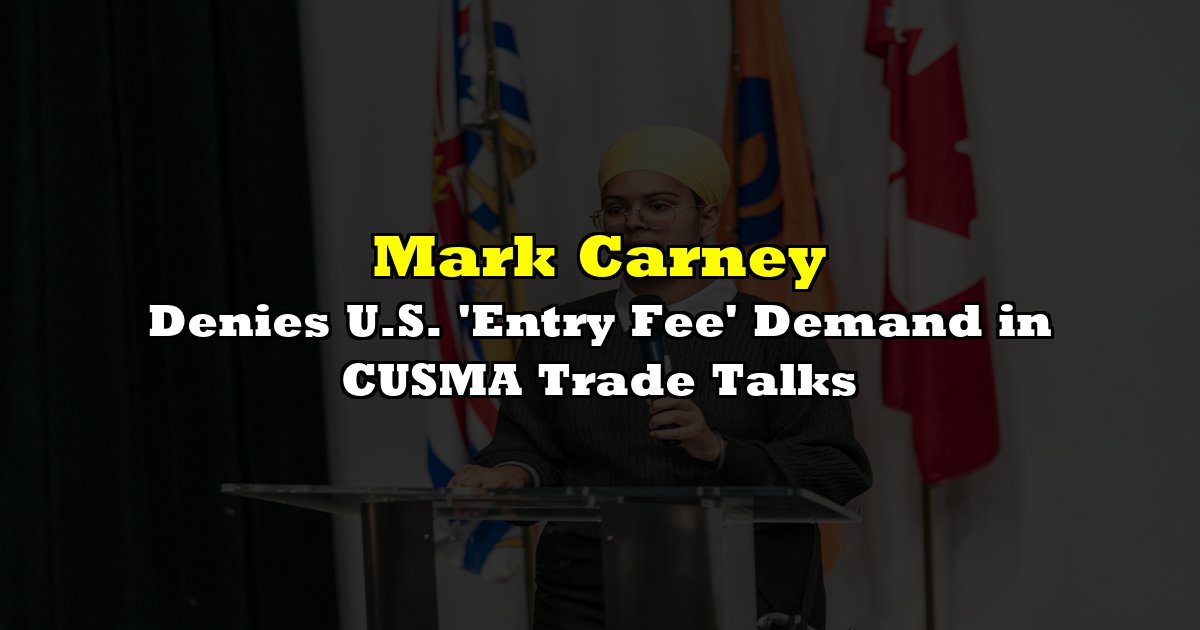

Prime Minister Mark Carney has firmly denied claims that the United States demanded an ‘entry fee’ in the form of upfront concessions from Canada ahead of negotiations to revise the Canada-United States-Mexico Agreement (CUSMA).
“I don’t know where the talk of an ‘entry fee’ is from, certainly not coming from me, it’s not language I’ve ever used and it’s not language I’ve ever heard from the President of the United States,” Carney stated.
Despite Carney’s dismissal, sources close to the discussions paint a different picture. The Trump administration has reportedly insisted on significant compromises from Canada before formal talks can commence, setting a contentious tone for the scheduled review on July 1. Four high-ranking individuals confirmed that Washington’s stance is clear, expecting Ottawa to yield ground upfront without reciprocal gestures.
Former Quebec Premier Jean Charest, now part of Carney’s advisory committee on Canada-U.S. economic relations, pointed to the imbalance in expectations. “Trump wants us to make a lot of concessions before we sit down at the table, while he wouldn’t make any,” Charest said. This sentiment underscores the frustration in Ottawa as two prior offers of concessions from Canada reportedly received no response from the U.S.
 Sponsored · Silver47 Exploration Inc.
RELATED: Canada Faces ‘Entry Fee’ Demand from U.S. Ahead of CUSMA Trade Talks
Several issues are already straining the relationship. A provincial ban on American wine, beer, and spirits—enacted since March 2025 in Ontario, Quebec, and British Columbia—has drawn sharp criticism from Washington. Provincial leaders remain unyielding, with a Quebec source asserting that U.S. alcohol will not return to shelves without mutual concessions. Additionally, disputes over Canada’s dairy quota administration and digital sovereignty policies are key sticking points.
Canada has made efforts to de-escalate tensions. Last spring, Ottawa rolled back a substantial portion of retaliatory tariffs on U.S. steel and aluminum. By June 2025, the government also repealed a 3% digital services tax on tech giants like Amazon and Apple, a move Finance Minister François-Philippe Champagne described as fostering broader economic and security ties with the U.S.
Carney has also signaled a pivot, emphasizing trade diversification away from the U.S. in a government video released on April 19. With $1.2 trillion in annual trade between the two nations at stake, the outcome of these early skirmishes could reshape North American economic dynamics by the 2026 review deadline.
Information for this story was found via the sources and companies mentioned. The author has no securities or affiliations related to the organizations discussed. Not a recommendation to buy or sell. Always do additional research and consult a professional before purchasing a security. The author holds no licenses.