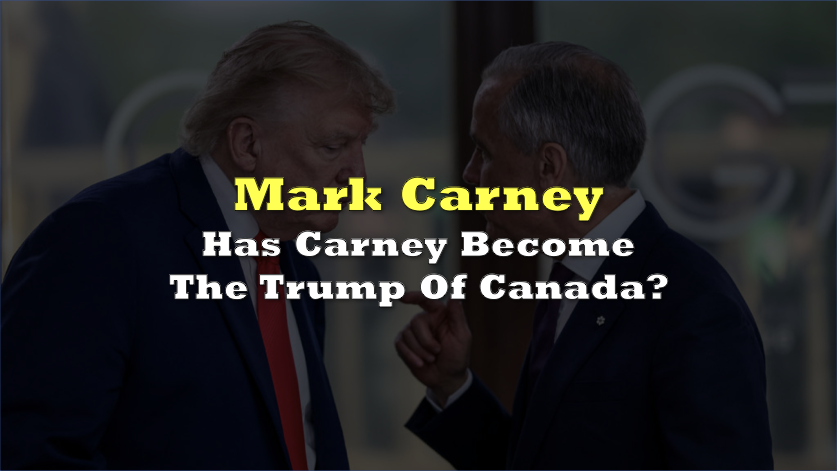

At the very least, Prime Minister Mark Carney is clearly a polarizing politician. But drop the party lines, is he acting like a Donald Trump for Canada?
The easy answer: he is not. But the comparison is not completely useless.
Carney entered federal politics as the anti-Trump archetype: a former central banker, Goldman Sachs alumnus, climate finance envoy, and institutionalist whose pitch was competence under stress. Trump’s brand is personal power, disruption, grievance, tariffs, immigration crackdowns, and permanent political theatre.
 Sponsored · McLaren Resources Inc.
Yet Carney’s governing agenda has moved into terrain that, a few years ago, Liberals would have been more likely to describe as conservative. He scrapped the consumer carbon tax, promised to return immigration to more “sustainable” levels, accelerated defence spending, backed border-security legislation, and recast Canada’s economic strategy around national resilience against the US.
That does not make him Trump. It makes him a case study in how Trumpism changes the politics of countries that oppose it.
Economic nationalism
Trump imposed tariffs on Canada and Mexico as part of a broader pressure campaign tied to border security and fentanyl. Carney’s response was not a return to pre-Trump free-trade optimism. He asked voters for a mandate to confront Trump, argued Canada needed to reduce its dependence on the US, and framed trade policy as a sovereignty question.
While it’s not a local MAGA version, Carney’s message has been that Canada must build at home, defend supply chains, remove internal trade barriers, and diversify abroad.
 Sponsored · Altamira Gold Corp.
Trump’s version is coercive and unilateral. Carney’s version is defensive and institutionally packaged. The shared premise is still a major break from the assumption that trade integration alone guarantees stability.
At its strongest, both leaders treat economic policy as a sovereignty weapon.
But the mechanics are different. Trump uses tariffs to extract concessions from allies and rivals. Carney uses Trump’s tariffs as the justification for Canadian industrial policy.
Leaning right
The comparison also lands because Carney has repositioned the Liberals toward the political centre and, in some files, toward the centre-right.
His government cancelled the planned capital gains inclusion-rate increase, removed the consumer-facing carbon price, committed to lower operating spending while making large capital investments, and moved on defence spending with a speed Canadian governments had avoided for years.
On immigration, the Liberal platform under Carney promised to cap temporary workers and international students below 5% of Canada’s population by the end of 2027, down from a cited high of 7.3%. While that is not akin to Trump’s mass-deportation agenda, it is a clear break from the Trudeau-era political comfort with higher immigration levels.
READ: Breaking Down Budget 2025: Deficits, Borrowings, Investments
On border security, Carney’s government introduced legislation described by the Prime Minister’s Office as aimed at strengthening immigration integrity, fighting transnational organized crime, stopping fentanyl flows, and improving border enforcement.
None of this makes Carney anti-immigrant in the Trump mold, but it does mean the political centre in Canada has shifted. Carney is governing as if affordability, housing, public infrastructure, and border integrity now require limits that Liberals once preferred not to emphasize.
Key difference
The key difference between the two North American leaders? Trump personalizes power. Carney bureaucratizes it.
Trump’s politics are built around spectacle, enemies, and executive force. Carney’s politics are built around mandates, fiscal frameworks, procurement agencies, defence strategies, and technocratic urgency.
Carney’s politics are also still multilateral. His government has leaned into NATO, G7 coordination, defence industrial partnerships, and trade diversification. Trump’s trade model is more openly transactional and adversarial, including toward allies.
The comparison persists because Carney’s own political story is inseparable from Trump. He became prime minister in March 2025 after Justin Trudeau’s resignation, then quickly called an election for April 28. Reuters reported that he sought a mandate to deal with Trump’s threat to Canada, including tariffs and comments about Canada becoming the 51st state.
That is the part that echoes Trump-era politics most strongly. The state is no longer presented mainly as a provider of programs. It is presented as a shield.
But Carney’s shield is designed to protect Canada from Trump. That makes the comparison inherently unstable. He is borrowing the urgency of nationalist politics to resist the most powerful nationalist in the room.
Calling Carney “the Donald Trump of Canada” is too blunt to be accurate. The better read is that Carney is Canada’s answer to a Trump-shaped world: more nationalist than Trudeau, more interventionist than conservatives expected, more pro-defence than recent Liberal tradition, and more willing to abandon policies that became political liabilities.
Not that Canada has produced its own Trump, but that even Canada’s most elite institutionalist now governs like the old trade order is gone.