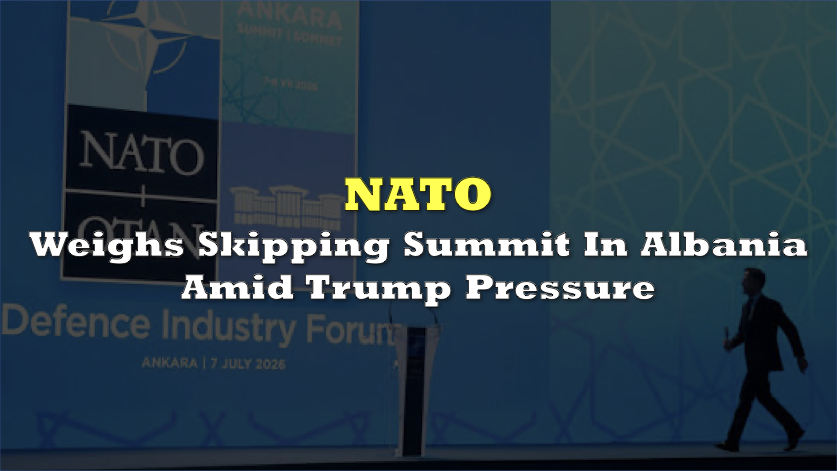

NATO’s possible decision to skip or downgrade next year’s annual summit would do more than spare leaders another tense encounter with US President Donald Trump. It would expose a deeper contradiction inside the alliance: members have agreed to a historic 5% defense-spending target, but the summit meant to showcase unity may be hosted by a country still well short of the new benchmark.
The 2027 meeting in Albania is now in doubt, Reuters reported, citing diplomats and officials who said US reluctance and concern over Albania’s defense spending have complicated planning. NATO has not publicly cancelled the event, and the alliance’s 2025 Hague declaration had said leaders looked forward to meeting in Turkey in 2026 and then in Albania.
At The Hague in 2025, NATO leaders agreed to invest 5% of GDP annually in defense and defense-related spending by 2035. The pledge includes at least 3.5% of GDP for core defense requirements and 1.5% for broader defense and security-related spending such as infrastructure and cyber resilience.
 Sponsored · Mercado Minerals Ltd.
Albania’s numbers illustrate the gap between political commitment and fiscal delivery. NATO’s latest 2026 estimates put Albania’s core defense expenditure at 2.15% of GDP, up from 1.34% in 2014, with core defense spending estimated at $469 million in constant 2021 dollars.
It has pushed back on the perception that it is lagging. Reuters reported that Albanian officials said new measures would lift the country’s defense and defense-related expenditure for 2026 to 2.6% of GDP.
The host-country problem is therefore awkward but not isolated. NATO’s 2026 estimates show only five allies above 3.5% of GDP for core defense this year: Lithuania, Estonia, Latvia, Poland, and Greece. Major members including the US, Germany, the UK, and France remain below that new core-defense threshold, according to Reuters’ summary of alliance estimates.
Reuters reported in April that NATO had already been discussing whether to reduce or potentially end annual summits, with officials pointing to Trump-era tensions and concerns that frequent high-level meetings create more political drama than strategic value. The alliance has held yearly leaders’ meetings since 2021.
The immediate backdrop is also more combustible than a routine budget dispute. Trump arrived at the 2026 NATO summit in Ankara after criticizing allies over their response to the Iran conflict, Axios reported. The report said European officials were increasingly worried that his dissatisfaction could feed into decisions about the US military presence in Europe.
The bigger risk for NATO is that summit avoidance becomes its own message. If the alliance proceeds, Albania could become a test case for whether members can defend gradual spending increases under Trump’s scrutiny. If NATO steps back, it may avoid one difficult meeting while confirming that its highest-profile political format is now vulnerable to the very divisions it is meant to manage.