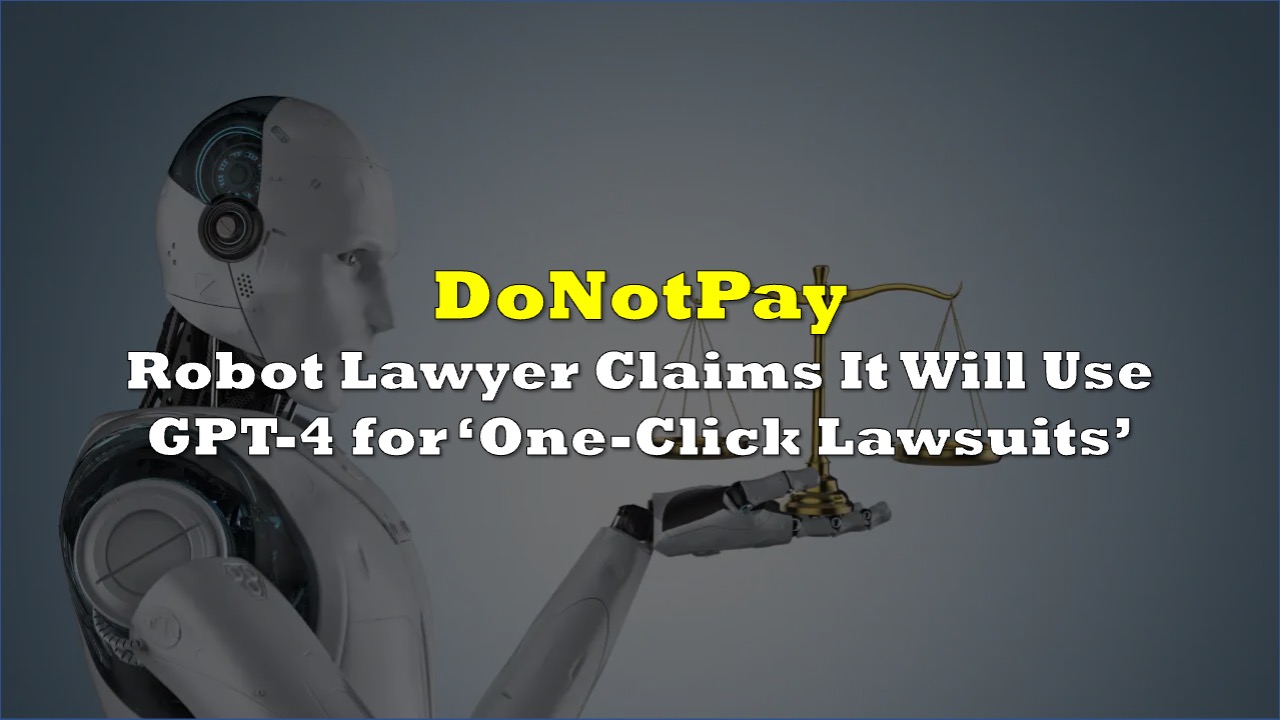

DoNotPay, Inc, the New York-based startup behind the app that claims to be “the world’s first robot lawyer” but isn’t actually a lawyer, is riding the OpenAI’s GPT-4 wave. The app’s founder and CEO Joshua Browder announced that it is “working on using GPT-4 to generate ‘one click lawsuits’ to sue robocallers for $1,500.”
The new feature would automatically transcribe the spam phone call and generate a 1000-word lawsuit.
“The new GPT-4 has almost a 5x improvement on earlier models,” Browder told Time Magazine. “This latest one is sophisticated enough to draft a lawsuit. Earlier models didn’t have that level of sophistication — they would make things up, they would pretend to know things, which we call hallucination. But we’re not really seeing that with GPT-4.”
 Sponsored · Selkirk Copper Mines
Curiously, in Browder’s accompanying video demo of the announcement, the chatbot gives a fair warning:

“As an AI language model, I am not an attorney and cannot provide legal advice. However, I can provide you with a general outline of a complaint for a violation of the Telephone Consumer Protection Act (TCPA) based on the context I have learned from other cases. Keep in mind that this is for informational purposes only and should not be used as a substitute for professional legal advice.”
Browder founded the app in 2015 when he was 19 and on the receiving end of 30 parking fines. DoNotPay started out as a parking ticket contesting app and has now expanded to provide services for a variety of legal issues such as consumer protection, immigration rights, refunds, free trial cancellations, lawsuits, and so on.
Unlike the AI chatbot that knows that it is an AI language model and not a lawyer and that it could not provide legal advice, Browder initially wanted to take DoNotPay further and use it to defend an actual case in court.
 Sponsored · Altamira Gold Corp.
After GPT-3.5 was released late last year, Browder boldly announced that DoNotPay will provide the first robot lawyer to defend a client in a live situation. The AI bot would listen to the case and generate comments, which the client would hear through AirPods and repeat in front of the court.
Browder had to pull the plug on the endeavor when he was warned by multiple state prosecutors, with one saying that the illegal practice of law is a misdemeanor in various jurisdictions, punishable by up to six months in county jail.
A few weeks later, a lawsuit was filed against DoNotPay by Jonathan Faridian of Yolo County in San Francisco Superior Court. Faridian was seeking damages over violations of California’s unfair competition law, claiming that he would not have subscribed if he knew DoNotPay was not genuinely a lawyer.
The complainant claimed that it engaged the San Francisco-based DoNotPay to create demand letters, a small claims court filing, and LLC operating agreements and received “substandard and poorly done” results.
“Providing legal services to the public, without being a lawyer or even supervised by a lawyer is reckless and dangerous. And it has real world consequences for the customers it hurts,” Faridian argued.
But GPT-4 has gotten the DoNotPay CEO very excited. Apart from the one-click lawsuits (which GPT-4 clearly says “should not be used as a substitute for professional legal advice”), he told Time that he also plans on using GPT-4’s multimodal feature so users “can scan their medical bills and have the chatbot identify errors, compare prices to other hospitals, and automatically draft a legal defense under the No Surprises Act, which protects medical patients from surprise bills.”
Information for this briefing was found via Twitter, Time Magazine, and the sources and companies mentioned. The author has no securities or affiliations related to the organizations discussed. Not a recommendation to buy or sell. Always do additional research and consult a professional before purchasing a security. The author holds no licenses.