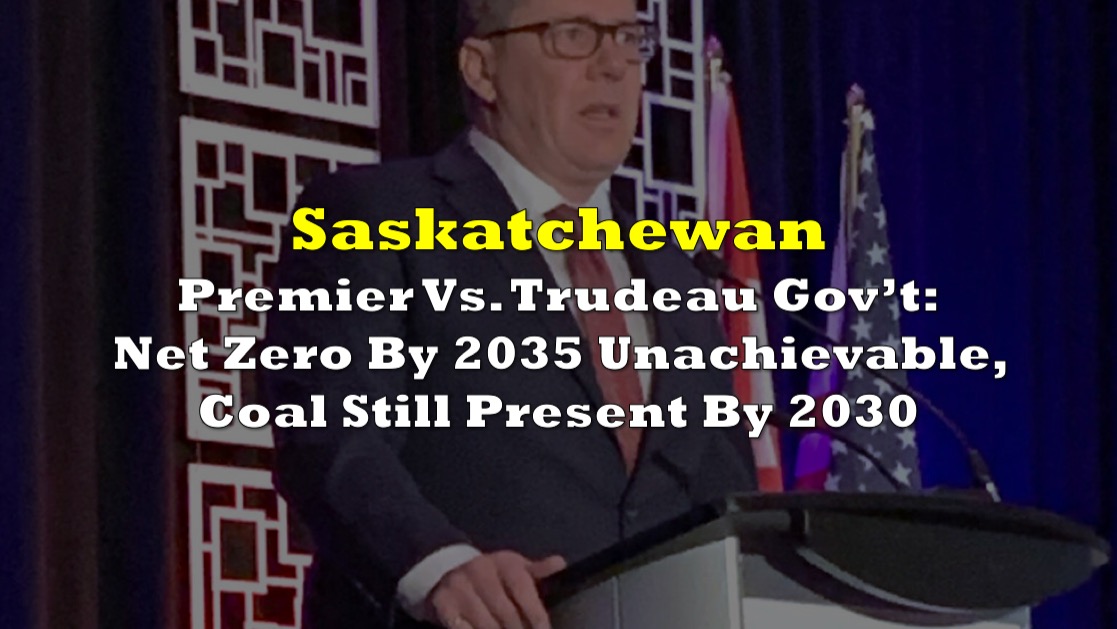

Saskatchewan Premier Scott Moe has indicated that the province may oppose an upcoming federal emission policy that he feels will make it harder to keep the lights on.
Moe did not elaborate on what he may do to potentially thwart Ottawa’s clean energy standards on Tuesday, but said more information would be given in the coming weeks.
“We’re going to continue to chart Saskatchewan’s path,” he told reporters after speaking at the Williston Basin Petroleum Conference in Regina. “It may not necessarily be Canada’s path, and we’ll have more details on that in the coming weeks.”
 Sponsored · Cambria Gold Mines
According to Moe, Saskatchewan is unable to meet possible criteria imposed by the federal government’s clean electricity guidelines, which state emissions from electricity generating should be net-zero by 2035, and conventional coal should be phased out by 2030.
“The fact of the matter is, the policies of net-zero by 2035, Ontario has already indicated that they’re not able to achieve that. Here in Saskatchewan, we’re not going to be able to achieve that,” he said. “We have a natural gas plant that isn’t even completed construction, yet. We have no intention of turning it off in 2035. I’m not sure we’re going to be able to turn our coal off by 2030, in particular, BD3 (Boundary Dam Unit 3), which is the cleanest coal fired plant operating in the world.”
Saskatchewan’s electricity infrastructure is primarily reliant on natural gas and coal, and the province has invested hundreds of millions of dollars in new natural gas plants.
He contended that Ottawa is making the same decisions as Europe, which is now looking for reliable and stable sources of power after Russia invaded Ukraine.
 Sponsored · Silver47 Exploration Inc.
“(That’s) not going to happen in Saskatchewan. We’re going to be using every tool that we have as a province to ensure that yes, we’re reducing emissions, but we’re also making sure that we have a sustainable power supply,” he said.
The premier clarified, however, that this is not about the province “not continuing their march towards greening our power grid” but it’s about “what’s affordable, and it’s actually about what’s possible, versus some ideological policy that may come from another level of government.”
“So we’re continuing our march in greening our power grid. We’re going to do so in a way that ensures that we have sustainable supply of that power in this province, our electricity, and in a way that continues our planned net-zero by 2050, not necessarily net-zero 2035, as the federal government has shifted those sands yet again,” he added.
He also commented that there’s a possibility of increasing power rates in trying to follow a federal plan “which can’t be achieved.”
“You think about where Saskatoon, the City of Saskatoon, receives their power. January 1 of 2035 is a very cool morning in Saskatoon, because the lights will come on and the furnaces won’t furnace fans won’t work,” Moe illustrated.
Moe delineated that this “isn’t about a standoff with the federal government” but it’s about having “what’s real, what’s realistic, and what is in the best interest of Saskatchewan people.”
The Saskatchewan First Act expressly states that the province will determine the “regulation of environmental standards and the regulation of greenhouse gas emissions and other emissions; and the source of fuel for electrical generation, including renewable and non-renewable resources.”
NDP energy critic Aleana Young agreed that the federal government is moving too quickly on clean energy targets, claiming that 2035 is unrealistic. However, she called Moe’s comments about power facilities being forced to close “unhelpful.”
“I don’t quite know what to make of it other than fear mongering,” she said. “If the plan was to turn off all natural gas plants in seven years, I would have serious questions for this government about why they just invested three quarters of $1 billion in more natural gas plants.”
This comes after Moe’s announcement in March saying that Saskatchewan is devising ways of how to reduce greenhouse gas emissions from electricity generation, and one of the options is to bring small modular reactors (SMRs) to the province.
Information for this briefing was found via National Post, Pipelineonline.ca, and the sources mentioned. The author has no securities or affiliations related to this organization. Not a recommendation to buy or sell. Always do additional research and consult a professional before purchasing a security. The author holds no licenses.