

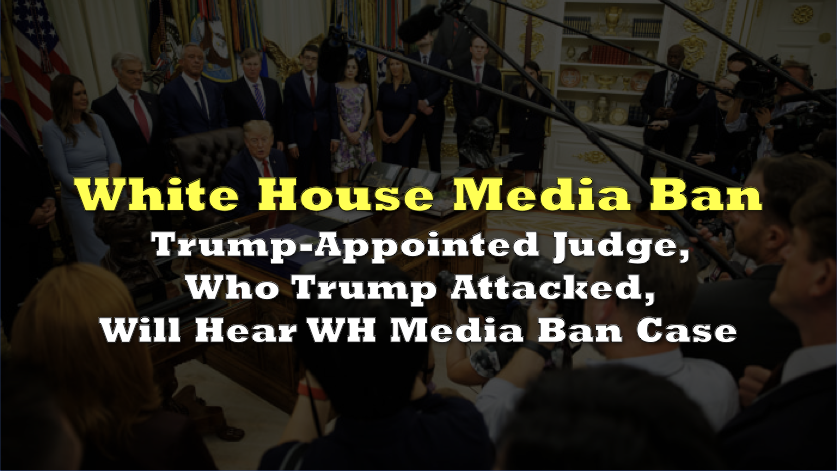

President Donald Trump’s decision to ban CNN, MS NOW, and Politico from the White House is headed to an emergency federal court hearing less than a week after it was announced, with Trump already signaling that his administration could appeal an unfavorable ruling.
CNN, MS NOW, and Politico sued the administration Monday, asking US District Judge Timothy Kelly to immediately restore their White House access while the case proceeds. The organizations allege the government violated the First Amendment and due-process protections by revoking credentials because of their reporting.
Kelly has scheduled a hearing for Wednesday.
 Sponsored · Selkirk Copper Mines
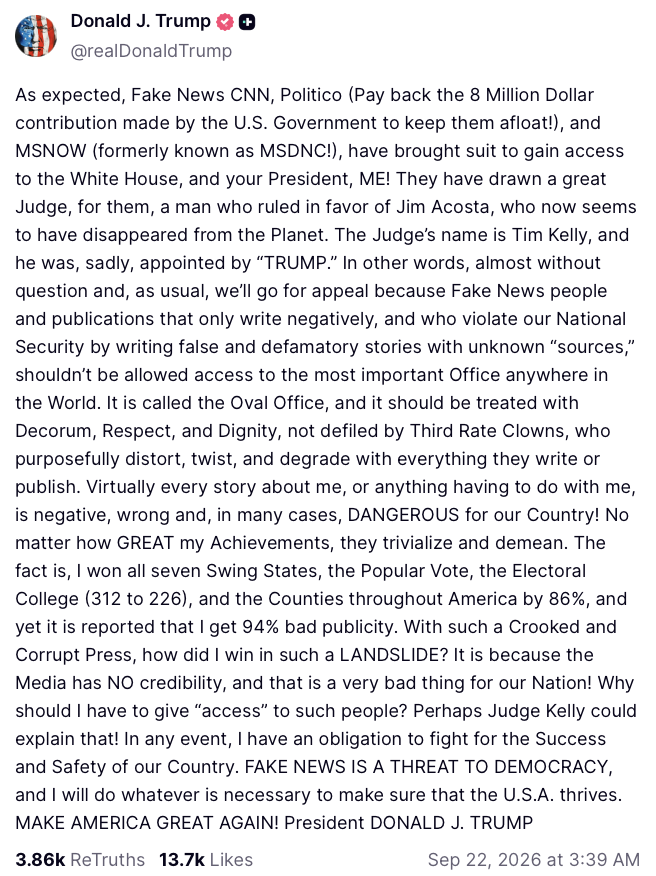
Trump, meanwhile, attacked Kelly in a Truth Social post after the case was assigned to him. Kelly was appointed by Trump in 2017 and, during Trump’s first term, ordered the White House to temporarily restore CNN correspondent Jim Acosta’s credential after it had been revoked.
The president wrote Monday that, “almost without question … we’ll go for appeal,” while again accusing the banned organizations of publishing false and defamatory stories.
The White House has rejected the outlets’ legal interpretation. It argues that First Amendment protections allow the organizations to publish but do not automatically guarantee White House credentials, a briefing-room seat, or membership in a presidential press pool. The constitutional question is now before the court.
Why ban now?
Trump has attacked news organizations throughout both of his presidencies, making the timing of a ban covering three entire outlets more notable than the complaints themselves.
 Sponsored · Altamira Gold Corp.
His public explanation was straightforward. Asked Friday whether a specific incident prompted the decision, Trump said there was none.
“It’s really just cumulative stories over the past few years,” Trump told reporters.
But subsequent reporting provides additional context about what was reaching Trump immediately before the decision.
Reuters reported Monday, citing a person familiar with the matter who spoke anonymously, that presidential aide Natalie Harp had shown Trump clips and graphics from recent news coverage and that the material contributed to his decision to bar the three organizations. The source said Trump had been particularly unhappy with coverage surrounding the November midterm elections and that his frustration increased following a Supreme Court ruling that blocked his attempt to restrict mail-in voting.
The Wall Street Journal separately reported on Trump’s recent frustration with television coverage and his belief that too few political allies were publicly defending him.
Networks refuse to replace CNN
The consequences extended beyond the three organizations once CNN was removed from its scheduled television pool assignment for Trump’s Monday trip to New York for the UN General Assembly.
CNN ordinarily rotates presidential television coverage with ABC, CBS, NBC, and Fox News. Whichever network is assigned supplies video to the rest of the press when space or logistics prevent every outlet from sending its own camera crew.
Instead of filling CNN’s slot, the television pool suspended presidential operations.
“Effective today, the TV pool will not be covering events designated as pool coverage of the President,” Fox News Washington bureau chief and pool chair Bryan Boughton wrote Monday. “There will be no replacement pool put in place.”
ABC, CBS, CNN, Fox, and NBC said jointly that the public has an interest in receiving independent information about the government and that an administration should not restrict a news organization because it objects to its reporting.
The suspension did not amount to a general blackout of Trump. Networks remained free to report on him using their own available footage, and pool operations covering Congress, Vice President JD Vance, Secretary of State Marco Rubio, and other officials continued. But there was no replacement television pooler for presidential events normally covered through the shared system.
The Washington Post also withheld photographs from Trump’s Monday presidential events until midnight as part of a separate coordinated action among White House photographers.
Hours after the ban, the administration launched “TRUMP TV: The Essentials Station,” a 24/7 White House streaming channel featuring presidential remarks, videos, and administration highlights updated in real time. The timing put the new government-controlled feed in sharp contrast with the independent television pool system that had just gone dark for presidential events, although the White House has not said Trump TV was created in response to the networks’ action.
Reuters described the platform as promoting the administration’s achievements, while the White House said it would collect the administration’s “biggest moments all in one place.”
Trump’s decision therefore produced something his earlier complaints about unfavorable reporting generally did not: three national outlets locked out of White House grounds, an emergency constitutional lawsuit, and competing television networks voluntarily declining to fill the access slot left by one of their rivals.
Whether that exclusion can continue now moves to the courtroom.



One Response
Great Apes share a 98.7% genome genetic match with human-beings. By what measurement readily discerns the switch from grasshopper to the cursed and utterly vile locust? Europeans minds have no loyalty to their allies when loyalty – goes out of fashion.
Houston Stewart Chamberlain: A British-born Germanophile and racial ideologist (1855–1927) whose work The Foundations of the Nineteenth Century advocated for the superiority of the Aryan race and claimed Jewish influence was negative. His theories influenced Adolf Hitler and National Socialist thought, and he viewed the conflict between Aryans and Jews as the basis of European history.
Neville Chamberlain: The British Prime Minister (1937–1940) pursued a policy of appeasement toward Nazi Germany, which included signing the Munich Agreement (1938) that sacrificed Czechoslovakia. He also expressed antisemitic attitudes in private letters and his government introduced the White Paper (1939) which denied Jews unrestricted entry to Mandatory Palestine which
Britain needed acetone as a solvent to manufacture cordite, a smokeless gunpowder used in its munitions. Political Zionist, Chaim Weizmann developed a bacterial fermentation method that produced acetone from starch; his contribution helped solve a serious acetone shortage during WWI. How did the British government award Weizmann’s contribution to the war effort to defeat the “ethnic cleansing” “Germanic Huns”? The British government’s most famous political concession to Herzl’s Political Zionism vision; David Lloyd George’s government on November 2, 1917, became the great power “partner” which Herzl’s “The Jewish State” required in order for Jews to achieve permanent equal rights to achieve self-determination within the borders of their own homeland.
Later revisionist history sources such as the corrupt Wikipedia whose story line can change at the whip of a pen, claim that the Balfour Declaration reflected some undefined and never proven temporary “strategic and political calculations”. Hence the Balfour Declaration stands as the opposite – so to speak – bookend as the Chamberlain White Paper. The White Paper declared where permanently decreed minority Jewish populations could and could not live within the promised lands of an Arab Palestinian state within 10 years after the war. The UN SC later passed 2334 whose language likewise declares “as the New UN International Law”, the bogus declaration where Israelis can live and operate businesses like as the current Socialist Government boycotts Israeli private industry and housing within the Capital of Jerusalem and Judea/Samaria as if dirty Jews Europeans possess the God Given power of kings to establish Ghetto-gulags like as did the Popes of Rome!
Based upon the fact, that all Arab Israeli wars fought over Arab rejection of Jewish self determination as defined through the Balfour Declaration, the White Paper coupled with the British wartime policy and post war policy of restricting Jewish escape to the mandate territories, later revisionist history which declares a Arab/Jewish sharing of authority amounts to a straight up propaganda lie on par with the current “ethnic cleansing” and “genocide” slander in post Oct7th Gaza. Britain carpet bombed German cities and civilian populations, the example of Dresden which had no strategic value prove this condemnation of hypocrisy.
Hamas initiated the Oct7th invasion. It rejects the Oslo Accords wherein PM Sharon made a unilateral withdraw from Gaza. It openly initiated conflicts with Israel once it won the general election and cast the PA out of Gaza. The propaganda lie that “debates” in Oxford the so-called “proposition” – Israel never sought peace with Arabs another bald faced lie. The Wikipedia revisionist history which declares Hamas rejected “the Quartets’ conditions of nonviolence, recognition of Israel, and acceptance of prior agreements” utter narishkeit. The Olso Accords negotiated outside the UN. Post the Nakba Allah defeat in another Arab war to exterminate the Jews, proven by the massacre of Oct7th 2023, the UN has no seat in the Board of Peace as also excluded Britain and France and Russia.
Claims made by SA of ‘genocide’ rich! SA sits at the tip of Africa! Its black Apartheid reputation a ‘Turd Reich’ of political opportunism on par with Arafat’s Palestinians really the descendants of Greek Boat People later called Philistines. Yishmael in general and Arabs in particular do not originate from Europe any more than Palestine an Arab name or the ICC has jurisdiction of the Palestinian State in Gaza! The UN has a long revisionist history of anti-Israel block-headed voting. UN GA 3379 an infamous disgrace which the current British Green Party has embraced as their flag in their homosexual relationship with the current Socialist government sitting in London.
‘Ethnic Cleansing’ and ‘genocide’, an emotion arousing slander on par with the blood libel slanders which resulted in Jewish communities destroyed! Attempts to pigion hole history of nations into some BC/AC bible narishkeit an utter abomination. International Law does not begin and end with the establishment of the UN. Traditional diplomatic historians argue that the Balfour Declaration represents a formal recognition of the historic, indigenous rights of the Jewish people to national self-determination in their ancestral homeland, fulfilling a profound moral and political commitment.
The Oct7th War initiated by the Hamas/UNWRA alliance which invaded Israel, a war in self-defense. Attempts by hostile states such as within the gossip society represented by the UN nothing short of a denial of Israel’s rights to self-defense. The British invasion of Saddam’s Iraq in conjunction with the Neo-Con Chaney\Bush lies concerning WMD when Iraq connection with 9/11 prove that nations who go to war – they and they alone determine their self-defense strategies – especially after Bush campaigned on a commitment of “No Nation Building”. The October 7, 2023 assault—rests on core principles of national sovereignty and international law.
The historical pattern wherein European ape-like governments minimize Zionist leadership(s) repeated acceptance to compromise proposals for partition and peace—starting with the 1937 Peel Commission, the 1947 UN Partition Plan, post-1967 land-for-peace frameworks, and the 2000 Camp David/2008 Olmert offers—while Arab leadership systematically rejected them, preferring absolute denial of Jewish sovereignty over compromise – the Jewish people remember and fundamentally refuse to forget.
Revisionist history compares to Holocaust Denial wherein European project their guilt by calling Israel an Nazi State. Palestine ceased to exist in 1948. European attempts to restore the Roman decree of Syria-Palestine post the Bar Kochba defeat amount to European imperialism and attempts to dominate the balance of power which the Nakba Allah Oct 7th War Hamas defeat has radically changes with both the UN and Britain and France excluded from the Trump Gaza peace. Breaking News … Britain and France ceased being ‘great powers’ after they ran away from the Suez attempt in ’56.
Europe has no shame nor loyalty when viewed under the lenses of complex geopolitical conflicts wherein European leaders make appeals to domestic mobs, such as the Green Party in England who wave the flag of ‘Zionism is Racism’. The European grasshopper/locust “genetic” mental insanity – whenever they throw an ally under the bus they flatten multi-dimensional realities into two dimensional box declarations of condemnations which arouses the mobs into hysteria – like as seen in Universities across Europe and the US – which has disgraced their good name reputations as places of objective ‘Higher Learning’.
Actual human history simply not a record of times, places, and events. For example: Who killed President Kennedy? Was 9/11 a False Flag attack to invade Iraq and dominate the balance of power in the Middle East which prioritized the domination “New World Order” of the Western democracies over the break up of the USSR?
The ruse wherein Arabs rejected the 1947 UN Partition Plan which granted 55% of the land to the Jewish State ignore the fact that the Palestine mandate originally awarded to Britain included Trans-Jordan which reflects multiple Byzantine designations of post Bar Kochba Roman Syria-Palestine, akin to the British two state solution which exploded in multiple Indian “civil wars” with Pakistan! Together with the post WWII division of Korea and Vietnam and the “genocide” of Algerians by France.
Great power politics has never attempted to establish a Independent Kurdistan post WWI despite the collapse of the Ottoman empire and the removal of the Turkish Capital from Istanbul! Had Russia not collapsed, replace by Bolshevik revolutionaries, cold, calculated realpolitik would have awarded a restored Constantinople to the Czar of Russia.
The disgraced UN Chairman’s attempt to declare the existence of “Two national movements claiming the same land”, this revisionist history ignores the 1964 PLO Charter which only referred to ’48 Israel as “Occupied Territory”. And the cold hard fact that never in all recorded human history has their ever existed an Arab Palestinian state with Jerusalem as its Capital and having an Independent national currency – as do all nation states.
This underscores the retroactive UN fabrication of “West Bank” nonsense which hides Judea/Samaria. Throughout the Ottoman period and the British Mandate, the region was officially and commonly referred to in administrative, legal, and biblical contexts as Judea and Samaria. Stripping the territory of its thousands of years of recorded Jewish history and connection, international bodies and opponents of Israel could more easily frame the area as “foreign” or “occupied” land belonging exclusively to another sovereign entity, rather than the heartland of ancestral Jewish heritage.
Furthermore the revisionist history “prohibition of acquiring territory by war”, ignores the forced mass population transfers of Germans from Prussia and the division of Prussia between Poland and Russia. The choice of words in international diplomacy – never neutral; it actively shapes legal claims, historical memory, and the political reality on the ground. Post War Germany lost 25% of its land. History simply not a moral scoreboard or tribal contest; but rather a record of choices, alliances, and consequences that evolve with evidence, not ideology nor theology.