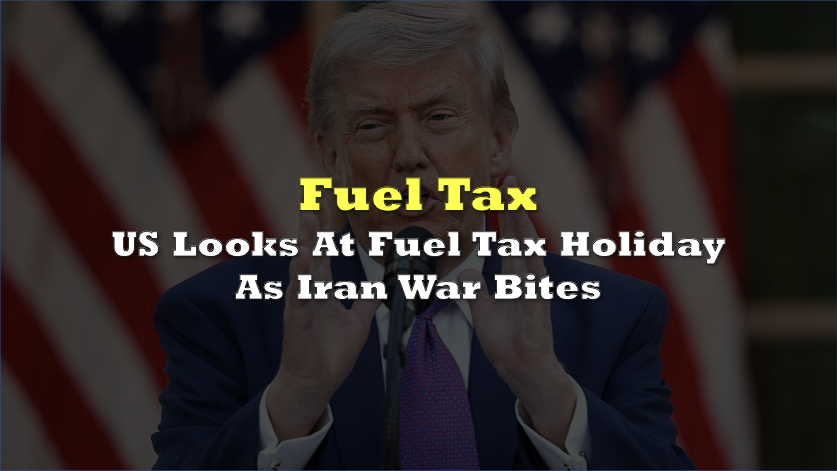

President Donald Trump’s fuel-tax plan would use federal road money as an inflation cushion, turning the Iran war’s oil shock into a fight over whether Congress should discount pump prices by weakening transportation revenue.
The proposal targets a small but politically visible slice of fuel costs. Federal gasoline taxes are 18.4 cents per gallon, while highway diesel is taxed at 24.4 cents per gallon, including the 0.1-cent Leaking Underground Storage Tank fee, according to Penn Wharton Budget Model. Those rates have not changed since 1993, which means Congress would be pausing a tax whose real value has already been eroded by more than three decades of inflation.
The retail pressure is much larger than the tax itself. AAA listed the national average for regular gasoline at $4.533 per gallon as of May 19, while its latest market update said pump prices remained elevated with crude oil hovering near the $100 per barrel range.
 Sponsored · Selkirk Copper Mines
A full gasoline-tax suspension would remove 18.4 cents from a gallon before any retail pass-through effects. The cut would be noticeable on receipts, but it would not unwind the broader increase caused by crude volatility, refining margins, and war-risk pricing.
Diesel makes the plan bigger than a driver-relief headline. A 24.4-cent diesel-tax holiday would reach trucking, construction, farming, logistics, and delivery networks. That gives the policy a supply-chain argument, not just a consumer-politics argument, but it also widens the revenue loss from any suspension that covers both gasoline and diesel.
Bloomberg reported that the Trump administration is working with Congress to suspend federal excise taxes on gasoline and diesel as the war in Iran pushes oil and fuel costs higher. Bloomberg also reported earlier this month that Trump was backing a temporary halt to the federal gasoline levy as the conflict continued.
The road fund tradeoff
The suspended revenue would come from the tax stream that finances the Highway Trust Fund. Penn Wharton modeled a June 1 to October 1, 2026 holiday and estimated that gasoline revenue losses alone would exceed $8 billion under all tested pump-price scenarios. It estimated diesel would add roughly $3.06 billion in lost revenue over the same 122-day window.
 Sponsored · Altamira Gold Corp.
Together, the model put the total Highway Trust Fund hit at roughly $11.5 billion. Penn Wharton said that would equal about 19% of the fund’s fiscal 2025 outlays, which were approximately $62 billion.
Budget analysts have already warned that the consumer benefit may be smaller than the fiscal cost. The Peter G. Peterson Foundation, citing several budget analyses, said a federal gas-tax holiday would increase deficits and accelerate pressure on the Highway Trust Fund while delivering limited savings to consumers. It also cited pass-through estimates from Penn Wharton showing that not every suspended tax cent would reach drivers.
A visible lever
The politics are simple because fuel prices are posted in public every day. The economics are less clean because the federal excise tax sits downstream from the global oil market.
AAA’s April 30 update said the national average had jumped 27 cents in a week as oil prices moved above $100 per barrel. By May 14, AAA said the average remained elevated despite short-lived declines earlier that week.
A tax holiday can lower the legal cost embedded in a gallon. It cannot directly lower crude prices, reopen disrupted supply routes, increase refining capacity, or guarantee that retailers pass the full tax cut through to consumers. That makes the policy attractive as a fast political response but limited as an energy-market intervention.
For Trump, the diesel component may be the stronger economic argument. Gasoline prices hit households directly. Diesel prices can move through freight and business costs before showing up in goods prices. A diesel-tax pause therefore gives the administration a broader inflation narrative, but it also makes the measure more expensive.
The risk is that a temporary suspension becomes politically hard to reverse. If the Iran war keeps oil prices high, reinstating the tax would look like a price increase. If oil prices fall, lawmakers may still resist restoring a levy that voters were told could be removed.
Information for this briefing was found via the sources and the companies mentioned. The author has no securities or affiliations related to this organization. Not a recommendation to buy or sell. Always do additional research and consult a professional before purchasing a security. The author holds no licenses.