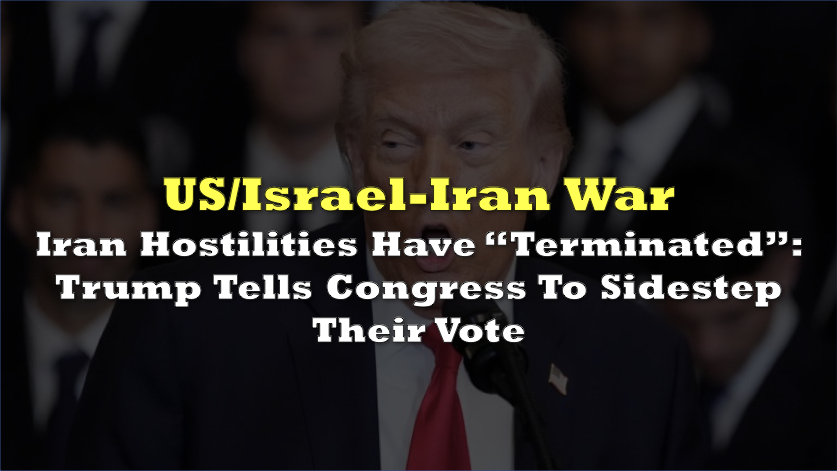

President Donald Trump told Congress that US hostilities with Iran have “terminated,” using an April ceasefire to argue that the 60-day War Powers Resolution deadline no longer requires congressional authorization for continued military action.
The letter, dated May 1, arrived as the statutory clock hit its limit for US military operations that began on February 28, 2026. Under the 1973 War Powers Resolution, a president must end the use of US armed forces after 60 days unless Congress has declared war, authorized force, extended the period, or the president certifies that a 30-day extension is needed for troop safety during withdrawal.
Trump wrote to congressional leaders that “the hostilities that began on February 28, 2026, have terminated,” arguing that an April 7 ceasefire, with no further exchanges of fire since then, ended the conflict for War Powers purposes.
 Sponsored · Selkirk Copper Mines
The legal fight is not over the existence of a ceasefire. It is over whether that ceasefire ends the 60-day clock while US forces remain deployed in the region and while the US continues coercive operations tied to Iran. Critics point to continuing US naval blockades of Iranian oil exports as evidence that conflict conditions have not ended.
Defense Secretary Pete Hegseth has argued that the ceasefire paused or ended the countdown, a position disputed by Democrats and legal critics who say the War Powers Resolution does not contain a ceasefire pause mechanism. The statute’s text provides a 60-day limit and a possible 30-day withdrawal extension, not an executive reset button.
Former Rep. Marjorie Taylor Greene accused Trump of using the termination claim to restart the clock and avoid a congressional vote that could restrict his authority to wage war on Iran. She wrote that the war “is absolutely not over just because there has been a ceasefire” and claimed Trump is “about to start military actions again very soon.”
Senate Democrats including Chuck Schumer and Jeanne Shaheen have said US forces remain exposed and that the conflict remains unauthorized, while Sen. Tim Kaine has contested the administration’s legal interpretation.
The political math has so far favored Trump. A Democratic-led war powers resolution seeking to halt the Iran conflict unless Congress authorized it was blocked in the Republican-led Senate, with a 47-50 vote.
The House has also rejected efforts to constrain Trump’s Iran authority. The Washington Post reported that some Republicans have questioned the administration’s position, while others have signaled that Congress should act if military operations resume.
The White House position also carries a broader precedent risk. If a president can declare hostilities “terminated” during a ceasefire while maintaining regional deployments, blockades, and the option of renewed strikes, the practical effect may be to dilute the War Powers Resolution’s 60-day limit without a direct vote to repeal it.
Information for this briefing was found via the sources and the companies mentioned. The author has no securities or affiliations related to this organization. Not a recommendation to buy or sell. Always do additional research and consult a professional before purchasing a security. The author holds no licenses.