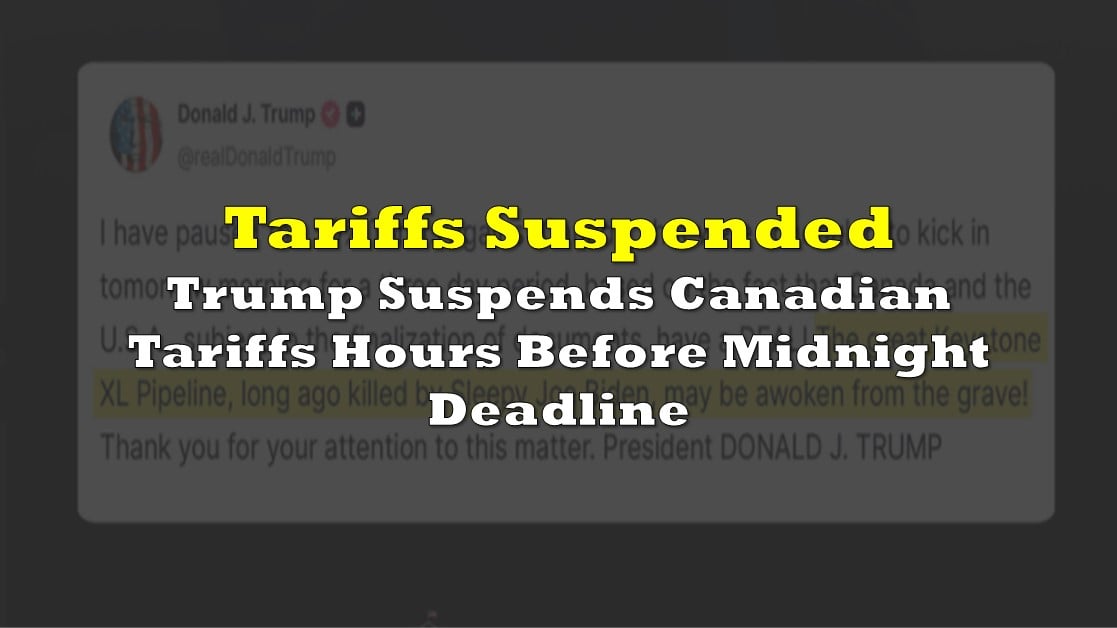

Hundreds of Canadian products that were bracing for a 50 per cent tariff will get a temporary reprieve, after U.S. President Donald Trump announced a three-day suspension of the levies less than two hours before they were due to take effect at 12:01 a.m. on Wednesday.
Trump tied the pause to progress at the negotiating table. In a post on Truth Social, he said the delay came “based on the fact that Canada and the U.S.A., subject to the finalization of documents, have a DEAL!”
A White House proclamation issued minutes afterward pointed to a commitment from Canadian negotiators, who officials said “expressed a commitment to remove the discriminations” that Washington had cited when it threatened the tariffs last month.
 Sponsored · Cambria Gold Mines
Products from plywood and cement to wine and hockey sticks would have been swept up by the duties. The value of the affected trade was pegged differently by different bodies, with one estimate placing it above $28 billion and the Office of the U.S. Trade Representative putting the figure closer to $20 billion. Whichever number holds, it accounts for a portion of the $382 billion the U.S. imported from Canada last year.
Authority for the measure came from Section 338 of the Tariff Act of 1930, a Depression-era provision that has scarcely been invoked and has languished for decades. When the administration rolled it out last month, it described the move as retaliation against what it labelled Canadian trade discrimination in the motor vehicle, alcohol and dairy sectors.
Businesses on both sides of the border sounded the alarm over the steep rate. Dan Kelly, president of the Canadian Federation of Independent Business, told CNBC that “a 50% tariff essentially makes a product uneconomic to sell into a particular market.” He said many of the group’s 103,000 members feared the duties could “grind their U.S. sales to a halt,” and that some American buyers were already delaying future orders.
Trade officials from both countries held repeated meetings in Washington in recent days, while Prime Minister Mark Carney spoke with Trump by phone on Monday and again on Tuesday. Carney did not immediately comment on the pause.
U.S. Trade Representative Jamieson Greer described the agreement as delivering “comprehensive market access for all American goods, economic security commitments, digital trade alignment,” but did not elaborate. According to sources, the question of what tariff, if any, would apply to Canadian autos remained unresolved.
Trump also floated the possibility that the pause could breathe new life into the Keystone XL pipeline, saying the long-shelved project “may be awoken from the grave.”