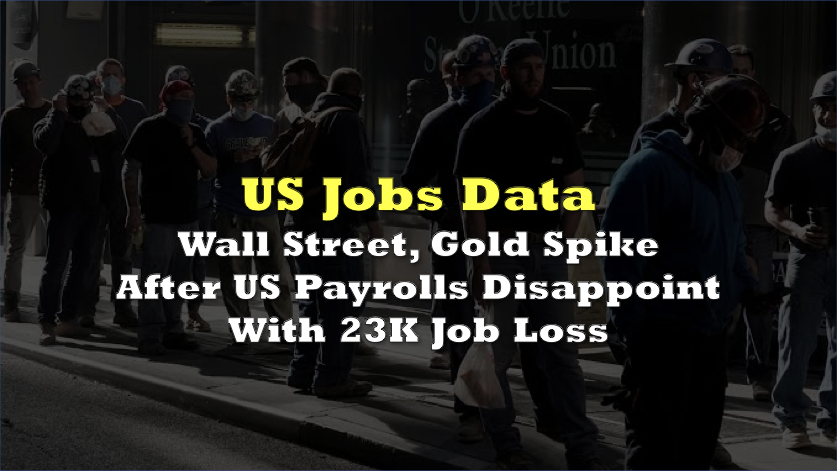

US employers cut 23,000 jobs in July, but investors responded by driving stocks and gold sharply higher as the surprise contraction weakened expectations that the Federal Reserve will raise interest rates in September.
The payroll decline missed the 80,000-job increase expected by economists surveyed by Reuters by more than 100,000 jobs. The Bureau of Labor Statistics also erased another 103,000 jobs from previously reported May and June gains, cutting May to 63,000 from 129,000 and June to just 20,000 from 57,000.
Wall Street moved in the opposite direction of the employment data. The Nasdaq Composite was up about 1.2%, the S&P 500 had gained about 0.6%, and the Dow Jones Industrial Average was up about 0.2% as of this writing. Eight of the S&P 500’s 11 sectors were trading higher, while 336 of the index’s 503 components were advancing.
 Sponsored · Selkirk Copper Mines
Gold rallied alongside stocks, with spot bullion briefly gaining more than 3% during Friday trading. Investing.com’s chart showed spot gold at $4,341.30 per ounce as of press writing, up 2.37% on the day, after reaching an intraday high of $4,371.89.
Gold futures were trading at $4,400.95 per ounce, up 2.36%, after touching a session high of $4,432.10. Both spot and futures prices had risen just over 3% at their intraday peaks.
The common driver was interest rates. Markets sharply reduced the probability assigned to a Federal Reserve increase at its September meeting after the payroll release. Estimates moved during the session, with Reuters reports citing LSEG data putting the probability at anywhere from about 20% to roughly 44%, down from approximately 55% to 57% before the jobs data.
Treasury yields also fell, with the two-year yield down about five basis points to 4.20% near midday and the 10-year yield two basis points lower at 4.64%.
 Sponsored · Altamira Gold Corp.
The employment report gave markets new reason to question whether the Fed can tighten policy again without adding pressure to a labor market that has already lost momentum.
The central bank held its federal funds target at 3.50% to 3.75% on July 29, but the decision exposed a significant split. Beth Hammack, Neel Kashkari, and Lorie Logan voted against the decision and instead favored a quarter-point increase as policymakers continued to confront inflation above the Fed’s 2% target.
July’s data complicated that argument. Payroll growth has now averaged only 20,000 jobs per month over the past three months, Reuters calculated, compared with an average of 77,000 per month in the three months through June before the latest revisions.
Private payrolls still increased by 30,000 in July, with much of the overall decline coming from a 50,000-job drop in local government education. Retail employment fell by another 19,000, while health care added 22,000 positions.
The headline unemployment rate declined to 4.1% from 4.2%, but employment measured through the household survey fell by 87,000 while the labor force shrank by 264,000. The participation rate slipped to 61.4%, down 0.7 percentage point since January and its lowest level in more than five years.
Wage pressure also moderated. Average hourly earnings rose by just $0.02 in July to $37.62 and were up 3.2% from a year earlier.
However, the report did not eliminate the possibility of another rate increase. Inflation remains above the Fed’s target, and July inflation figures due next week could move expectations again.
For financial markets, that shift outweighed the immediate economic implications of losing 23,000 jobs.