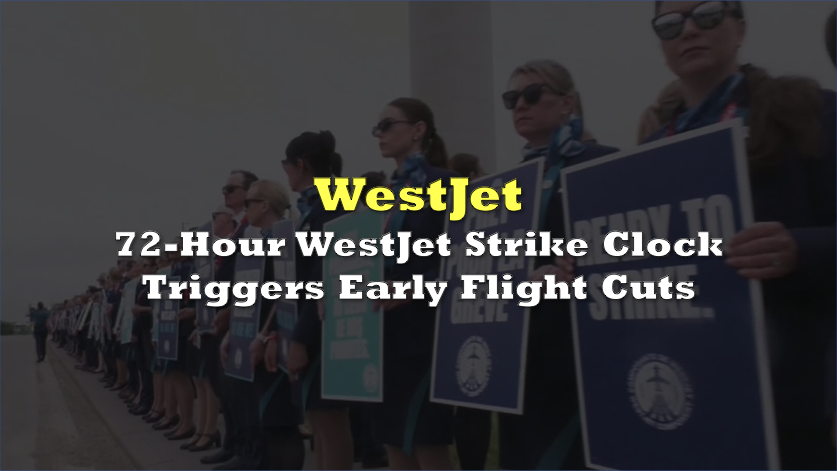

The Canadian Union of Public Employees’ Local 8125, which represents approximately 4,400 WestJet mainline flight attendants, issued a 72-hour strike notice on July 30.
WestJet responded with a matching lockout notice. Either side could begin job action at 12:01 a.m. Mountain Time on August 2 unless negotiators reach an agreement.
Both sides said bargaining remains underway.
 Sponsored · Selkirk Copper Mines
WestJet said it is preparing to operate a reduced schedule and will proactively manage flight changes and cancellations. Passengers travelling between July 30 and August 4 can make a one-time change or cancellation without an additional fee under the airline’s temporary flexible-booking policy.
The parties have already signed an operational wind-down agreement governing how aircraft, passengers, and cabin crew would be returned to Canadian airports before operations are suspended. The agreement requires crew members operating a flight when job action begins to complete that flight to its scheduled destination. It also establishes procedures for employees who may be away from their home bases when a strike or lockout takes effect.
That process means the disruption window extends beyond the strike itself. CUPE said WestJet had advised that cancellations could begin before August 2 as the carrier winds down parts of its schedule. Travelweek reported that some aircraft could begin being grounded as early as July 31 unless a tentative agreement is reached. WestJet has not published a flight-by-flight shutdown schedule.
CEO Alexis von Hoensbroech said the airline has a responsibility “to ensure the integrity of our network and to minimize the risk of stranding our guests, crew and aircraft.”
 Sponsored · Altamira Gold Corp.
The operational stakes are amplified by WestJet’s position as Canada’s second-largest airline. Reuters reported that the carrier controls roughly 30% of the domestic market, meaning a broad shutdown would remove a significant block of national capacity during the summer travel season.
The bargaining dispute is centred on how flight attendants are paid for duties performed before departure and after arrival. CUPE wants cabin crew compensated from check-in through clock-out, including boarding, safety inspections, passenger assistance, and other ground duties. The union says attendants currently perform an average of 35 hours of unpaid work each month and is also seeking higher overall compensation and improved work rules.
WestJet says cabin crew are paid through a credit-hour model rather than a conventional hourly system. The airline lists current rates of $28.45 to $53.61 per credit hour for cabin crew and acknowledges that both the pay structure and compensation levels require improvement following inflation.
It has not disclosed the value or structure of its latest proposal.
The strike mandate passed with 99.4% support after 97.3% of eligible members participated, giving the union substantial authority to reject a deal it considers insufficient.
“There’s still time to avoid a strike,” CUPE 8125 President Alia Hussain said. “We will continue to bargain around the clock until this is resolved.”
CUPE has also asked the federal government not to intervene, following Ottawa’s use of the Canada Labour Code to halt the 2025 Air Canada cabin crew strike and refer that dispute to arbitration.