
Canada’s latest confrontation with the US changed what voters were worried about, but not the distance separating the country’s two largest parties.
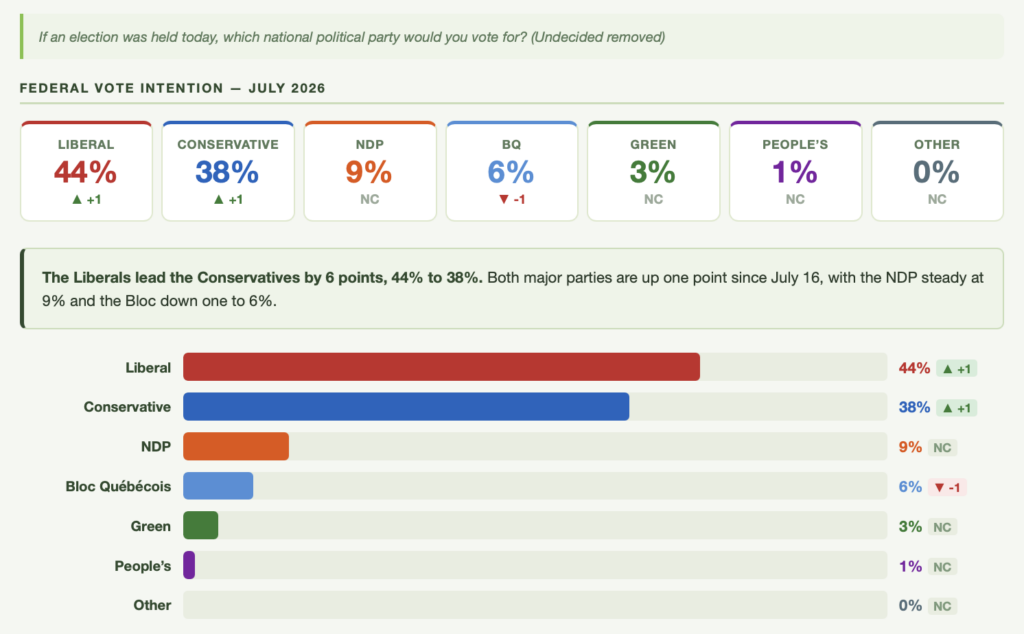
A new Abacus Data poll placed the governing Liberals at 44% among committed voters and the Conservatives at 38%. Both parties gained one percentage point from the previous survey, preserving the Liberals’ six-point national advantage despite a new US tariff threat and increased public attention to wildfires and climate change.
The NDP remained at 9%, while Green support was unchanged. The Bloc Québécois fell one point to 6%. Abacus surveyed 1,910 Canadian adults between July 23 and 29.
Voter concerns moved faster than party support
The vote numbers were stable even as the public agenda shifted toward issues that have generally favoured the Liberals.
 Sponsored · Selkirk Copper Mines
The cost of living remained the dominant concern, selected by 65% of respondents as one of Canada’s three most important issues. Concern about Trump and his administration rose six points to 37%, moving from fifth place to second. Climate change and the environment gained three points as wildfires affected communities and spread smoke across parts of the country.
The survey began three days after Trump signed proclamations imposing additional 50% tariffs on selected Canadian goods, including wine, cement, and hockey sticks. The measures cover certain goods even when they qualify under the CUSMA and are scheduled to take effect on August 19.
Canada’s federal government convened its advisory committee on Canada-US economic relations on July 21 to discuss the measures.
Abacus Data’s cross-tabs show why the issue shift did not necessarily produce a broader change in voting intention. Among respondents who identified Trump as a top concern, the Liberals led the Conservatives by 30 percentage points. Their advantage among voters focused on climate change was 47 points.
The Conservatives retained stronger perceived ownership of the cost of living and the economy, along with larger advantages on immigration, crime, and public safety. However, respondents who ranked affordability among their top concerns remained nearly evenly divided between the two major parties, limiting the Conservatives’ ability to convert their issue advantage into a larger vote gain.
Government approval also holds
Approval of Prime Minister Mark Carney’s government remained at 52%, while 32% disapproved. Both figures were unchanged from the previous wave.
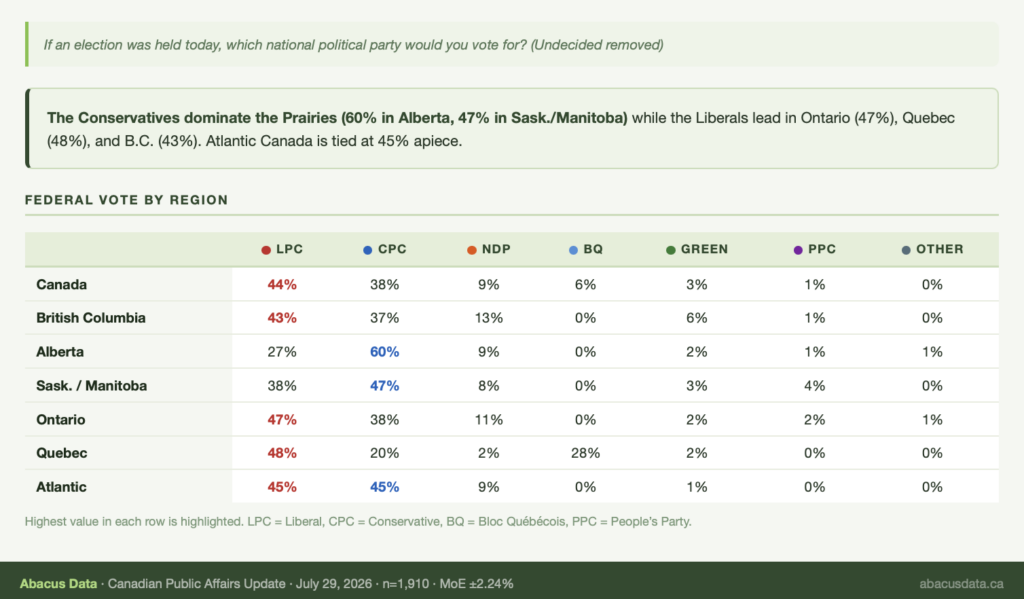
The regional results continued to favour the Liberals in the provinces containing the largest numbers of federal seats. They led the Conservatives 47% to 38% in Ontario and 43% to 37% in BC. In Quebec, the Liberals stood at 48%, compared with 28% for the Bloc Québécois and 20% for the Conservatives. Atlantic Canada was tied.
The latest movement therefore occurred beneath the national ballot numbers rather than within them. Trump’s tariff actions and the wildfire season pushed attention toward external threats and climate risks, where the Liberals hold substantial advantages. Affordability remained far more important overall, preserving an opening for the Conservatives.
Neither party converted its most favourable political terrain into a change in the national margin. The Liberals gained support without widening their lead, while the Conservatives gained the same amount without closing it.