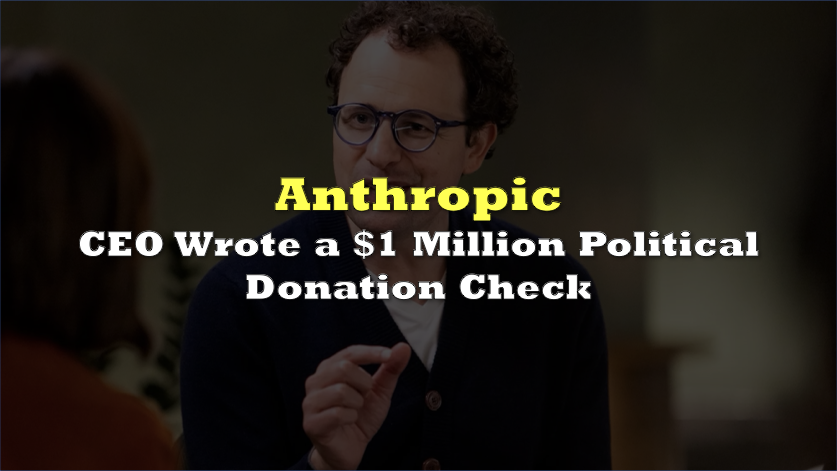

The competition between leading artificial intelligence developers is extending beyond model performance and into campaign finance, with Anthropic chief executive Dario Amodei personally committing $1 million to a super PAC backing stronger AI regulation.
The contribution, disclosed through newly released Federal Election Commission filings, adds a personal financial commitment to Anthropic’s broader political strategy after the company pledged $20 million earlier this year to Public First Action, a nonprofit that supports candidates favoring stronger AI oversight.
Public First Action has positioned itself behind candidates who support AI transparency requirements, safety testing, and preserving the ability of individual states to regulate AI systems.
 Sponsored · Selkirk Copper Mines
That places it opposite Leading the Future, another AI-backed political network supported by figures including OpenAI President Greg Brockman and venture capitalist Marc Andreessen. In The Washington Post report, Leading the Future has argued that fragmented state regulation could slow innovation and has instead advocated for a lighter national regulatory framework. It has raised approximately $125 million since launching in 2025, according to previous disclosures.
According to reporting based on the FEC filings, the contribution was made in May and appears to be Amodei’s first publicly reported seven-figure political donation.
The filing also reinforces Anthropic’s long-standing public position that advanced AI systems should be accompanied by stronger safety safeguards. The company has repeatedly argued that AI developers should support regulatory frameworks that balance technological progress with risk management.
According to reporting based on the latest FEC disclosures, five additional Anthropic employees collectively donated more than $2 million to Public First around the same period as Amodei’s contribution. Those donations further strengthened the organization’s fundraising ahead of the 2026 election cycle.
The political spending has increasingly centered on congressional races where AI legislation could become a defining issue. Recent reporting has described competitive House races, including contests in New York, as proxy battles between organizations aligned with Anthropic and those supported by AI industry leaders favoring lighter regulation. Campaign advertising has often focused on broader political themes rather than AI itself, even though the underlying financial backing reflects disagreements over future AI policy.