

Bitcoin’s latest push back above $80,000 has revived the market’s familiar “HODL” script, but the move is less a clean breakout than a stress test for investors still holding through a brutal correction from last year’s record highs.
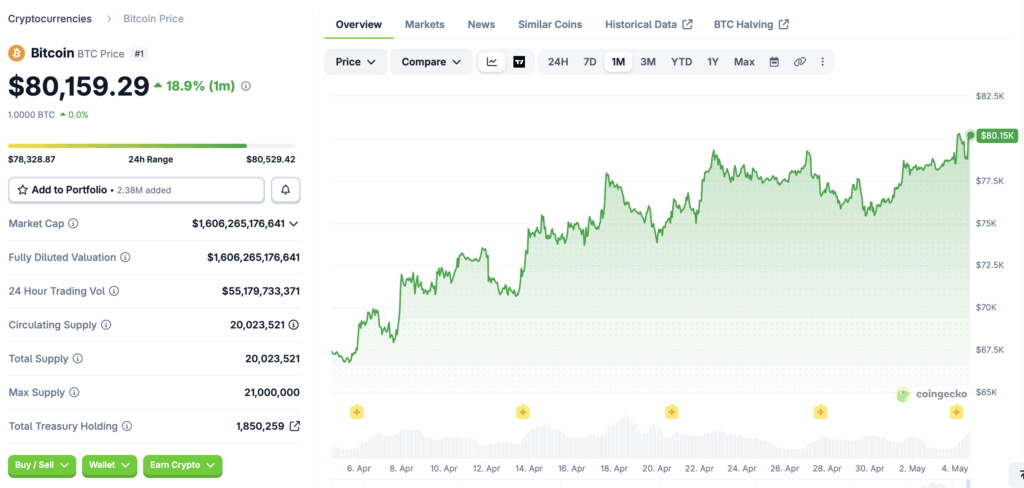
Bitcoin was recently trading around $80,224, up about 2.0% from the previous close, after reaching an intraday high of $80,529 and falling as low as $78,254.
The rally follows a choppy rebound in which Bitcoin briefly cleared $80,000 on May 4, 2026, with reports showing it rose as high as roughly $80,595 before slipping back below that level.
 Sponsored · Selkirk Copper Mines
MarketWatch reported that the move marked Bitcoin’s first break above $80,000 since January, when it closed at $83,817 on January 30.
A bounce, not a breakout
The current move is being framed by crypto traders as a return to “HODL” conditions, where volatility punishes short-term positioning and rewards longer-term conviction.
The technical hurdle remains obvious. Barron’s cited resistance at $81,000 and $83,000, with Bitcoin’s 200-day moving average at $83,863 described as a key level for a stronger medium-term signal. Until Bitcoin can hold above those levels, the latest rally is still a recovery attempt inside a wider drawdown.
Bitcoin hit an all-time peak above $126,000 in early October 2025, before a tariff-driven market break helped trigger more than $19 billion in leveraged crypto liquidations, the largest such wipeout in crypto market history.
 Sponsored · Altamira Gold Corp.
Macro is still driving the tape
The bigger risk for Bitcoin is that its rally remains tied to macro liquidity, not just crypto-native conviction. Reuters reported in January that Bitcoin sold off as speculation intensified that former Federal Reserve Governor Kevin Warsh could be selected to replace Fed Chair Jerome Powell, with Bitcoin down 2.5% at $82,300 and headed toward a fourth straight monthly decline.
The Warsh angle matters because Bitcoin has been trading like a high-beta liquidity asset. Later, precious metals and cryptocurrencies sold off heavily on January 30 after Trump named Warsh as the next Fed chair, with markets reacting to expectations that he could shrink the Fed’s balance sheet and reduce demand for Bitcoin.
The latest move also came alongside stronger crypto equity performance and renewed regulatory optimism. Investor’s Business Daily reported that Bitcoin briefly topped $80,000 as crypto stocks rallied after a revised Clarity Act draft advanced a compromise on stablecoins, banning yield solely from holding them while allowing incentives tied to actual transactions.
The same report said Circle Internet jumped nearly 11%, while bitcoin miner and AI infrastructure firm Iren rose more than 10% after energizing its 1.4 GW Texas data center. It also cited $629.37 million in Bitcoin ETF inflows on Friday and $1.97 billion in April inflows, up from $1.32 billion in March.
Still, the market remains far from repaired. Bitcoin is below its October 2025 record by more than one-third, and recent reports show the rally has not yet delivered a sustained move above the levels technicians are watching. A return to $80,000 may be enough to revive long-holder confidence, but it is not enough to erase the consequences of the last cycle’s leverage, liquidation, and macro repricing.
Information for this briefing was found via the sources and the companies mentioned. The author has no securities or affiliations related to this organization. Not a recommendation to buy or sell. Always do additional research and consult a professional before purchasing a security. The author holds no licenses.