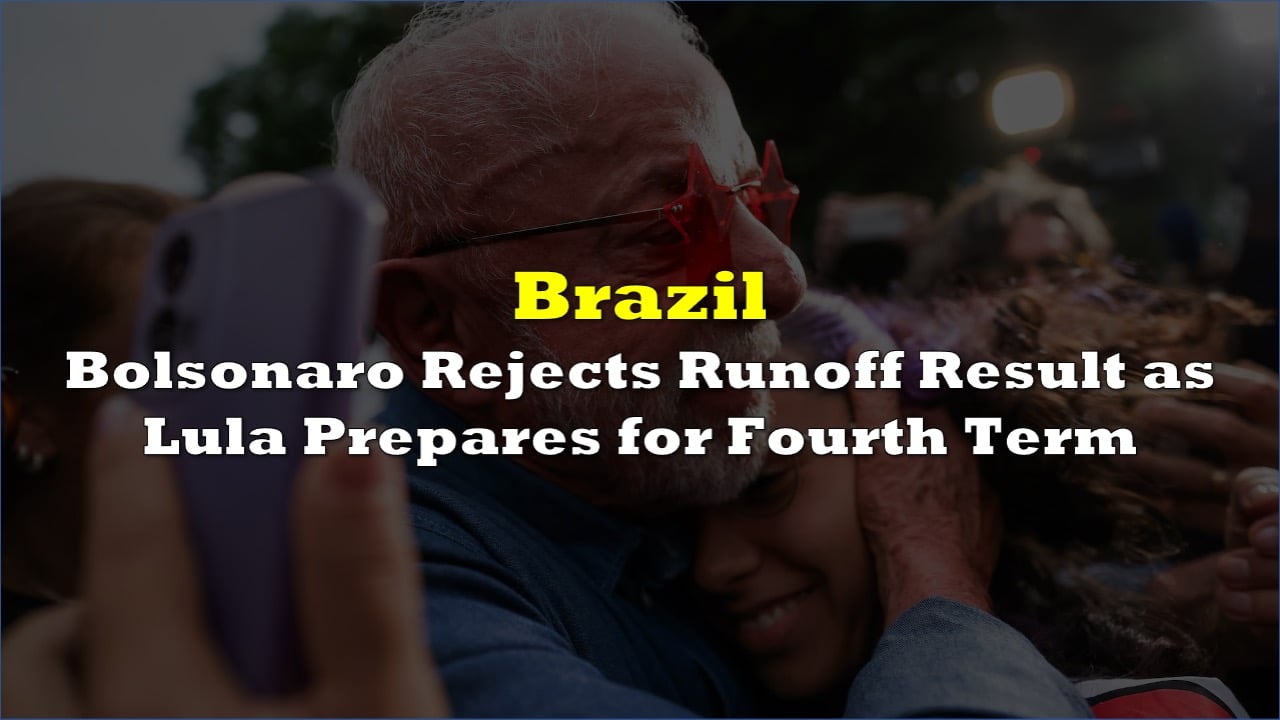

Brazilian President Luiz Inácio Lula da Silva won a fourth term in Sunday’s runoff, and Sen. Flávio Bolsonaro responded by refusing to concede and promising a court challenge.
Lula took 51.79% of valid votes to Bolsonaro’s 48.21%, a lead of 4,429,907 votes. Bolsonaro had finished first in the October 4 first round, 47% to 45%. No candidate who placed second in a first round had won Brazil’s presidency since the military dictatorship ended in 1985.
Read: Brazil Runoff Set for October 25 as Flávio Bolsonaro Finishes Ahead of Lula
 Sponsored · Selkirk Copper Mines
Bolsonaro said late Sunday in Brasília that he would “seek to have the election annulled”. He said he cannot recognize the outcome and accused Supreme Court Justice Cristiano Zanin, a Lula appointee and the president’s former personal lawyer, of changing the rules of the vote.
Electoral court President Kassio Nunes Marques, a Jair Bolsonaro appointee, called both candidates and confirmed Lula’s reelection. Jair Bolsonaro, the former president, also refused to accept a narrow 2022 loss to Lula and was later convicted of plotting a coup.
Zanin extended voting by two hours with a ruling issued three minutes before polls were due to close, after both campaigns petitioned the Supreme Court. Lula’s campaign cited bus disruptions in São Paulo and Salvador. Bolsonaro’s cited downpours across the south, his stronghold. The extension delayed the count by two hours. The number of stations that kept voting past the deadline is unknown, and at one Rio de Janeiro station the machines had already been shut off.
The electoral court has declared Lula the winner. It must issue his diploma by December 18, and he takes office January 5, 2027. It is unknown whether Bolsonaro has filed a petition.
 Sponsored · Cambria Gold Mines
Lula, who turns 81 on Tuesday, pledged to defend Brazil’s sovereignty and said, “Either the homeland remains free or we die for Brazil.” He campaigned on warnings that a Bolsonaro presidency would let the United States steer Brazil’s affairs.
Donald Trump Jr., the US president’s son, suggested the extension amounted to judicial malpractice and said US media would object if a conservative government had done the same. US Rep. Ro Khanna, a critic of President Donald Trump, said “Trump must respect the results and not undermine Brazil’s elections.”
The Trump administration imposed 50% tariffs on Brazil in July 2025, partly over Jair Bolsonaro’s prosecution. After the Supreme Court struck down the legal basis for those levies in February, it imposed a 25% Section 301 tariff on most Brazilian imports, exempting beef, orange juice and energy products.
Related: US Embassy Accuses Canadian Officials of Trying to Influence Midterm Elections
Trading in São Paulo resumes Monday at 10 a.m. local time. The Ibovespa ended Friday at 205,083 points, and a Tokyo-listed Ibovespa fund fell more than 11% in overseas trading after the result. Citigroup polled 73 investors, and most said a Lula win would weaken the real by 5% or more and lift swap rates by over a full percentage point as traders unwind rate-cut wagers placed after Bolsonaro topped the first round. Brendan McKenna, an emerging markets strategist at Société Générale, projected an 8% to 10% drop for the real and a 150 to 200 basis point swing in local bond yields.
Bolsonaro’s Liberal Party is the largest force in the 513-seat Chamber of Deputies with 121 seats, up 22 from 2022. One political-science classification puts right-leaning parties at about 276 seats, 32 short of the 308 required for constitutional amendments. The Centrão, a center-right bloc that trades votes for ministries and budget funds, holds the balance. Two of its members, Progressistas and União Brasil, have served in Lula’s cabinet.
Public debt equals about 93% of GDP, and the central bank’s weekly survey projects 2026 inflation of 5.22%, above the 4.5% ceiling. Lawmakers will vote first on the 2027 budget, which aims for a primary surplus of 0.5% of GDP.
Brazil and Mexico, Latin America’s most populous countries, both remain under left-of-center presidents, while right-leaning leaders govern seven of South America’s 12 countries by one count.