
Canada’s proposed free trade agreement with the Philippines starts with a modest number: $3.4 billion in bilateral merchandise trade in 2025.
That is not yet a market-moving figure for Canada. It is the scale of a relationship still being built, not one already carrying the weight of Ottawa’s diversification agenda. The question is whether Prime Minister Mark Carney’s government can turn that small base into a larger strategic platform.
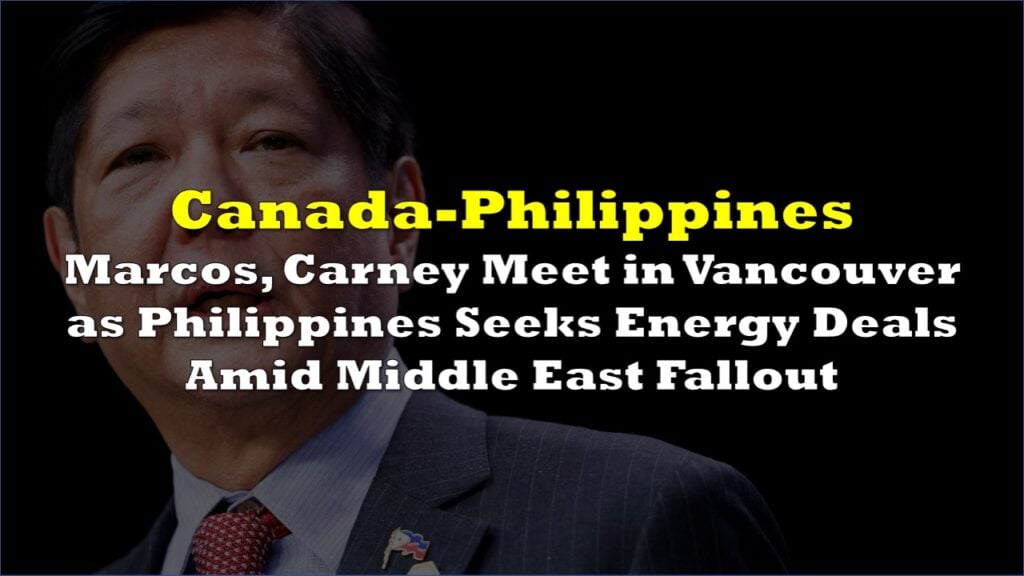
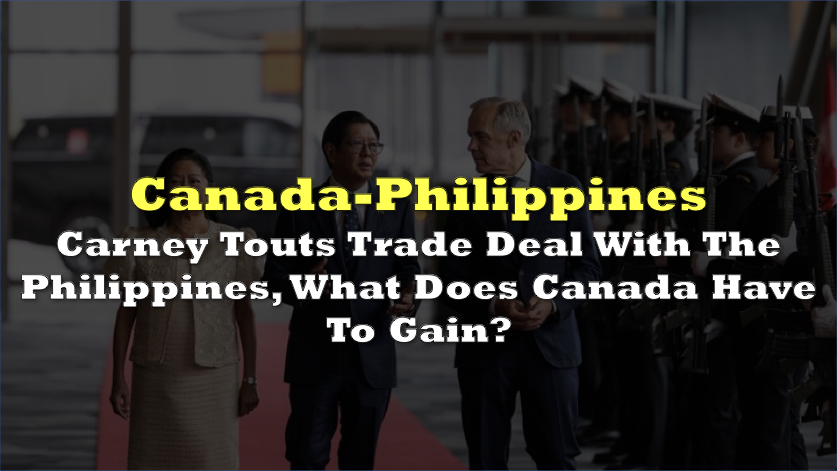
Carney and Philippine President Ferdinand Marcos Jr. met in Vancouver to launch a broader Canada-Philippines Strategic Partnership covering trade, energy, defence, labour, tourism and culture. Ottawa said the priority is concluding a bilateral free trade agreement by the end of 2026, with a target of tripling bilateral trade by 2035.
That would imply a goods trade relationship of roughly $10.2 billion by 2035, based on the 2025 baseline. For Canada, that would still be far smaller than its trade with the US or China, but it would be material in a different way: as a proof point that Canada can grow non-US export channels in markets where food security, infrastructure demand and strategic alignment overlap.
 Sponsored · Selkirk Copper Mines
The strongest case for the deal sits in agriculture and resource exports, not in a vague promise of “more trade.” Canada’s own consultations identified the Philippines as a market for mineral ores, meat, cereals, wood, machinery, electronics, fertilizers and aircraft parts. Agriculture and agri-food groups made up 45% of submissions received by Global Affairs Canada during consultations on a possible bilateral FTA.
That is the cleanest commercial logic. The Philippines is a large food-importing economy with more than 100 million people, rising consumption and limited domestic capacity in some staple commodities. Canada’s agriculture department said the Philippines was a net importer of agri-food and seafood products in 2023, with large global imports of wheat, oilcake and milled rice. It also said Canadian wheat and frozen pork accounted for 9.2% and 25.2% of Philippine imports in those categories.
For Canadian farmers, meat producers and grain exporters, the Philippines is not a symbolic market. It is a real demand center where tariff cuts, clearer sanitary rules and fewer non-tariff barriers could matter. Global Affairs Canada’s consultation summary shows agri-food groups pushed for tariff removal and more predictable regulatory treatment, while supply-managed sectors urged Ottawa not to trade away protections for dairy, poultry and eggs.
However, the deal’s upside is not automatic. Canada exported $1.1 billion in merchandise to the Philippines in 2025, down from $1.4 billion in 2024. Imports from the Philippines climbed to $2.3 billion, up from $1.8 billion. Total trade grew to $3.4 billion, but Canada’s goods position moved further into deficit.
That does not make the agreement a bad deal but it does make the government’s framing incomplete. Canada has something to gain only if the agreement opens actual export channels rather than simply making imports cheaper and diplomatic language shinier.
The timing helps Ottawa’s argument. The Philippines remains one of Southeast Asia’s faster-growing economies. The World Bank said Philippine GDP grew 5.6% in 2024, placing it among the region’s top performers, while the Asian Development Bank forecast growth of 6.0% in 2025 and 6.1% in 2026.
The Philippines also reported $218.68 billion in total external goods trade in 2025, up 8.9% from 2024, according to the Philippine Statistics Authority. Imports made up 61.4% of that trade, and the country recorded a $49.72 billion goods trade deficit.
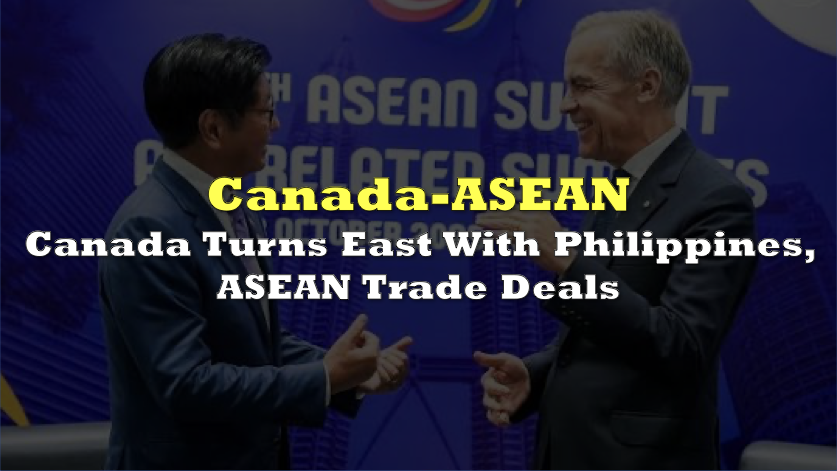
Canada is not negotiating in a vacuum. Ottawa is also pursuing a Canada-ASEAN free trade agreement, which the government says could add nearly $2 billion to Canadian GDP and create nearly 14,000 Canadian jobs. The Philippines’ 2026 ASEAN chairship gives Marcos leverage as both a bilateral partner and a regional convenor.
That is why the bilateral FTA looks like a wedge strategy. A Philippines deal can move faster, build trust and create a template for wider ASEAN access. Canada formally launched bilateral FTA negotiations with the Philippines on October 27, 2025, after exploratory discussions began in December 2024.
The non-trade pieces are also not decorative. Canada and the Philippines also announced energy and natural resources cooperation, a technical assistance partnership, tourism and cultural MOUs, and a labour and migration declaration focused on worker protections and ethical recruitment. Ottawa said the countries will work on resilient and responsible supply chains in both countries and across the Indo-Pacific.
The defence track is also already moving. Canada said the Status of Visiting Forces Agreement will soon come into force, building on a Mutual Logistics Support Arrangement and a defence cooperation statement signed during Philippine Defence Secretary Gilberto Teodoro’s June 2026 visit to Ottawa. Canada’s defence department has described the relationship as deepening through arrangements signed across 2024, 2025 and 2026.
Admittedly, in the grand scheme of trade, the Philippines agreement is one tile in a larger mosaic: Mercosur, ASEAN, and bilateral Asian deals are all attempts to reduce the economic risk of overdependence on Washington.
There are limits. Even if bilateral goods trade triples by 2035, the Philippines alone will not transform Canada’s export map. The market is promising, but it is competitive, price-sensitive and logistics-heavy.
The deal also carries political sensitivities. Canada’s own consultation summary noted concerns raised by some stakeholders about human rights, environmental and labour standards in the Philippines, as well as the treatment and credential recognition of Filipino migrant workers in Canada.
That makes the labour declaration more than an add-on. More than one million Filipino Canadians live in Canada, and the Philippines is a major source of immigrants, students, health-care workers and agricultural workers. A trade partnership that ignores labour mobility would miss one of the relationship’s biggest existing assets.
So does Canada have anything to gain? Yes, but not in the simplistic way political announcements usually sell FTAs.
The commercial upside is concentrated in agriculture, forestry, food inputs, machinery, services and investment. The strategic upside is broader: a deeper foothold in ASEAN, a security partner in the Indo-Pacific, a labour framework tied to an already large diaspora, and another route away from US-centric trade exposure.
The risk is that Ottawa markets a small trade relationship as a major breakthrough before exporters feel the gains.