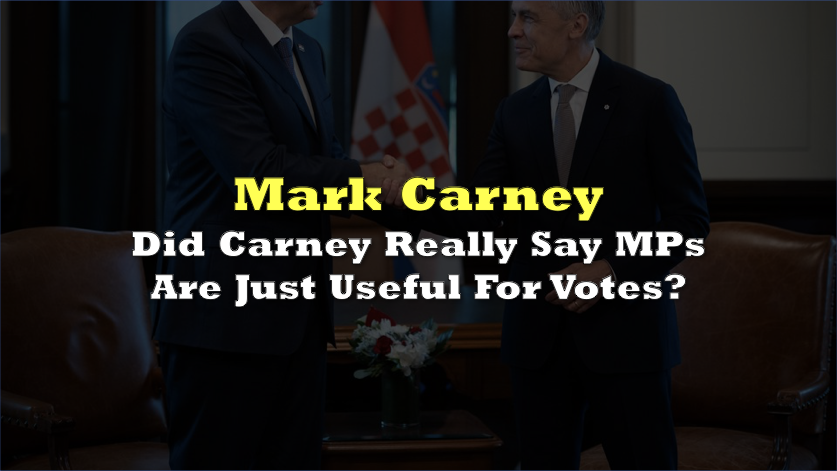

Prime Minister Mark Carney appeared to say MPs are “useful for votes” during a recent hot mic exchange with Croatian Prime Minister Andrej Plenković, but the surrounding context suggests the two leaders were discussing parliamentary systems rather than Carney making a direct attack on MPs.
The moment was captured during Plenković’s official visit to Parliament Hill in Ottawa. CPAC listed the footage as Carney welcoming the Croatian prime minister before brief remarks. The Prime Minister’s Office said the meeting covered defence, energy, trade, critical minerals, Ukraine, NATO, transatlantic security, and a drone manufacturing agreement involving Canadian and Croatian companies.
Western Standard reported that Carney was caught on a live microphone appearing to tell Plenković that MPs are just “useful for votes.” Circulating versions of the clip quote Carney as saying, “You just have MPs, and they’re not … they’re useful for votes,” followed by Plenković responding that Canada’s model is the British system and that a prime minister must be elected.
 Sponsored · Cambria Gold Mines
That exchange changes the meaning of the clip.
Rather than a standalone remark about Liberal MPs, the conversation appears to have been a comparison between Canada’s Westminster-style system and Croatia’s parliamentary structure. In Canada, prime ministers and cabinet ministers sit in Parliament, and governments survive through confidence votes in the House of Commons.
So, in a blunt institutional sense, MPs are “useful for votes” because votes are the mechanism that keeps a parliamentary government alive.
Plenković’s reported response points in that direction. Rather than reacting as if Carney had insulted MPs, the Croatian prime minister reportedly replied by identifying Canada’s system as the “British system” and noting that, under that model, someone who is not elected could not be prime minister. Carney then appeared to agree and added that the same applied to cabinet members.
 Sponsored · Selkirk Copper Mines
Croatia is also a parliamentary democracy, but its governments are commonly shaped through coalition bargaining among parties after elections. Plenković’s current government, for example, depended on securing support from lawmakers in Croatia’s 151-seat parliament after his party fell short of governing alone. In that context, the path to executive power depends less on a single-party majority and more on assembling enough parliamentary support to govern.
The distinction has not stopped the clip from spreading as a political attack. Critics have framed the remark as evidence that Carney views MPs mainly as vote counters for the Prime Minister’s Office. The line is especially sensitive because the Liberals now hold a working majority after falling short of one in the 2025 federal election.
The House of Commons currently lists the Liberals with 173 seats, compared with 140 for the Conservatives, 21 for the Bloc Québécois, five for the NDP, one for the Greens, one Independent, and two vacancies.
That political backdrop gives the clip its force. A remark about MPs and votes lands differently when the government’s control of the House depends on a majority assembled after election day.
The available evidence supports the core quote more than the harshest interpretation of it. Carney appeared to make a blunt comment about MPs being useful for votes. But the surrounding exchange points to a conversation about how parliamentary governments function, not necessarily a claim that MPs have no other purpose.
The official purpose of the Plenković meeting was foreign policy and defence industry cooperation. Online, it became a test of how Carney talks about the MPs who keep his government in power.