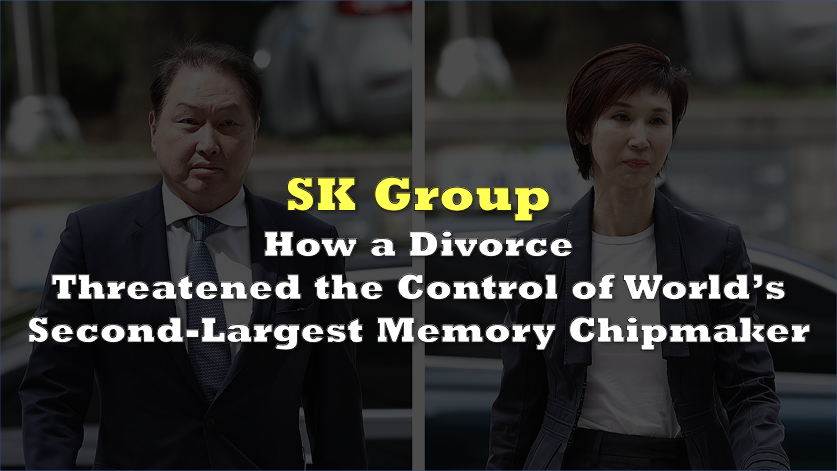

For two years, one of South Korea’s most expensive divorces carried an unusual corporate risk. A sufficiently large payout by SK Group Chairman Chey Tae-won could have forced him to raise money against, or potentially sell, the shares underpinning his control of a conglomerate whose most important asset is now one of the pillars of the global AI boom.
That risk has largely receded. Chey has appealed a Seoul High Court order requiring him to pay former wife Roh Soh-yeong 944 billion won, or about $668.5 million at current exchange rates, Reuters reported, citing Yonhap and Chey’s lawyers. It remains South Korea’s largest divorce settlement.
But the latest ruling is substantially less threatening to his corporate position than the judgment that initially put SK Group’s ownership structure under scrutiny.
 Sponsored · Selkirk Copper Mines
The $1 billion control scare
In May 2024, the Seoul High Court ordered Chey to pay Roh 1.38 trillion won, then worth roughly $1 billion, after determining that his holdings in SK Inc. should be included in the marital estate. SK Inc. shares jumped 9% following the decision as investors tried to assess what the enormous cash obligation could mean for Chey’s position in the holding company.
Chey then owned about 17.7% of SK Inc., the stake through which he controlled SK Group companies including SK Hynix. Reuters reported at the time that investors considered the possibility that he could sell shares to fund the divorce payment.
The concern became explicit weeks later. Chey said in June 2024, per Reuters report, that SK would take steps to prevent his divorce ruling from creating vulnerabilities to hostile takeovers or other corporate-control problems. Analysts nevertheless argued that he had alternatives, including borrowing money or disposing of holdings in non-core affiliates rather than weakening his SK Inc. position.
The feared risk was that the size and financing of the settlement could disturb the ownership chain above the chipmaker.
 Sponsored · Altamira Gold Corp.
Chey is SK Inc.’s largest shareholder, which owns about 32% of SK Square, while SK Square is SK Hynix’s largest shareholder with 20.5% of the chipmaker.
Court saved the shares
The control issue changed materially in July. After South Korea’s Supreme Court rejected the inclusion of alleged funds linked to Roh’s father, former President Roh Tae-woo, as a legally protected contribution to the marital estate, the Seoul High Court recalculated the award at 944 billion won.
More importantly for SK, the court ordered the settlement paid in cash rather than shares.
The ruling specifically allowed Chey to retain ownership of his holdings because of their role in maintaining management control of SK Group. Analysts and fund managers interviewed by Reuters said Chey could still sell interests in other SK companies or pledge assets to finance the payout, but they did not expect the award to disrupt management control.
Chey’s SK Inc. stake has since risen to 17.9%.
The stakes surrounding that ownership chain have also become much larger because of SK Hynix. The company is the world’s second-largest memory chipmaker after Samsung and has emerged as a major supplier of high-bandwidth memory used with AI processors.
SK Hynix also listed American depositary shares on Nasdaq in July, widening its exposure to international investors after an AI-driven surge in its valuation.
Chey’s latest appeal means the divorce settlement is not finished.
It does not, however, restore the corporate-control threat that surrounded the case in 2024.