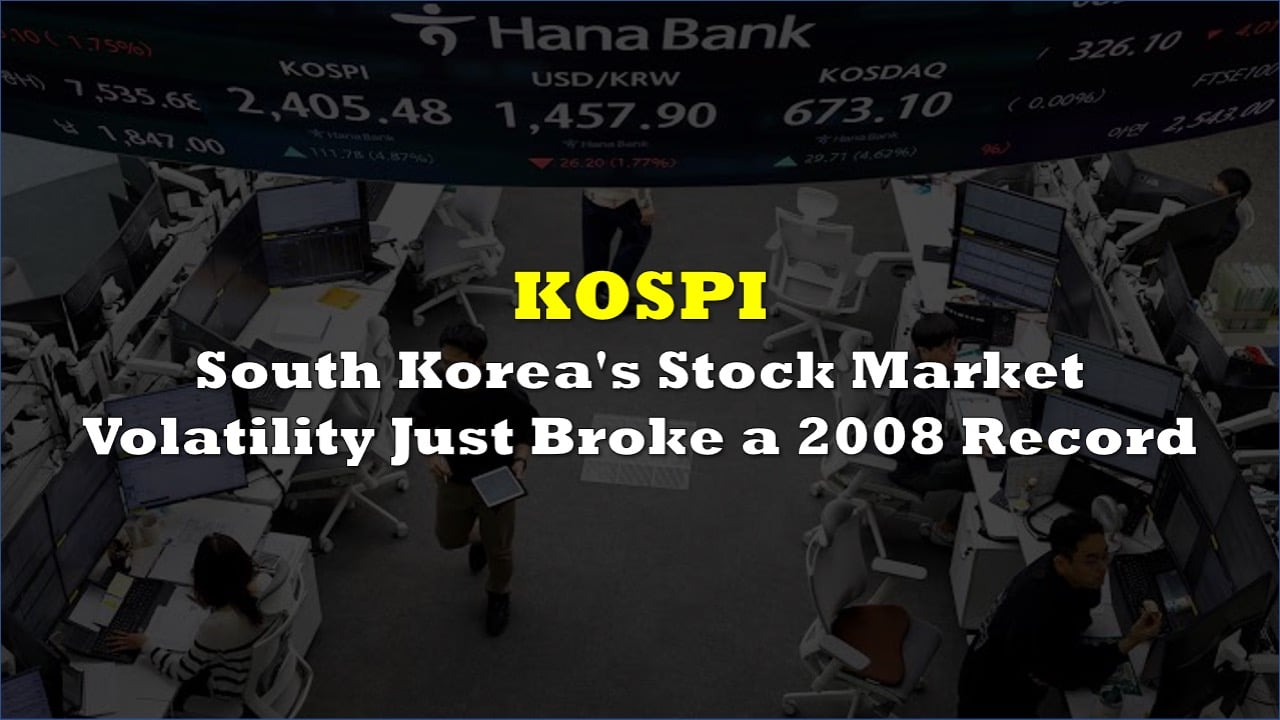

South Korea’s stock market volatility has surpassed levels last seen during the 2008 global financial crisis, driven by an AI-fueled rally that has unwound into repeated single-day crashes.
The VKOSPI, South Korea’s version of Wall Street’s VIX, spiked to nearly 98 intraday in late June, its highest reading since Korea Exchange began tracking the index in 2009. On July 16, the Kospi tumbled 6.37% in a single session, erasing the prior day’s gains, with Samsung Electronics and SK Hynix leading the decline, down 8.77% and 11.53%, respectively.
Trading halts known as sidecars have been triggered 37 times on the Kospi and 22 times on the smaller Kosdaq this year, both surpassing 2008’s records.
The Kospi surged more than 100% by June, crossing 9,000 points for the first time as investors piled into memory-chip makers riding the global AI buildout. SK Hynix briefly became South Korea’s most valuable listed company, touching a $1.35 trillion market cap on June 22 on demand for the high-bandwidth memory chips used in AI training hardware.
 Sponsored · Selkirk Copper Mines
Samsung and SK Hynix together account for roughly 60% of the Kospi’s total market capitalization, so swings in either stock ripple through the entire index.
Heavy use of leveraged, single-stock exchange-traded funds has amplified moves in both directions, and margin calls have forced rounds of rapid selling once prices turned. “This is just too much of the leverage trading that’s affecting the market,” Yuanta Securities strategist Daniel Yoo told CNBC.
Related: South Korea’s Stock Frenzy Turns Dangerous as Borrowed Money Pours Into Semiconductor Rally
Foreign investors have pulled roughly $70 billion out of Korean equities this year, including $13.2 billion in a single week in May. The won slid to about 1,545.2 per dollar on June 29, its weakest mark in nearly two decades. South Korea’s central bank raised interest rates 25 basis points to 2.75% in July, its first hike since January 2023, adding another jolt to an already jittery market. The ongoing US-Iran conflict, active since late February, has compounded the AI-driven swings with a separate layer of geopolitical risk.
Notably, the Kospi remains one of the best-performing major indexes anywhere in the world this year, still up more than 60% year to date despite losing roughly a quarter of its value since the June peak.