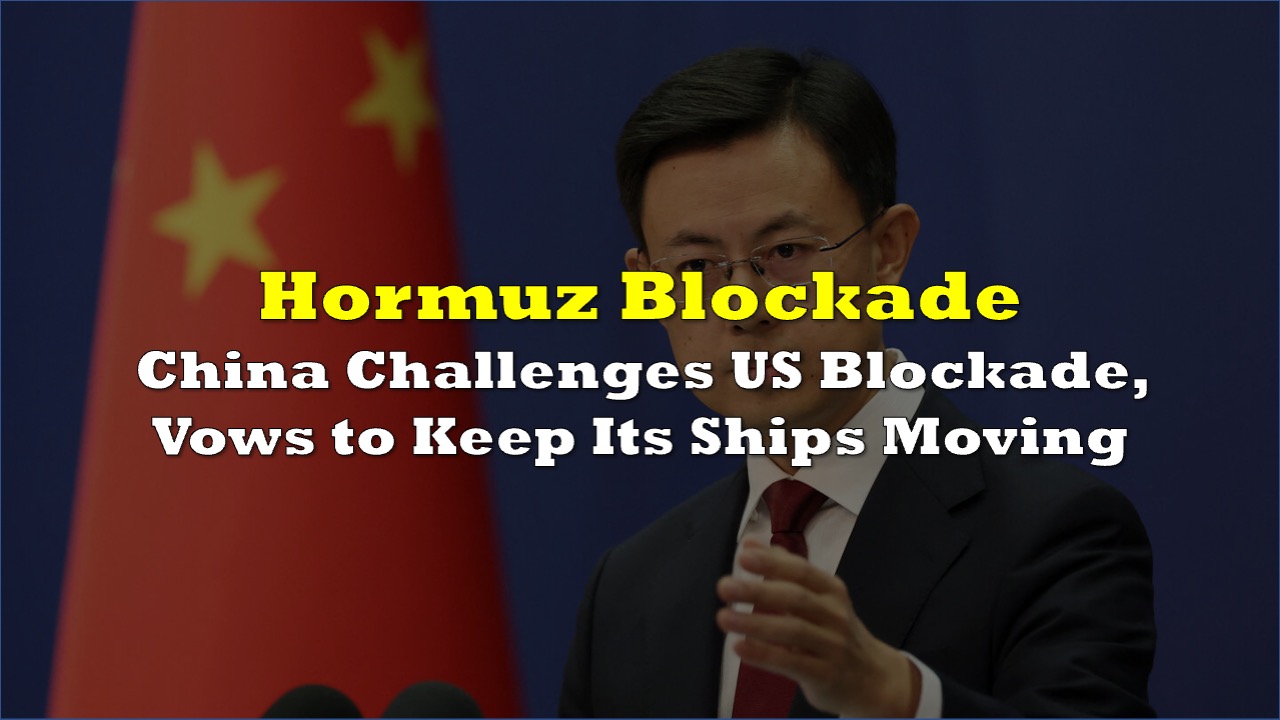

China’s defense minister warned Washington on Monday not to interfere with Chinese vessels at the Strait of Hormuz as a US naval blockade of Iranian ports took effect, raising the risk of a direct confrontation between the world’s two largest economies.
Admiral Dong Jun said Chinese ships were actively transiting the strait under existing agreements with Tehran. “We have trade and energy agreements with Iran. We will respect and honor them and expect others not to meddle in our affairs,” Dong said. “Iran controls the Strait of Hormuz, and it is open for us.”
US Central Command said forces began enforcing the blockade at 10 a.m. ET Monday, targeting all maritime traffic entering and exiting Iranian ports along the Persian Gulf and Gulf of Oman, after weekend peace talks in Islamabad collapsed.
Foreign Ministry spokesman Guo Jiakun told reporters that keeping the strait “safe, stable and unimpeded” served the common interests of the international community, called for restraint from all parties, and said the only path to resolution was an immediate ceasefire.
 Sponsored · Selkirk Copper Mines
Foreign Minister Wang Yi, meeting a UAE envoy in Beijing, said the blockade was “not in the common interest of the international community” and urged all sides to preserve what he called an “extremely fragile” ceasefire.
China and Russia vetoed a UN Security Council resolution last week, co-sponsored by Bahrain, that aimed to protect commercial shipping in the strait. Eleven of the council’s 15 members voted in favor. China’s UN envoy Fu Cong said adopting the text while the US was “threatening the survival of a civilisation” would have sent the wrong message.
Related: Barbed Wire Goes Up at Chinese Embassy in DC as Security Concerns Mount
Russia, China, and Iran also announced joint naval exercises under the “Maritime Security Belt 2026” framework in the Strait of Hormuz.
Iran had granted transit rights to ships from China, Russia, India, Pakistan, Iraq, and other friendly nations, in some cases requiring vessels to contact the IRGC and pay a toll. At least two payments have been made in Chinese yuan, part of a broader Iranian effort to conduct transactions outside the US dollar.
Trump urged China to redirect its energy purchases to the United States instead. “China can send their ships to us. China can send their ships to Venezuela,” he told Fox News on Sunday.
CNN reported, citing three people familiar with recent US intelligence assessments, that China is preparing to deliver shoulder-fired anti-air missile systems known as MANPADs to Iran within weeks, with shipments routed through third countries to mask their origin. Trump warned Monday that “if China does that, China’s going to have big problems.”
A spokesperson for the Chinese Embassy in Washington said the claims were false, adding that China has “never provided weapons to any party to the conflict.”
Capital Economics chief economist Neil Shearing warned of dangerous miscalculations at sea. “Would the US Navy seize allied ships that have paid tolls to Tehran? Would it target Chinese vessels in the Strait? Either outcome would represent a significant escalation,” he wrote in a note.
Brent crude settled near $99 a barrel Monday — roughly 40% above its pre-war level — while West Texas Intermediate closed similarly. International Energy Agency head Fatih Birol last week called the disruption the worst energy shock the world has ever seen, surpassing the 1970s oil crises and the fallout from Russia’s war in Ukraine combined. Before February 28, roughly one-fifth of the world’s oil and liquefied natural gas moved through the strait daily. That flow has fallen to under 10% of pre-war levels, with an estimated 230 loaded tankers stranded inside the Persian Gulf.
International Maritime Organization Secretary-General Arsenio Dominguez said international law bars any country from blocking straits used for international transit. “There is no right to prohibit the right of innocent passage, nor to impede the freedom of navigation through international straits,” he said.
The two-week ceasefire between the US and Iran expires on April 21. Pakistan has offered to host a second round of talks, and Trump said Monday that Iranian officials had called and “want to work a deal,” leaving the diplomatic window narrowly open.
Information for this story was found via the sources and companies mentioned. The author has no securities or affiliations related to the organizations discussed. Not a recommendation to buy or sell. Always do additional research and consult a professional before purchasing a security. The author holds no licenses.