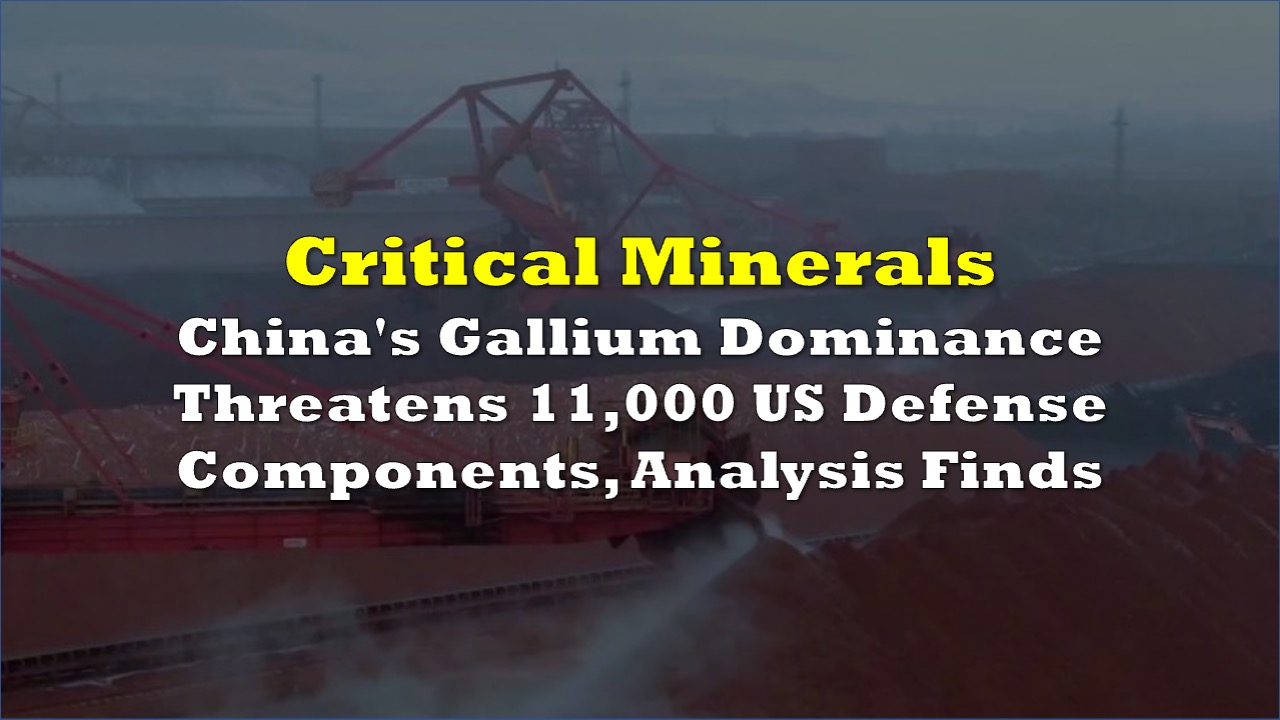

More than 11,000 individual parts used across the US Department of Defense require gallium, a critical mineral that China has weaponized through export restrictions, according to a new analysis that reveals the scope of American vulnerability in defense supply chains.
The Center for Strategic and International Studies report shows that China’s control over gallium production poses far greater risks to US national security than previously understood. Nearly 85% of defense supply chains containing gallium include at least one Chinese supplier, creating dangerous dependencies on an increasingly assertive rival.
Read: Pentagon Targets Domestic Gallium Recovery After China Export Curbs
 Sponsored · Selkirk Copper Mines
“The importance of gallium to advanced defense systems is difficult to overstate,” the CSIS report states. The mineral enables semiconductors that outperform silicon in extreme conditions, making them essential for next-generation military electronics.
China’s December export ban on gallium to the United States has exposed vulnerabilities across America’s most sophisticated weapons systems. The restrictions target semiconductors that power the Navy’s AN/SPY-6 radar, the Marine Corps’ G/ATOR radar, the Army’s LTAMDS radar and the F-35 Lightning II’s upgraded radar system.
The analysis reveals that actual US gallium consumption reaches up to 200 tons annually — ten times higher than the 20 tons reported in official statistics. This hidden dependency has left American defense contractors scrambling for alternatives as Chinese restrictions tighten.
“Gallium-enabled radar systems will also play an irreplaceable role in any efforts to build a layered nationwide missile defense shield,” the report notes.
 Sponsored · Silver47 Exploration Inc.
China’s control extends beyond raw materials. Chinese chemical company Sunresin produces 90% of the extraction resins essential for gallium production, while authorities have expanded export controls to include the extraction technologies themselves.
“With near-complete control over the floodgates of global supply, Beijing can easily manipulate gallium prices to desired levels,” the analysis warns. This gives China the ability to flood markets when competitors emerge, undermining efforts to develop alternative sources.
CSIS researchers outline four key policy recommendations. The Defense Department should establish a 50-ton gallium stockpile over a five-year period using Defense Production Act authorities, despite the mineral’s challenging one-year shelf life. Federal agencies should expand matching funds for gallium recovery at existing facilities, while creating joint procurement mechanisms with allies to pool purchasing power.
Several projects could help diversify supply. MTM Critical Metals plans to begin operations in early 2026 at a Texas facility using new technology to extract gallium from industrial scrap. Rio Tinto is exploring gallium recovery in Quebec, potentially supplying 40 tons annually.
“If even a subset of the above international and domestic projects come online as planned, non-Chinese production capacity could grow by as much as 170 t—approximately 24 percent of current global supply,” the report concludes.
However, the analysis warns that market forces alone cannot solve the gallium challenge. The unique characteristics of gallium production mean that sustained government intervention is essential.
Key US allies, including Poland, Saudi Arabia, and Taiwan, have ordered American-built radar systems dependent on gallium technology, extending supply vulnerabilities beyond US borders.
“Failing to respond effectively will send dangerous signals to Beijing about its ability to inflict asymmetric pain on the United States and allied economies,” the report warns.
The recently passed spending legislation provides $2 billion for critical minerals stockpiling, offering resources that could support comprehensive gallium security measures if properly allocated.
Information for this story was found via the sources and companies mentioned. The author has no securities or affiliations related to the organizations discussed. Not a recommendation to buy or sell. Always do additional research and consult a professional before purchasing a security. The author holds no licenses.