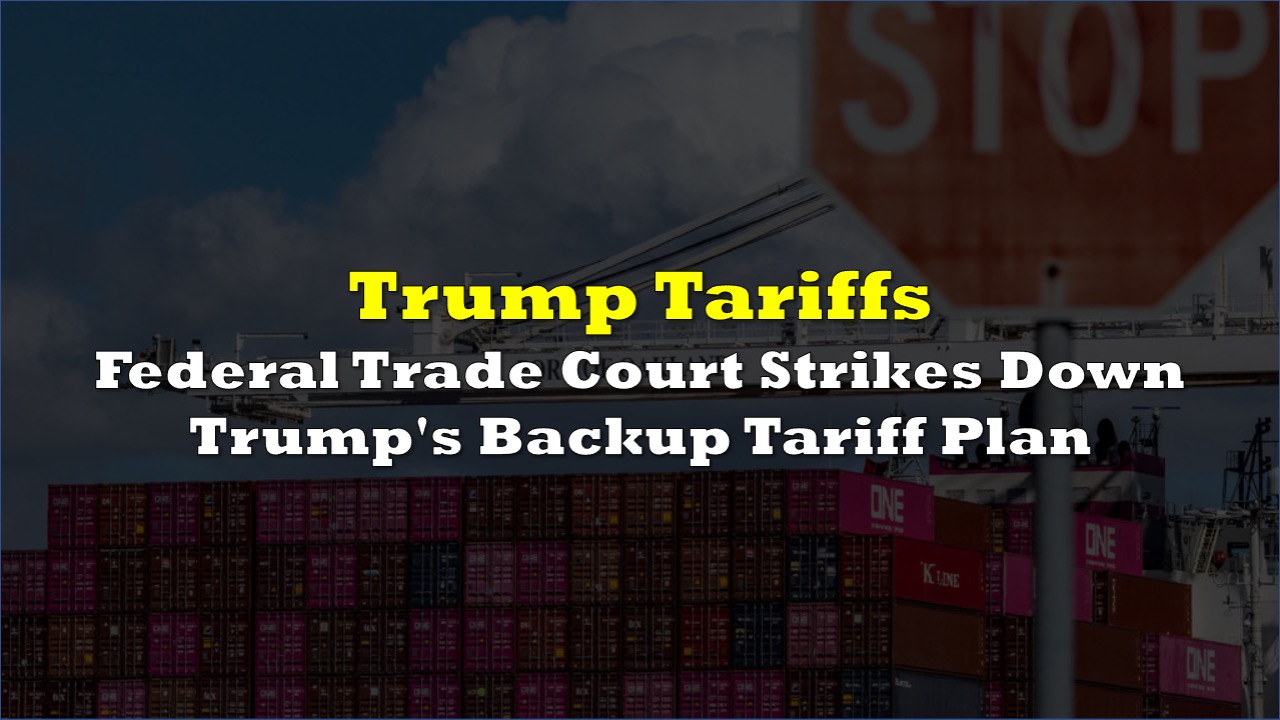

A federal trade court has struck down President Trump’s backup tariff plan, dealing the administration its second consecutive legal defeat on broad-based import taxes and leaving it with narrowing options to maintain a global tariff regime.
The US Court of International Trade ruled 2-1 on May 7 that Trump’s 10% universal tariff — imposed under Section 122 of the Trade Act of 1974 hours after the Supreme Court struck down his IEEPA tariffs in February — is “invalid, and the tariffs imposed on plaintiffs are unauthorized by law.” The court ordered refunds with interest for all Section 122 duties already paid by the plaintiffs.
On February 20, the Supreme Court ruled 6-3 in Learning Resources, Inc. v. Trump that the International Emergency Economic Powers Act does not authorize the president to impose tariffs — invalidating Trump’s entire suite of “Liberation Day” reciprocal tariffs and fentanyl-related trafficking tariffs, an estimated $160 billion in duties collected since 2025.
 Sponsored · Selkirk Copper Mines
Read: Supreme Court rules Trump tariffs illegal
Within hours of that ruling, Trump signed Proclamation No. 11012 imposing a new 10% global tariff under Section 122, a Korean War-era balance-of-payments law never previously used to impose broad-based tariffs. The administration argued the US trade deficit constituted the kind of international payments crisis the law was designed to address.
The CIT disagreed. The court found the proclamation failed to identify the specific economic conditions Section 122 requires.
“The United States has a trade deficit, not a balance-of-payments deficit, and does not have international payments problems,” said Jeffrey Schwab, senior counsel at the Liberty Justice Center, which brought the case on behalf of Burlap & Barrel, a New York spice retailer, and Basic Fun, a Florida toy company facing more than $750,000 in combined tariff costs.
 Sponsored · Silver47 Exploration Inc.
The majority cited the Supreme Court’s own February ruling directly: “The President enjoys no inherent authority to impose tariffs during peacetime.”
The administration can and likely will appeal, ultimately back to the Supreme Court. Section 122 also carries a built-in 150-day limit, meaning it would expire around July 24 regardless of the litigation outcome.
What remains intact are industry-specific tariffs: Section 232 national security tariffs on steel, aluminum, and autos, and Section 301 tariffs targeting China. Treasury Secretary Bessent had argued that stacking Section 122, 232, and 301 tariffs would produce “virtually unchanged tariff revenue in 2026.” With Section 122 now invalidated, that math no longer holds.
Canada was among the countries subject to the Section 122 tariffs, adding a 10% surcharge on top of existing Section 232 steel and aluminum duties. Thursday’s ruling removes that layer, at least temporarily, though the appeal timeline and remaining sector-specific tariffs mean relief for Canadian exporters remains partial and uncertain.
The broader refund question from the IEEPA tariffs — $166 billion in duties the US began processing last month — remains unresolved at the CIT.
Read: US Begins Processing $166 Billion in Tariff Refunds After Supreme Court Strikes Down IEEPA Policy
Information for this story was found via the sources and companies mentioned. The author has no securities or affiliations related to the organizations discussed. Not a recommendation to buy or sell. Always do additional research and consult a professional before purchasing a security. The author holds no licenses.