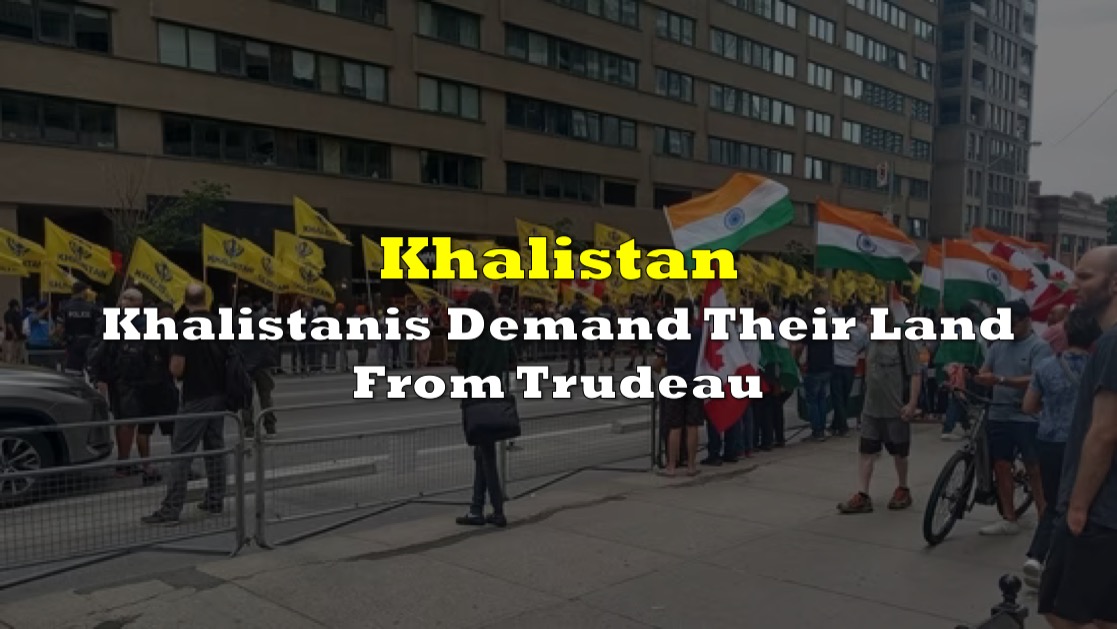

In a display of mounting tensions, clashes erupted between pro-Khalistan and pro-India demonstrators outside the Indian consulate in Toronto, Canada. The rally, organized by the secessionist group Sikhs for Justice (SFJ), saw approximately 250 pro-Khalistan individuals gather near the consulate building. The protest had gained attention through the circulation of controversial ‘Kill India’ posters online, targeting senior Indian envoys in Canada.
However, this time the pro-Khalistan group faced opposition from pro-India demonstrators who confronted them across the street. The two groups were separated by a line of Toronto Police personnel, and barricades were set up to restrain the protestors. The section of Bloor Street, where the consulate is located, was blocked to traffic to ensure security.
As tensions escalated, the pro-Khalistan group attempted to breach the barricades and attack the pro-India contingent. The police managed to push them back, and one individual who rushed ahead was apprehended and detained. Another person was also taken into custody for allegedly assaulting a police officer. However, both individuals were subsequently released without charges, according to a spokesperson for the Toronto Police.
 Sponsored · Cambria Gold Mines
During the protest, the Khalistan supporters held posters of SFJ leader Hardeep Singh Nijjar, who was murdered in Surrey, British Columbia, on June 18. The posters accused India of being behind the assassination. Additionally, the demonstrators promoted the upcoming phase of the so-called Punjab Referendum, scheduled to take place in the Greater Toronto Area (GTA) on July 16. Some protesters even wore jackets with the inscription “Republic of Khalistan” and an image of an AK47.

The pro-India group, though outnumbered, stood firm in the face of the attempted attack. After the dispersal of the pro-Khalistan group, one of the pro-India demonstrators, Arvind Mishra, expressed satisfaction, stating, “We were successfully able to demonstrate resistance to the Khalistanis.” Mishra criticized the Khalistanis for exceeding the limits of freedom of speech.
Another attendee, Neel Sehgal, condemned the violent actions of the pro-Khalistan group, particularly when one individual breached the police barricade to attack the peaceful gathering. Sehgal called on Canadian Prime Minister Justin Trudeau and his government to swiftly ban violent rallies and referendums.
Similar but smaller-scale protests were witnessed in Ottawa and Vancouver, with about 30 and 50 protesters respectively. The rallies were organized under the banner of Nijjar, whose murder remains under investigation by the Integrated Homicide Investigation Team (IHIT).
Khalistan
The Khalistan movement advocates for the creation of an independent Sikh state, known as Khalistan, in the Punjab region of India. The movement has its roots in the post-British Empire era and has been strongly opposed by the Indian government.
 Sponsored · Selkirk Copper Mines
Khalistan is the proposed independent homeland sought by some Sikhs in Punjab, India. The term “Khalistan” is derived from two Punjabi words: “Khalis,” meaning pure, and “Stan,” meaning land or nation. The movement gained momentum in the 1980s, driven by political, cultural, and religious factors.
Advocates argue that Sikhs have historically faced discrimination and seek greater autonomy to protect their rights. Some Sikh separatist groups argue that Sikhs have historically faced discrimination and marginalization within India and that the creation of an independent Sikh state would provide them with greater autonomy and protect their religious and cultural rights. They point to incidents such as the 1984 anti-Sikh riots, in which thousands of Sikhs were killed following the assassination of the then-Indian Prime Minister, Indira Gandhi, by her Sikh bodyguards.
However, not all Sikhs support Khalistan, leading to ongoing debate within the community. The Indian government opposes the idea, emphasizing its commitment to a unified and secular nation, while making efforts to address Sikh concerns.
Canada, home to a significant Sikh population, has faced criticism from India over its handling of Khalistani elements. The Indian government has called on Canada to ensure the safety of its diplomats and take action against Khalistan groups, including banning them or declaring them terrorist entities. Trudeau responded by stating that his government takes the surge in pro-Khalistan activity “extremely seriously” and will push back against violence and extremism.
“Khalistani patronage”
Amidst the escalating tensions, concerns have been raised about a float featuring the assassination of the late Indian leader, Indira Gandhi, during a shaheedi diwas or martyrdom day event in Brampton, a town in the GTA. The tableau displayed the 1984 Operation Bluestar, when Indian forces stormed the Golden Temple in Amritsar to flush out separatist leader Jarnail Singh Bhindranwale and his supporters. The presence of such displays and the circulation of threatening posters online have raised questions about the Canadian government’s response to Khalistani extremism.
The incident sparked a reaction from India’s External Affairs Minister who described it as an “egregious incident” that highlighted a broader concern about Canada providing space for Khalistani groups, separatists, extremists, and individuals advocating violence.
Following the tableau display, Trudeau has denied accusations of his government exhibiting “Khalistani patronage”. In response to strong criticism from the Indian government, Trudeau defended his position, stating that India’s accusations were unfounded and incorrect.
In response, Foreign Affairs Minister Mélanie Joly has said Canada will safeguard its Indian diplomats, tweeting that Ottawa “takes its obligations under the Vienna Conventions regarding the safety of diplomats very seriously.”
India has lodged a formal complaint with the Department of Global Affairs regarding the safety and security of its diplomatic premises in Canada. The tensions between the two countries have strained diplomatic relations, with India urging Canada to take concrete action against Khalistan groups.
While Canada asserts its commitment to freedom of expression, it also emphasizes the need to push back against violence and extremism in all forms. The situation remains tense as both sides await further developments in the ongoing tensions.
Information for this briefing was found via Hindustan Times, The Globe And Mail, VOA News, and The Times Of India. The author has no securities or affiliations related to these organizations. Not a recommendation to buy or sell. Always do additional research and consult a professional before purchasing a security. The author holds no licenses.