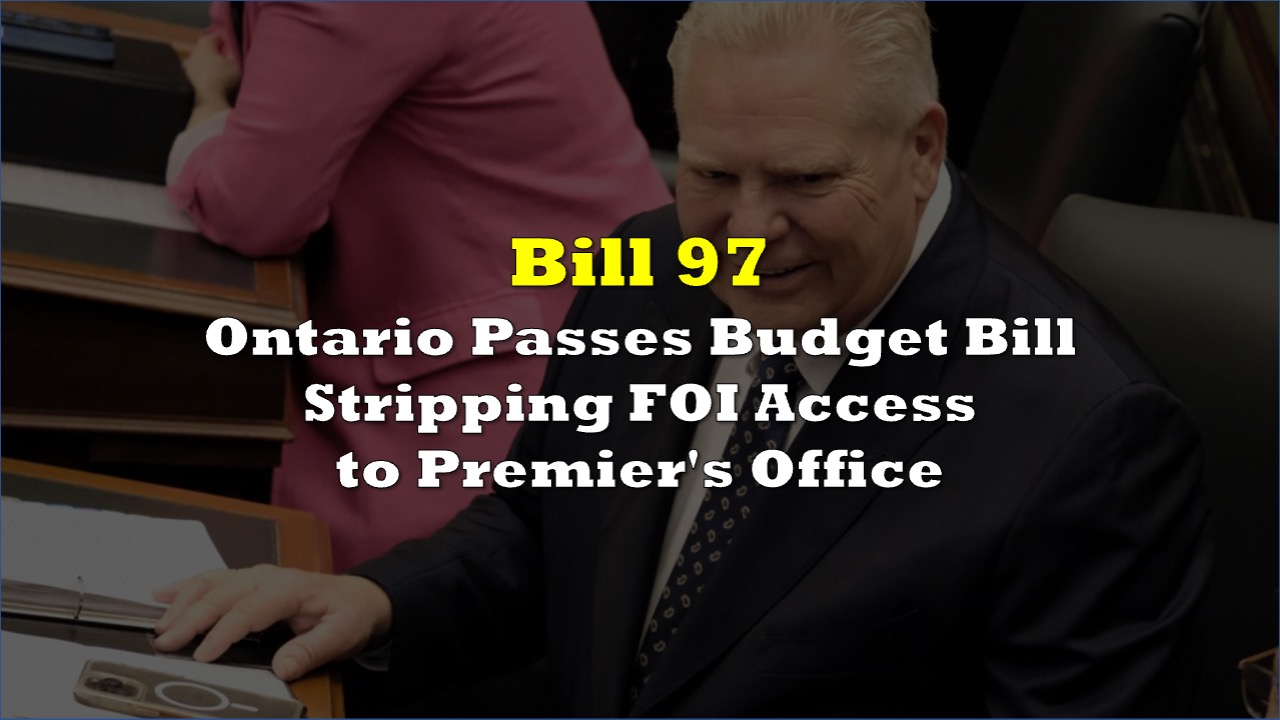

The Ford government passed its omnibus budget bill Thursday, burying sweeping changes to Ontario’s freedom of information laws that permanently shield the Premier’s Office, cabinet ministers, and their staff from public records requests — and retroactively wipe out dozens of existing FOI cases, including a court-ordered release of Premier Doug Ford’s personal cellphone records.
Progressive Conservative MPPs voted to pass Bill 97 at Queen’s Park after the government bypassed public hearings and fast-tracked the legislation through committee. Opposition NDP, Liberal, and Green MPPs all voted against it. Opposition members chanted “FOI” in the chamber as the vote was taken.
Bill 97 rewrites the Freedom of Information and Protection of Privacy Act to exclude the Premier’s Office, cabinet ministers, parliamentary assistants, and all staff in their offices from freedom of information requests. The exclusions take effect retroactively — wiping out dozens of pending FOI cases and nullifying three court decisions already in progress.
Among those, Bill 97 is expected to nullify a court ruling that directed Ford to release call logs from his personal cellphone covering November 2022 — the month his government announced its plan to remove land from the Greenbelt, triggering a major corruption scandal. Ford had refused to comply with the ruling, citing confidentiality with constituents, and has admitted that blocking the Global News FOI request for those records was part of the rationale for the changes.
 Sponsored · Selkirk Copper Mines
Ontario’s Information and Privacy Commissioner Patricia Kosseim warned last month: “If records about government business can be shielded from scrutiny simply because they sit in a minister’s office, on a staffer’s device, or within a political account, public accountability is eviscerated.”
The budget was tabled in late March and sat dormant at the committee stage for more than two weeks. The government announced the previous week it would bypass committee hearings, though as late as Thursday morning Clark was still telling reporters the matter was “to be determined” — before the bill passed hours later, after only a late-night debate session the previous evening.
Ontario Liberal MPP Tyler Watt, of Nepean, called it “a dark day for democracy in Ontario,” saying the government “rammed it through” by pulling the bill from committee, cutting debate, and shutting down scrutiny. Ontario Liberal MPP Ted Hsu, of Kingston & the Islands, accused the government of passing “sloppy, low effort legislation” while cutting access to information. Both are opposition members.
Stephen Crawford, the PC MPP for Oakville and minister responsible for the province’s freedom of information framework, pushed back at a brief press conference after the vote, arguing that the changes would have little practical effect. “Ninety-five per cent of the FOIs that are available right now — 95% — are through the public service,” he said, adding “there’s very little changing.”
The government has argued that the changes align Ontario with other jurisdictions, including the federal government. But Ontario’s IPC and legal experts disagree. Unlike the federal law, Ontario’s changes apply retroactively and shield records indefinitely, with no provision for eventual release.
Beyond the FOI changes, Bill 97 reduces the small-business tax rate, introduces an enhanced one-year HST rebate on new homes for all eligible buyers, merges 35 conservation authorities into 8, and caps resale ticket prices. Opposition parties argued the transparency provisions overshadowed all of it, pointing to the Greenbelt scandal, the accidental release of dozens of prisoners, and other controversies as accountability failures only exposed through FOI requests.
When Ford took office, Ontario carried $337 billion in debt; that figure has grown to $485 billion for 2026-2027. Annual debt servicing now costs $17.2 billion — more than the province spends on post-secondary education.
Information for this story was found via the sources and companies mentioned. The author has no securities or affiliations related to the organizations discussed. Not a recommendation to buy or sell. Always do additional research and consult a professional before purchasing a security. The author holds no licenses.