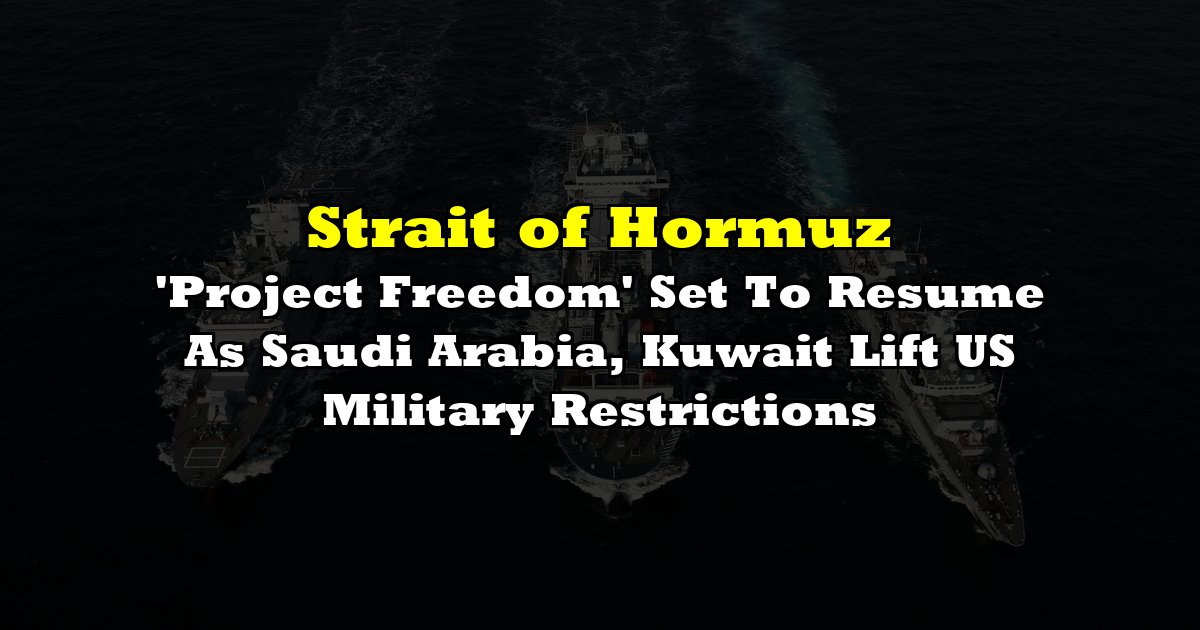

Saudi Arabia and Kuwait have lifted restrictions on the use of their military bases and airspace by U.S. forces, clearing a path for the resumption of Project Freedom, a U.S.-led operation to secure commercial shipping through the Strait of Hormuz amid tensions with Iran, as per recent reports by the Wall Street Journal.
The decision reverses a major hurdle that had stalled the initiative just 36 hours after its launch earlier this week. Initially, Saudi Arabia blocked U.S. access to Prince Sultan Airbase and overflight permissions, citing concerns over unclear terms of engagement and the risk of escalation with Iran. Kuwait followed suit with similar restrictions. The move came after high-level friction, including a tense call between President Donald Trump and Saudi Crown Prince Mohammed bin Salman, where the kingdom expressed fears of inadequate U.S. protection against Iranian retaliation.
Project Freedom, aimed at escorting commercial vessels through the vital waterway with naval and air support, initially succeeded in guiding two U.S.-flagged ships out of the Persian Gulf. However, the operation triggered a violent response from Iran, including cruise missile and drone attacks on U.S. warships and non-U.S. commercial vessels. Iran also struck the United Arab Emirates’ oil-export hub at Fujairah with 15 missiles, marking the first such attack since a fragile U.S.-Iran ceasefire took effect last month.
 Sponsored · Selkirk Copper Mines
A recent attack on a Chinese-owned oil tanker near the Strait of Hormuz, reported on Thursday, further underscores the ongoing risks. The vessel’s deck caught fire, though crew casualties remain unconfirmed. China, a major buyer of Iranian oil, had previously avoided direct hits in the conflict.
Gulf states remain wary of Iran’s potential to exploit perceived weaknesses. Defense Secretary Pete Hegseth described the U.S. presence as a “red, white and blue dome” over the strait, with destroyers, fighter jets, helicopters, and drones providing round-the-clock protection for transiting ships.
Tensions within the Gulf Cooperation Council add another layer of complexity. The UAE, frustrated by Saudi Arabia’s initial caution, has withdrawn from OPEC and is considering exiting the Arab League, signaling deep divisions over how to handle Iran’s aggression and U.S. strategy in the region.
Trump, who paused the operation after Saudi objections, framed the suspension as a diplomatic window to finalize a potential deal with Iran, partly crediting China and Pakistan for mediation efforts. Pentagon officials indicated a possible restart as early as this week, with commercial ships to be guided through a narrow, mine-cleared corridor under heavy U.S. protection.
The stakes are high as the Strait of Hormuz handles roughly 20% of global oil trade. Any sustained closure or escalation could ripple through energy markets, with Saudi Arabia already securing a pipeline deal to export 50% of its output via the Red Sea to mitigate risks in the Gulf.
Information for this story was found via the sources and companies mentioned. The author has no securities or affiliations related to the organizations discussed. Not a recommendation to buy or sell. Always do additional research and consult a professional before purchasing a security. The author holds no licenses.