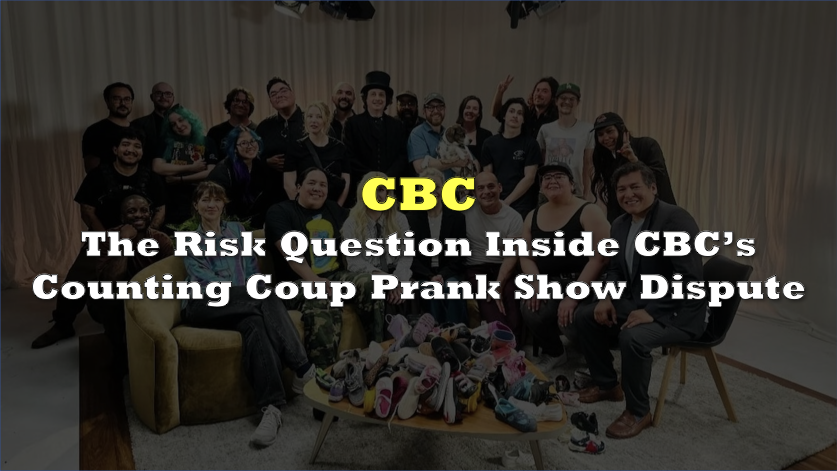

CBC is now facing a credibility problem created outside its newsroom, after a prank-style entertainment project used false pretences to bring critics of residential-school narratives into filmed interviews and triggered demands for accountability from Conservative MPs.
The project at the centre of the dispute is Counting Coup (Northland Tales), listed by the Indigenous Screen Office as a Saskatchewan-based television documentary series from NLT1 Productions Inc. ISO identifies the show as an unscripted half-hour comedy series led by an Indigenous activist trio using pranks as social action.
The public funding body said its 2024-2025 Story Fund production stream allocated $6.3 million across 28 Indigenous productions, including 14 television series. It does not identify how much went to Northland Tales.
 Sponsored · McLaren Resources Inc.
Conservative MP Aaron Gunn escalated the issue on May 14, saying he had written to CBC Ombudsman Maxime Bertrand to demand an explanation for the use of taxpayer money in what he described as efforts to mislead Canadians, including MPs. In the letter he shared online, Gunn alleged that a CBC-funded production used a fictitious company and a fake premise to approach critics of attacks on Sir John A. Macdonald.
The Canadian Press reported that Gunn’s office had received emails from the production team describing a series about Canadian historical memory, monument removals, and people pushing back against criticism of Macdonald. A staffer in Gunn’s office, cited by the report, said she was told the project was being prepared for CBC and that the broadcaster was under pressure to include balance on Macdonald. Gunn ultimately did not participate.
Juno News separately reported that Gunn’s office was approached through a production entity using a Macdonald-friendly pitch, and that correspondence discussed a $2,000 fee connected to helping secure interviews. Juno also reported that no deal or payment resulted from that exchange.
CBC has tried to contain the fallout by drawing an internal boundary. In a statement reported by CP, CBC public affairs head Chuck Thompson said Northland Tales is in early production for CBC Entertainment and APTN, and that the news divisions at both broadcasters were not involved and had no prior knowledge. He framed social-experiment and prank formats as established television devices, including for public broadcasters, and said the project’s creators were using comedy to address Indigenous history and reconciliation.
That defence may work operationally inside a broadcaster. It is less certain that it works externally. Audiences do not usually distinguish between CBC Entertainment, CBC News, third-party producers, commissioning executives, public funding bodies, and distribution partners when the same three letters sit on the finished product.
The format also sits in unusually combustible territory. Macdonald’s legacy, residential-school denialism, unmarked-grave disputes, reconciliation policy, and public funding for media are not low-stakes targets for hidden-camera experimentation. The issue is not whether the program’s point of view is valid. It is whether the method can survive scrutiny when participants say the consent process was built on false premises.
Information for this story was found via the sources and companies mentioned. The author has no securities or affiliations related to the organizations discussed. Not a recommendation to buy or sell. Always do additional research and consult a professional before purchasing a security. The author holds no licenses.