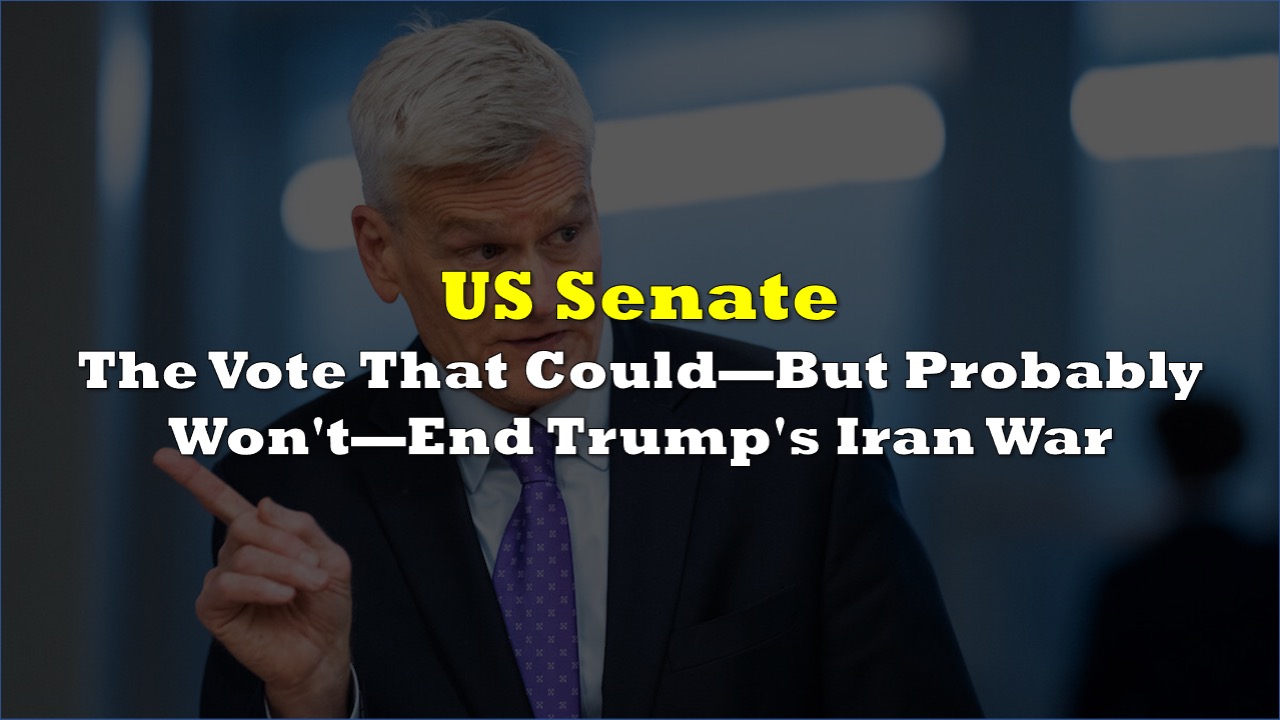

The Senate voted 50-47 Tuesday to advance a resolution that would force President Donald Trump to withdraw from the Iran war — the first time in eight attempts that a war powers challenge has gotten this far.
The decisive vote came from Sen. Bill Cassidy (R-La.), who lost his primary to a Trump-backed challenger just days earlier and voted to advance the measure for the first time after repeatedly opposing it. What happens next is a gauntlet that few expect it to survive.
The Next 72 Hours
Senate rules require a final floor vote within three calendar days.
 Sponsored · Selkirk Copper Mines
Three Republican senators — John Cornyn (Texas), Thom Tillis (N.C.), and Tommy Tuberville (Ala.) — skipped Tuesday’s vote. Their absence is the only reason the resolution advanced. If all three return and vote against it as expected, the resolution dies in a 50-50 tie, with Vice President JD Vance casting the deciding vote against it.
On Tuesday, Trump endorsed Texas Attorney General Ken Paxton over Cornyn in the state’s GOP Senate primary runoff. This has left Cornyn’s political standing suddenly uncertain. But whether that changes his calculus on the war powers vote, like it did with Cassidy, remains to be seen.
The Venezuela Playbook
Even if the resolution clears the Senate, history suggests the White House has a proven path to killing it without a veto.
Earlier this year, the Senate advanced a similar war powers resolution on Venezuela — then watched it collapse days later after two Republicans, Sens. Todd Young (Ind.) and Josh Hawley (Mo.), flipped back under pressure from Trump. The turning point: Secretary of State Marco Rubio agreed to a public congressional hearing on the administration’s Venezuela strategy, giving wavering senators just enough political cover to stand down.
 Sponsored · Silver47 Exploration Inc.
The same offer — a briefing, a hearing, a statement of intent — could neutralize the Iran resolution before it ever reaches a final vote.
If It Somehow Passes
Should the resolution clear the Senate, it then needs to pass the Republican-controlled House, which has already rejected three similar measures this year by narrow margins. And if it clears both chambers, Trump would almost certainly veto it — forcing a two-thirds supermajority override in both chambers, a threshold neither appears close to reaching.
No war powers resolution has ever survived a presidential veto.
Why the Vote Still Matters
The resolution almost certainly won’t become law. But Tuesday’s 50-47 margin is the first concrete evidence that Republican support for the war in Congress has a ceiling — and that ceiling is lower than the White House has been telling itself.
The ceasefire Pakistan brokered on April 8 remains deeply unstable. Speaking in the Oval Office on May 11, Trump said the truce was on “massive life support” after calling Iran’s latest counterproposal “a piece of garbage.”
Gas prices have climbed from $2.98 per gallon when the war began in late February to $4.53 as of May 19, according to AAA. The November midterms are six months away.
“Vote by vote, Democrats are breaking through Republicans’ wall of silence on Trump’s illegal war,” Senate Minority Leader Chuck Schumer said after the vote. “Today proved our pressure is working: Republicans are starting to crack, and momentum is building to check him.”
For now, three absent senators decide what that momentum is worth.
Information for this story was found via the sources and companies mentioned. The author has no securities or affiliations related to the organizations discussed. Not a recommendation to buy or sell. Always do additional research and consult a professional before purchasing a security. The author holds no licenses.