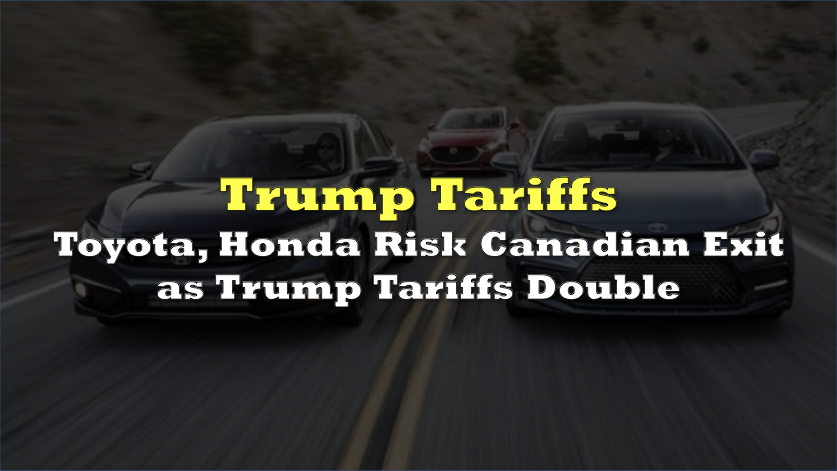

Canada’s exposure to President Donald Trump’s threatened 50% automotive tariff is concentrated heavily in two companies headquartered nowhere near Detroit.
Toyota Motor and Honda Motor accounted for 76.5% of Canada’s 1.23 million vehicles produced in 2025, according to Global Automakers of Canada cited in a Reuters report. That leaves the two Japanese automakers unusually exposed if Trump follows through on his plan to double the top-line tariff on Canadian vehicles, trucks, and automotive parts to 50% on January 1, 2027.
The issue is particularly acute because Canadian production is not peripheral to either company’s US business. Barclays analysts estimated that vehicles assembled in Canada represented almost one-quarter of Honda’s US sales last year and 17% of Toyota’s, Reuters reported.
 Sponsored · Cambria Gold Mines
Toyota alone assembled 537,518 vehicles in Canada in 2025, making it the country’s largest automotive manufacturer. Its Ontario operations produce the RAV4 and Lexus RX and NX models across facilities in Cambridge and Woodstock. Toyota employs more than 8,500 people at those operations.
Honda operates its Canadian manufacturing campus in Alliston, Ontario, where it builds the Civic and CR-V. Its facilities have annual capacity of roughly 390,000 vehicles and employ more than 4,300 workers, according to Honda.
Julie Boote, an automotive analyst at Pelham Smithers Associates, told Reuters that both companies would likely have to close some Canadian assembly lines under a 50% tariff.
Redirecting Canadian production is not necessarily an immediate substitute. Analysts cited by Reuters said vehicles built for the US can have market-specific specifications, while plants elsewhere may lack sufficient spare capacity to replace Canadian shipments.
The tariff would also widen an emerging discrepancy inside Trump’s automotive trade regime. Canadian vehicles currently face a top-line 25% tariff, while agreements with Japan, South Korea, and the EU have left many competing imports subject to a 15% rate.
A US-Canada agreement that collapsed in August would have reduced the Canadian rate to 15%. Instead, Trump threatened to double it.
Toyota is already increasing its US manufacturing capacity. The company committed in November to invest up to $10 billion more in US operations over five years. In July, it announced a $3.6 billion expansion of its San Antonio, Texas, complex that will add a second assembly line, approximately 150,000 units of annual capacity, and more than 2,000 jobs by 2030.
Honda, meanwhile, has already tied future North American investment decisions to trade policy. Executive Vice President Noriya Kaihara said in August that Honda may not proceed with an eighth North American assembly plant unless the CUSMA is extended, Reuters reported.
The January tariff remains a threat rather than a completed policy action, leaving several months for Washington and Ottawa to resume negotiations. Industry sources told Reuters they viewed the delayed effective date as potential room for another agreement.