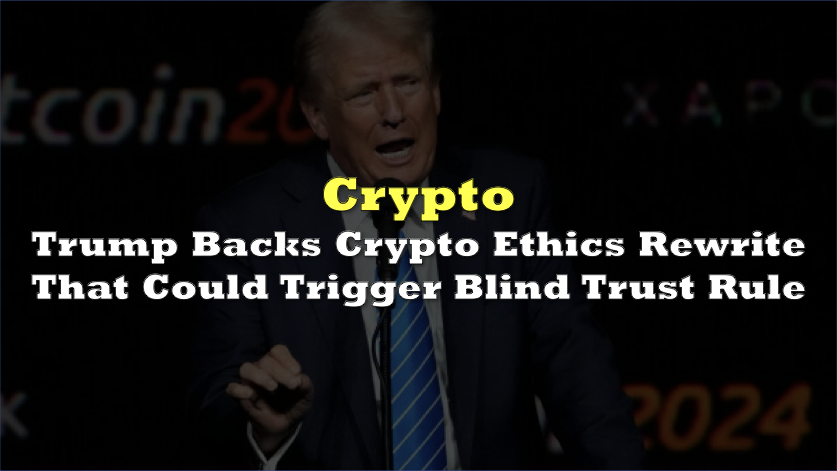

President Donald Trump’s late concession on crypto ethics would do more than limit future token launches. The final Senate draft of the Digital Asset Market Clarity Act creates a $15,000 threshold for certain crypto-business equity interests and adds a state-level enforcement backstop, potentially bringing parts of Trump’s own digital-asset holdings inside rules he agreed to as Republicans search for the votes needed to advance the bill Tuesday.
The draft released late Sunday by Sens. Cynthia Lummis, John Boozman, and Tim Scott says covered officials may not issue or sponsor digital assets for compensation or maintain a “significant financial interest” while in office. The term is defined as an equity interest worth at least $15,000 in a business that received a plurality of its revenue from issuing or sponsoring digital assets during any of the previous three calendar years.
Officials who meet that test would have to divest the interest or place it in a qualified blind trust. A knowing and willful violation involving a significant interest could carry a civil penalty equal to 20% of the value of that interest or $500,000, whichever is greater.
 Sponsored · Cambria Gold Mines
The language makes the scope broader than a simple ban on politicians launching meme coins, but it does not establish that every Trump crypto interest is automatically covered. The AP News reported that the proposal could potentially reach World Liberty Financial, the Trump family-linked crypto business. Whether a specific Trump holding satisfies the bill’s revenue and ownership tests would depend on the legal entity and financial interest involved.
Trump reported more than $1.4 billion in income from family crypto ventures in 2025, according to his annual financial disclosure. Nearly $800 million came from World Liberty Financial, including more than $520 million from token sales and more than $250 million from sales of interests in the business, while another $635 million came from Trump meme coin sales.
The other major concession is enforcement. The draft requires the US attorney general to pursue civil actions for knowing and willful ethics violations. It also says a state attorney general alleging harm to the state or its residents may sue the US attorney general for injunctive relief over an alleged violation. State attorneys general would separately be able to sue digital-asset intermediaries over prohibited listings.
AP News reported, citing a senior Republican aide, that Trump agreed to “about 80%” of the ethics proposal developed by Republican Sen. Thom Tillis and Democratic Sen. Ruben Gallego. The senators’ official release used broader wording, saying the final text reflects “substantially all” of the Tillis-Gallego proposal.
Lummis said Trump “voluntarily agreed to unprecedented ethics restrictions.”
The ethics deal does not guarantee passage. Tuesday’s vote is a cloture vote on the motion to proceed, not final approval. The measure needs 60 votes to advance. Republicans hold 53 Senate seats, meaning at least seven Democrats or independents would be needed if every Republican supports moving forward.