
President Donald Trump did not receive a damages check from his IRS lawsuit, but the settlement gives him something potentially more valuable: the government he leads agreed to stand down from covered past tax fights involving him, his sons, and the Trump Organization.
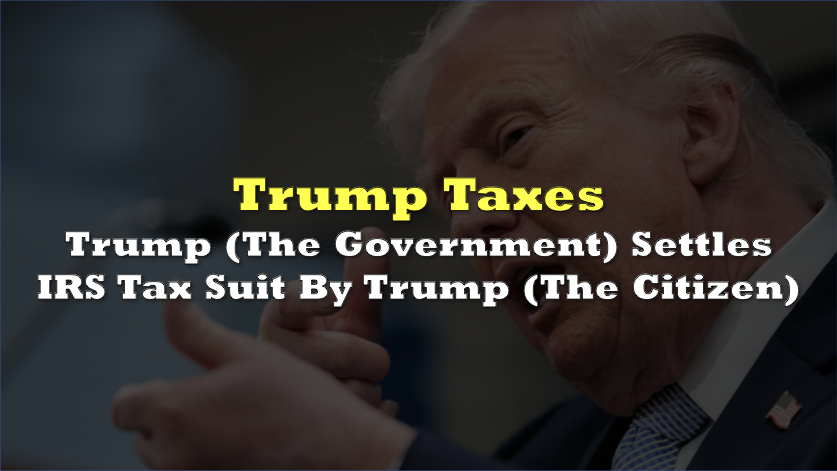
That is the central tension of the deal. Trump, as a private taxpayer and business owner, sued the IRS and Treasury over leaked tax records. Trump, as president, now sits atop the executive branch whose Justice Department signed off on a settlement that limits what the federal government may pursue against Trump-related taxpayers.
The Justice Department’s public settlement announcement said Trump, Donald Trump Jr., Eric Trump, and the Trump Organization will receive a formal apology and no monetary damages. In exchange, they agreed to dismiss their lawsuit with prejudice and withdraw two administrative claims tied to Mar-a-Lago and Russia-related allegations.
 Sponsored · Cambria Gold Mines
But the money is not the main benefit for Trump personally. The more material issue is tax finality.
A separate document signed by Acting Attorney General Todd Blanche functions as a stop sign for covered past tax proceedings, including IRS review paths that would normally remain open. AP reported that the document covers Trump, his sons, the Trump Organization, family members, affiliates, and others, while DOJ told AP it applies to existing audits and not future examinations.
In plain English, the person who heads the federal government has reached a settlement under which the federal government gives up covered avenues to demand tax payments from that same person’s already-filed Trump-related returns.
Trump the citizen no longer has to fight some tax claims from Trump the government.
Weaponization fund
The settlement also creates a separate financial machine around Trump’s broader “weaponization” argument.
 Sponsored · Silver47 Exploration Inc.
DOJ said the Anti-Weaponization Fund will receive $1.776 billion from the federal Judgment Fund, a standing federal source used to pay settlements and judgments. DOJ said the fund can award formal apologies and monetary relief to claimants, with unused money returning to the government once the fund shuts down.
The fund is not limited to Trump. DOJ said it is meant to hear claims from others who say they suffered government “weaponization and lawfare.” Submission is voluntary, and DOJ said there are no partisan requirements to file. The fund must stop processing claims no later than December 1, 2028.
That structure produces a split benefit. Trump and the named plaintiffs get apology and closure, but not damages. Other claimants may seek cash from a $1.776 billion pool financed through the Judgment Fund.
The governance model keeps control close to the executive branch. DOJ said the fund will consist of five members appointed by the attorney general, with one chosen in consultation with congressional leadership.
The president can remove any member, although replacements must be chosen through the same selection path as the removed member.
DOJ said the fund can be audited at the attorney general’s direction and must protect private information and guard against fraud. It also said quarterly reports will go to the attorney general identifying who received relief and what form of relief was awarded.
The rulebook problem
The legal question is not whether Trump settled a lawsuit. Private parties settle with the government all the time. The question is whether a sitting president’s own administration can resolve litigation by narrowing the government’s tax-enforcement posture toward the president’s own past filings and related business network.
AP reported that former IRS Commissioner Daniel Werfel said he was unaware of cases where the IRS agreed in advance to permanently give up examination of previously filed returns for a specific person or business. Werfel’s view is that the deal separates Trump-linked taxpayers from the normal IRS rulebook that the other Americans follow.
Reuters framed the Blanche document as expanding the settlement reached a day earlier, when Trump agreed to end his $10 billion lawsuit over leaked tax returns. Now, the document removes covered Trump-linked past-tax matters from IRS examination channels.
For Trump, the result is asymmetric but significant. He gets no damages from the settlement itself, according to DOJ. But he gets a formal apology, the end of litigation tied to leaked tax information, a new public claims process aligned with his political argument about government targeting, and a tax-enforcement shield over covered past matters.
For the government, the tradeoff is harder to price. DOJ says the fund creates a lawful channel for alleged victims of government abuse. Critics cited by AP argue the arrangement is opaque, vulnerable to political abuse, and potentially unconstitutional.
Trump did not monetize the lawsuit directly, but he converted it into legal risk reduction. In a normal tax dispute, that would be a private settlement outcome. In this case, the counterparty is the government he controls.
That’s the whole governance glitch, and it is not exactly a small software bug.
Information for this briefing was found via the sources and the companies mentioned. The author has no securities or affiliations related to this organization. Not a recommendation to buy or sell. Always do additional research and consult a professional before purchasing a security. The author holds no licenses.