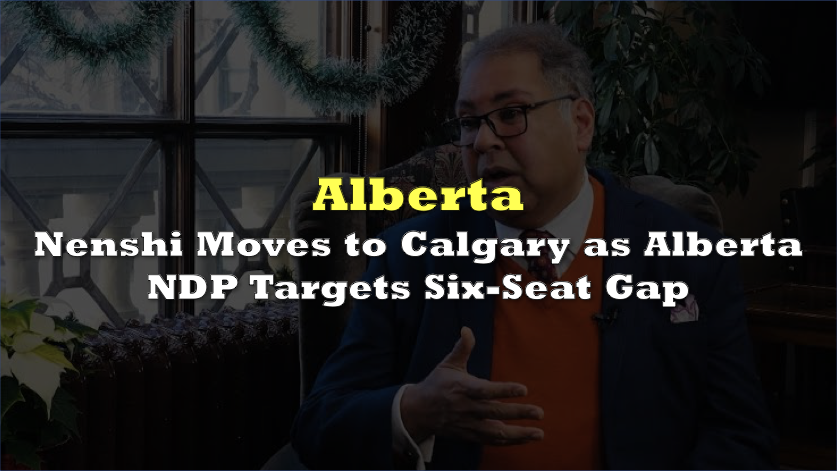

Alberta NDP leader Naheed Nenshi’s decision to contest a Calgary seat in Alberta’s next provincial election is less about where he can win personally and more about where his party believes it must win collectively.
Nenshi announced Thursday that he will not seek another term in Edmonton-Strathcona, opting instead to run in Calgary after the province completes its electoral boundary review. While the riding itself remains unknown, the geographic shift offers an early look at how the opposition intends to fight the 2027 election.
Recent Alberta elections have exposed a growing political divide. Edmonton has emerged as the Alberta NDP’s strongest base, while much of rural Alberta continues to favour Premier Danielle Smith’s United Conservative Party.
 Sponsored · Cambria Gold Mines
That leaves Calgary as the province’s most competitive political arena, where relatively small swings in voter support can determine which party secures a legislative majority.
Alberta’s legislature has 87 seats, meaning 44 are needed for a majority. In the 2023 election, the UCP won 49 seats to the NDP’s 38, leaving the opposition six seats short of government. While the NDP swept all 20 Edmonton constituencies, Calgary produced a far more competitive map, with the NDP winning 14 of the city’s 26 seats and the UCP taking the remaining 12.
For the Alberta NDP, adding seats in Edmonton produces diminishing returns because it already holds every Edmonton riding. Expanding in Calgary offers a clearer path to government. Based on the 2023 election map, flipping six additional seats while holding its existing caucus would have been enough to reach the 44-seat majority threshold.
Nenshi acknowledged that strategy when explaining his decision, saying the Alberta NDP needs to win more Calgary constituencies if it hopes to replace the current government.
The decision also reflects the mathematics of Alberta’s legislature. The UCP’s path to another majority depends largely on retaining enough Calgary seats while maintaining overwhelming support outside the province’s two major cities.
 Sponsored · Selkirk Copper Mines
The Alberta NDP faces the opposite challenge. Its support in Edmonton provides a strong foundation, but forming government requires converting Calgary’s competitive districts into victories.
The margins in several Calgary races illustrate why party leaders continue to focus on the city. In 2023, the UCP held Calgary-North by just 129 votes, while the NDP won Calgary-Klein by 867 votes.
Nenshi declined to identify his target riding because Alberta’s electoral boundaries are still under review.
The province launched a new boundary process earlier this year, meaning constituency lines could change before the next election. Waiting until that work is complete allows the Alberta NDP to evaluate the final electoral map before selecting a nominee.
The uncertainty also means the announcement should be viewed as a regional strategy rather than a commitment to any particular constituency.
Calgary was already central to Alberta’s electoral math. Nenshi’s move shows the NDP is now organizing its leadership strategy around that reality.