
President Donald Trump has put a roughly $1.2 trillion cash payment at the center of Republicans’ midterm pitch, promising $5,000 to every adult American citizen if the GOP keeps both chambers of Congress even as he dismisses the affordability problem the payment would ostensibly help voters address.
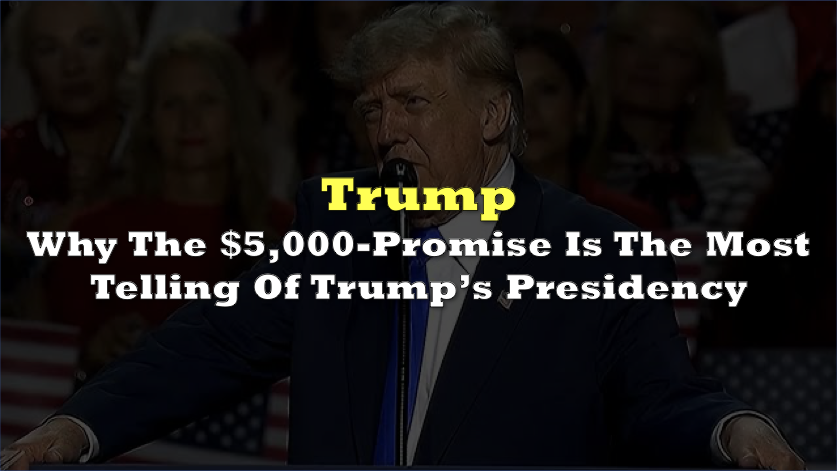
The president announced the “Trump Dividend” at the Republican midterm convention in Dallas on Wednesday. The following day, the White House formalized the pitch, explicitly stating that the payment “depends on President Trump and Republicans” and that Democratic control would mean no dividend.
The condition is unusually direct. Republicans have to win the House and Senate. Then, Congress would still have to authorize the money.
 Sponsored · Silver47 Exploration Inc.
And in the same speech, Trump questioned whether the underlying cost-of-living problem was real.
“They use the word affordability. Right? It’s fake,” Trump said before arguing that his administration was bringing prices down.
Federal data tell a different story. The US CPI rose 0.4% in August and 3.4% from a year earlier, according to the Bureau of Labor Statistics. Grocery prices were 2.2% higher year over year, while gasoline was up 27.4%. Average hourly earnings rose 3.1% over the same period, slightly behind headline inflation.
Inflation slowing from earlier peaks is not the same thing as prices falling. August’s CPI reading showed the overall price level continuing to rise.
 Sponsored · Cambria Gold Mines
But beyond that, there are many glaring issues to cover in this seemingly populist move, arguably the most telling
The $1.2 trillion problem
Give it to Trump to talk big and (maybe) back it up later. For this, the bigger contradiction is fiscal. Census data put the number of adult US citizens at roughly 245 million. At $5,000 each, the payment would cost approximately $1.2 trillion before administrative expenses.
The federal government does not currently have anything resembling a $1.2 trillion surplus waiting to be distributed. Through August, the fiscal 2026 budget deficit had already reached $1.97 trillion, according to Treasury figures reported by Reuters. The national debt has surpassed $40 trillion.
Trump has suggested tariffs make the dividend possible. That arithmetic does not currently work either. Net customs revenue through August stood at about $167.3 billion after tariff refunds, according to Treasury data reported by Reuters. A $1.2 trillion dividend would therefore cost more than seven times the net customs revenue collected during almost the entire fiscal year.
FactCheck.org calculated that at the current revenue pace it would take more than six years of tariffs to finance one round of $5,000 checks.
Without new taxes or spending cuts, the remaining amount would have to be borrowed.
Economists interviewed by FactCheck.org said a payment on that scale would likely increase the deficit, add consumer demand, worsen inflation, and put upward pressure on interest rates.
The Republican handout paradox
That creates an awkward fit with the Republican Party’s own platform, which explicitly promises to “rein in wasteful federal spending.”
The contradiction is broader than the dividend. The Congressional Budget Office estimates the Republican-backed 2025 reconciliation law will increase cumulative deficits by $4.7 trillion from 2026 through 2035, including additional interest costs.
The proposal also complicates Republican attacks on Democratic “handouts,” while doing the very thing akin to the hotly contested brand of socialism.
However, this is not the first of its kind. Trump signed the CARES Act in 2020, which provided payments of up to $1,200 per eligible adult. That December, he went further and demanded $2,000 checks, arguing that Americans should receive more direct relief. Democrats subsequently campaigned on $2,000 payments during Georgia’s January 2021 Senate runoffs.
The bribery concern
Politically, critics have called Trump’s offer a bribe. Legally, the case is much weaker.
Federal law prohibits offering money to a person in exchange for voting, withholding a vote, or voting for or against a candidate.
Trump’s proposal is different because the government payment is not conditioned on proving how an individual recipient voted. A Democrat, nonvoter, or Republican would theoretically receive the same benefit if the policy were enacted.
And it is without question that it is impossible to limit the checks to those who only voted Republican. Aside from voter secrecy issues, it is also illegal to conduct a government program aimed only at one party.
The Supreme Court addressed a related distinction in Brown v. Hartlage in 1982, holding that a candidate’s promise to provide a general financial benefit to citizens or taxpayers could not simply be treated like a private agreement to purchase individual votes.
Legal experts cited by Reuters likewise said Trump’s current proposal would probably be treated as a campaign policy promise rather than criminal vote-buying. Congress would, however, have to authorize the spending. Trump cannot simply order roughly $1.2 trillion in checks on his own.
There is therefore no factual basis at this stage to describe the proposal itself as an established criminal bribe. However, it follows the continued pattern of Trump’s campaign promises that have the tendency not to materialize once he’s in office.
For instance, the more documented pattern is Trump’s repeated use of cash-payment proposals as political promises. Early in his second term, Trump entertained a $5,000 “DOGE dividend” based on projected federal spending reductions. It never happened.
In November 2025, he proposed a tariff-funded dividend of at least $2,000 for many Americans, as reported by The New York Times. That proposal also never reached recipients.
Trump did deliver a $1,776 “warrior dividend” to military personnel in 2025, although those payments relied on previously authorized funding rather than a new trillion-dollar appropriation.
The White House is showing more institutional commitment to the $5,000 proposal than it did to some of the earlier ideas. It has issued an official promotion of the dividend, and National Economic Council Director Kevin Hassett has said Congress could potentially enact it through budget reconciliation.
However, it is still dependent on the Republican’s victory in the midterms.
The midterm conundrum
Which begs the question: can the Republicans retain the control of both houses?
Republicans currently hold a narrow House majority and a 53-47 advantage in the Senate, counting the two independents who caucus with Democrats on the Democratic side. Democrats need a net gain of four Senate seats to take outright control as Vice President JD Vance would break a 50-50 tie for Republicans.
The House currently appears more favorable to Democrats. Decision Desk HQ gives Democrats a 67% chance of winning the chamber, against 33% for Republicans. Democrats also hold roughly a six-point advantage in the national generic congressional ballot, although Republican redistricting has created a structural cushion in several states.
Cook Political Report currently rates 21 House races as toss-ups, with another nine leaning Democratic and seven leaning Republican. At the other end, 185 seats are classified as Solid Democratic and 180 as Solid Republican, meaning most of the country is effectively off the battlefield.
Among the races drawing particular attention are Republican-held districts in Arizona, California, New Jersey, New York, and Pennsylvania. Democrats need only a small net gain, although Republican-friendly redistricting in states including Texas has complicated the map.
The Senate is far closer. Decision Desk HQ gives Republicans a 51% probability of retaining control and Democrats 49%, effectively a coin flip. Its September 10 forecast has Maine, Ohio, Texas, Alaska, and Iowa as toss-ups, while Michigan currently leans Democratic.
Cook’s map is slightly different. It rates six races as toss-ups: Alaska, Iowa, Maine, Michigan, Ohio, and Texas. Georgia, North Carolina, and New Hampshire lean Democratic.
That leaves Republicans fighting in territory that would ordinarily be much safer. Texas Democrat James Talarico is running competitively against Republican Ken Paxton. Former Democratic Senator Sherrod Brown is attempting a comeback in Ohio. Republicans are also defending Alaska, Iowa, Maine, and the open North Carolina seat while trying to flip Democratic-held Michigan and Georgia.
At the same time, large portions of the Senate map remain functionally locked down. Cook rates races including Alabama, Idaho, Wyoming, Arkansas, and Tennessee as Solid Republican, while Colorado, Delaware, Massachusetts, New Jersey, and Virginia are Solid Democratic.
Trump’s payment therefore requires more than a campaign promise becoming policy. Republicans first have to survive an election in which Democrats are currently favored for the House and the Senate is nearly even. A Republican sweep would then have to produce congressional support for roughly $1.2 trillion of additional spending from a party that still publicly campaigns on fiscal restraint.
And the economic premise remains the central contradiction: Trump is proposing one of the largest direct cash distributions in US history while simultaneously arguing that the affordability crisis prompting demand for relief is largely manufactured.
It is not new but if anyone is looking for the most telling evidence, the $5,000-dividend is the surest way to say all Trump wants to do is win.