
A Western mining company now controls 92.5% of a Greenland rare earth deposit that outclasses anything China or the US currently operates. Washington helped engineer the deal. Now it may fund it too.
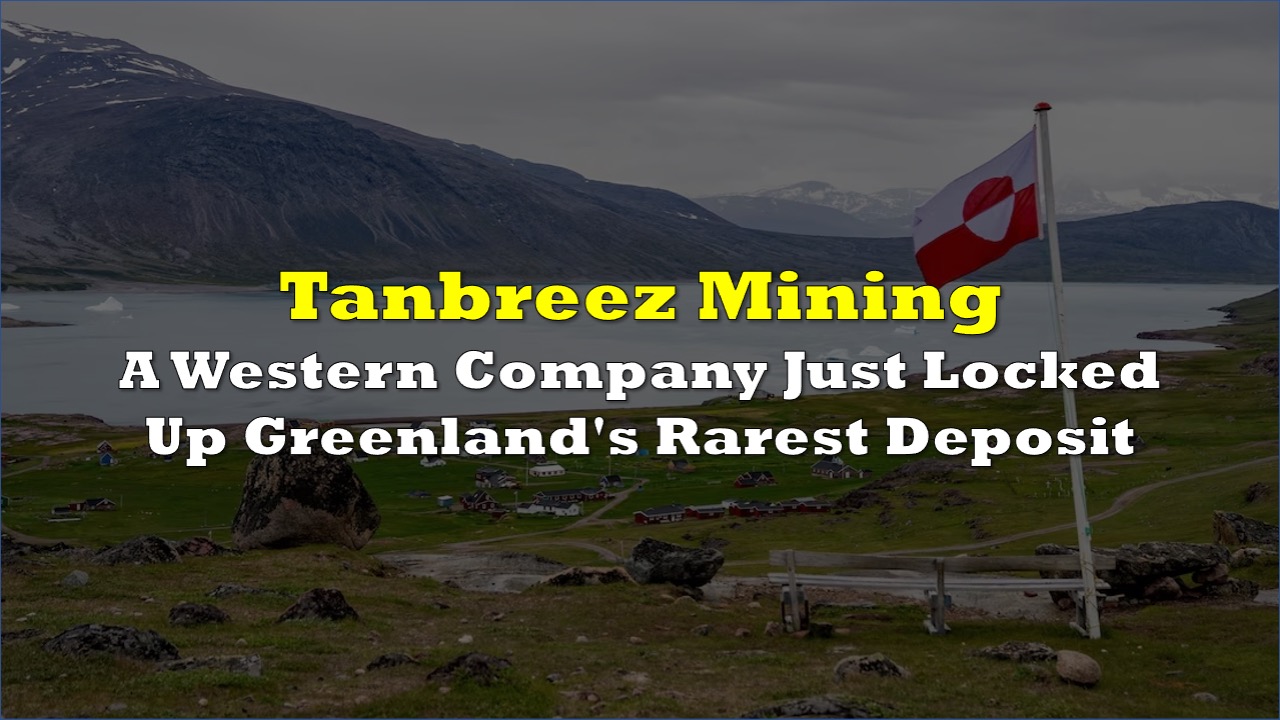
Critical Metals Corp (Nasdaq: CRML) holds a 92.5% stake in Tanbreez Mining Greenland A/S after closing the final tranche of its acquisition on April 30— securing majority control of the deposit itself. The Greenland government approval announced May 5, which drew the most attention this week, covers a separate but related deal, a 70% stake in 60° North Greenland ApS, a local construction and logistics company that holds land near Tanbreez and will support the mine’s development.
The Tanbreez deposit sits within approximately 4.7 billion tonnes of kakortokite host rock in southern Greenland and carries a certified mineral resource of 45 million tonnes at 0.4% total rare earth oxides — approximately 27% of which are heavy rare earth elements.
 Sponsored · Selkirk Copper Mines
Heavy rare earths — dysprosium, terbium, yttrium, and others — go into EV motors, wind turbine generators, and advanced military systems, including radar, missile guidance, and hypersonic weapons. China controls more than 90% of global refining capacity. Both Mountain Pass in California and Bayan Obo in Inner Mongolia — the primary US and Chinese rare earth operations — are dominated by light rare earth elements, with heavy rare earth content in the low single-digit percentages. Tanbreez’s 27% proportion represents a fundamentally different class of deposit.
The deposit carries exceptionally low uranium and thorium content — 10 to 20 parts per million uranium and under 100 parts per million thorium — removing one of the most significant processing complications that has slowed other rare earth projects. Year-round, ice-free deep water fjord access allows direct shipping to North America or Europe without transiting any maritime choke point.
Reuters reported in January 2025 that US officials visited the Tanbreez site twice the previous year, repeatedly warning its then-owner not to sell to a Chinese-linked buyer. Gregory Barnes ultimately accepted $5 million in cash and $211 million in Critical Metals stock — significantly less than Chinese firms had offered. “There was a lot of pressure not to sell to China,” Critical Metals CEO Tony Sage told Reuters.
Flashback: US weighs Critical Metals stake for Greenland; shares soar 80%
 Sponsored · PTX Metals Inc.
Cantor Fitzgerald, the brokerage firm formerly led by Howard Lutnick before his confirmation as US Commerce Secretary in February, is among Critical Metals’ largest investors. Lutnick transferred control of Cantor to his sons upon joining the cabinet. Sage told Reuters he has never met or spoken with Lutnick, though he acknowledged the investment was a positive for the company.
The US Export-Import Bank — a federal agency whose board is appointed by the executive branch — is considering a $120 million loan to Critical Metals to advance Tanbreez to initial production.
Democratic Sens. Elizabeth Warren, Chris Van Hollen, and Ron Wyden have written to Lutnick flagging conflict of interest concerns over Cantor’s involvement in separate critical minerals deals, arguing “federal investments in critical industries must be made free from conflicts of interest and on the merits.” The Commerce Department did not respond to a request for comment.
Critical Metals is incorporated in the British Virgin Islands, listed on the Nasdaq, and led by Tony Sage, an Australian mining executive. Its market capitalization has risen approximately 617% since listing, reaching $1.63 billion. The company has held supply talks with Lockheed Martin and has upcoming discussions with RTX and Boeing.
A preliminary economic assessment values Tanbreez at a net present value of $2.4 to $3.0 billion with an internal rate of return of 162% to 180% pre-tax, based on an initial planned output of 85,000 tonnes per year of rare earth oxides. The company has not announced a production timeline.
Not everyone is bullish. David Merriman, research director at minerals consultancy Project Blue, told Reuters the chance of Tanbreez reaching commercial production is low “given its complex mineralogy,” adding, “While the size of the Tanbreez is significant, the grade and the mineralogy are nothing to be shouted about.”
Information for this story was found via the sources and companies mentioned. The author has no securities or affiliations related to the organizations discussed. Not a recommendation to buy or sell. Always do additional research and consult a professional before purchasing a security. The author holds no licenses.