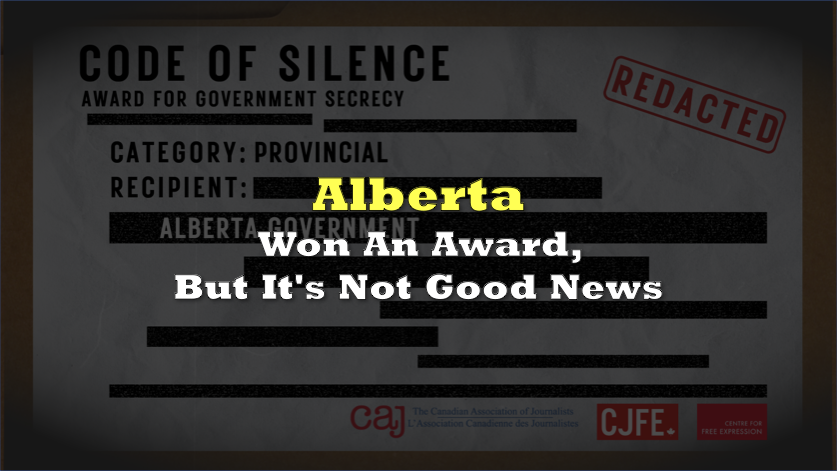

Alberta’s government has received a national “secrecy award” after the province’s information and privacy commissioner found that public bodies had used practices that did not comply with freedom-of-information law.
The Canadian Association of Journalists, the Centre for Free Expression at Toronto Metropolitan University, and Canadian Journalists for Free Expression named Alberta the provincial winner of the 2025 Code of Silence Award for Outstanding Achievement in Government Secrecy.
“Alberta Premier Danielle Smith’s government has been selected as the provincial winner of the 2025 Code of Silence Award for Outstanding Achievement in Government Secrecy after Alberta’s information and privacy commissioner found the province broke its own freedom of information laws,” said the group’s announcement.
 Sponsored · Cambria Gold Mines
The organizations announced the award on June 25, 2026. The groups present the awards annually to governments and publicly funded organizations they believe have restricted access to information.
The Alberta award followed a 21-month investigation by Information and Privacy Commissioner Diane McLeod into how 27 provincial public bodies handled access-to-information requests.
In a report released in May 2025, McLeod found that the government had adopted practices and interpretations that did not comply with Alberta’s former Freedom of Information and Protection of Privacy Act.
The investigation found that applicants had been required to limit requests to one subject, divide requests involving multiple subjects, restrict searches to specified periods, and structure applications so officials could complete them within 30 days.
 Sponsored · Silver47 Exploration Inc.
McLeod also found that the public bodies had failed to meet their legal duty to assist applicants. She recommended that the government stop the practices and establish policies ensuring that agencies comply with their access obligations.
Alberta replaced the former law on June 11, 2025, when the Access to Information Act and Protection of Privacy Act came into force. Both laws replaced separate portions of the previous FOIP legislation.
Journalism and free-expression groups have criticized parts of the new access law, including a provision covering certain communications between cabinet ministers and political staff.
Phil Tunley, a director of Canadian Journalists for Free Expression, described the provision as “a blanket smother-up,” arguing that ministerial communications can be important for understanding how government decisions are made.
Critics have also pointed to the new response period. Public bodies generally have 30 business days to answer access requests, compared with 30 calendar days under the former system.
The longer period can add roughly two weeks to the normal processing time, depending on weekends and public holidays.
The information and privacy commissioner has separately said the regulations supporting Alberta’s new laws contain both strengths and weaknesses. McLeod praised some of the new privacy requirements but raised concerns that parts of the access framework could shift more responsibility onto applicants seeking records.
Alberta previously received the provincial Code of Silence Award in 2019 after the Canadian Energy Centre was exempted from provincial freedom-of-information rules.