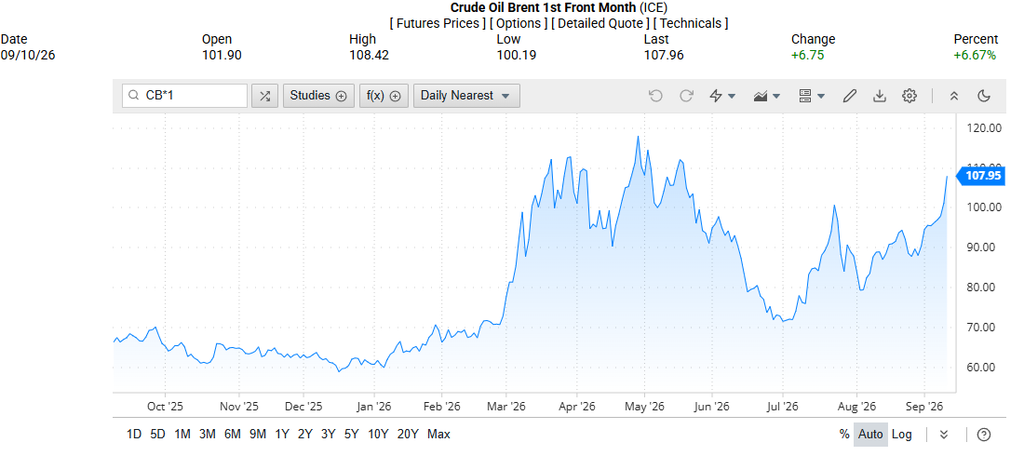

Fears over the security of global supply are pushing crude sharply higher, as the war with Iran and mounting attacks across the region keep traders unsettled. Brent crude was trading at $107.90 a barrel and West Texas Intermediate stood at $102.60, with both benchmarks driven up by tanker strikes and growing shipping risks throughout the Middle East that threaten to remove barrels from the market.
The move has spread beyond crude into the broader energy complex. Gasoline futures rose close to 6% and heating oil advanced more than 6%, mirroring the supply anxiety fueling the crude rally.
Banks have been recalibrating their outlooks as the pressure builds. With the crisis around the Strait of Hormuz dragging on, HSBC raised its 2026 Brent forecast to $90, while Morgan Stanley observed that traders are pricing risk more precisely the longer the conflicts wear on.
 Sponsored · Selkirk Copper Mines
US inventory figures offered little relief. In the week ended Sept. 4, crude stockpiles excluding the Strategic Petroleum Reserve slipped by 400,000 barrels, the Energy Information Administration reported. At 424.1 million barrels, holdings match the five-year average for the season. The release arrived a day late because the agency had closed for the US Labor Day holiday on Monday, Sept. 7.
Refiners ran near capacity during the period, operating at 97.8% and processing 17.6 million barrels per day. Distillate inventories climbed by 2.1 million barrels but remain about 13% under their five-year average, and gasoline stocks rose by 1.3 million barrels.
For now, with shipping lanes exposed and no clear resolution to the fighting in sight, the market looks set to keep crude anchored above the $100 mark.