
Canada’s debt burden is turning into a postcode problem, as new Fraser Institute estimates show households in different provinces facing sharply different combined fiscal exposure even before Ottawa’s next wave of borrowing is added.
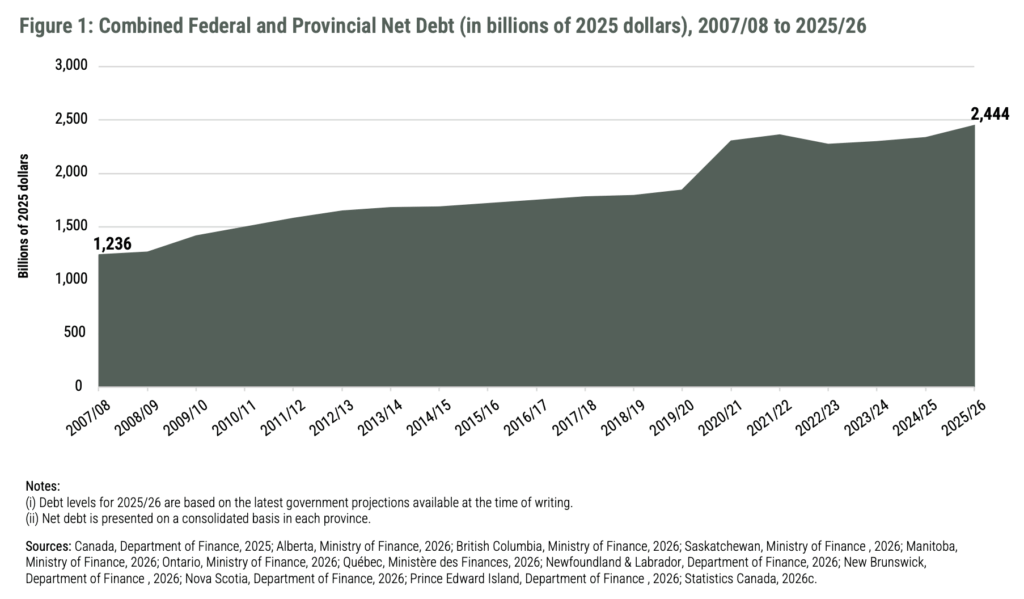
The report estimates combined federal and provincial net debt will reach $2.44 trillion in 2025/26, the highest it has reached in the past two decades.
The more revealing figure is not just the national total, but how differently that debt sits across provincial economies once each province’s own balance sheet is combined with its population-based share of federal debt.
 Sponsored · Silver47 Exploration Inc.
By that measure, Manitoba carries the heaviest load in the country. Fraser estimates its combined federal-provincial net debt at 91.3% of GDP, ahead of Newfoundland and Labrador at 89.7%, Quebec and Nova Scotia at 89.1%, Prince Edward Island at 88.8%, New Brunswick at 88.1%, and Ontario at 82.7%.
Alberta remains Canada’s fiscal counterweight. Its combined debt-to-GDP ratio is estimated at 43.4%, less than half Manitoba’s ratio and the lowest in the country. Saskatchewan follows at 53.2%, while British Columbia sits at 69.0%.
The per-person picture adds another layer. Fraser estimates Newfoundland and Labrador has the highest combined federal-provincial debt per person at $71,611, followed by Ontario at $63,574 and Quebec at $63,488. Alberta is lowest at $42,368 per person.
The combined debt figure has almost doubled since the late-2000s fiscal low point. Fraser puts inflation-adjusted federal and provincial net debt at $1.24 trillion in 2007/08, compared with the projected $2.44 trillion for 2025/26. That is an increase of $1.21 trillion, or 97.7%.
 Sponsored · PTX Metals Inc.
The economy has not kept pace with the borrowing. Fraser estimates the combined federal-provincial net debt-to-GDP ratio at 75.4% in 2025/26, compared with 53.2% in 2007/08 and 65.9% in 2019/20, the final pre-pandemic fiscal year. The report estimates governments added $603.7 billion in inflation-adjusted net debt from 2019/20 to 2025/26, a 32.8% increase.
Ottawa still accounts for the larger part of the stack. Fraser estimates federal net debt at $1.47 trillion in 2025/26, compared with provincial net debt of roughly $970.9 million across the 10 provinces. That leaves the federal government with 60.3% of total federal-provincial net debt and the provinces with 39.7%.
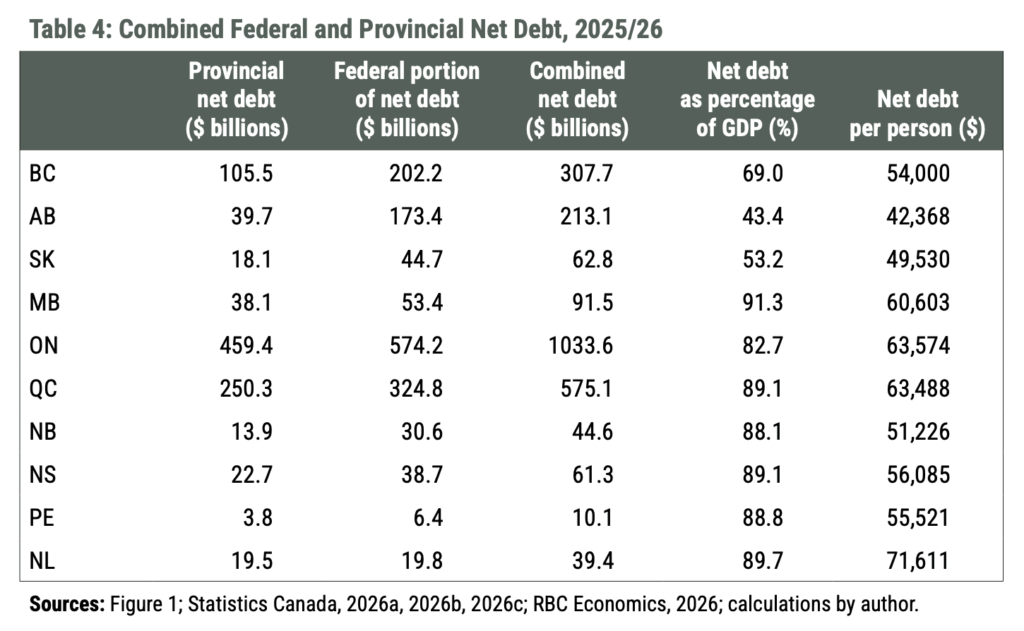
That split matters because provincial fiscal capacity is uneven. Ontario’s combined net debt is estimated at $1.03 trillion, the largest absolute total, but its ratio is lower than several smaller provinces because its economy is larger. Newfoundland and Labrador’s combined debt is estimated at $39.4 billion, but its per-person burden is the highest in the country.
The federal backdrop is not moving toward balance quickly. Reuters reported Canada’s 2026 Spring Economic Update projected a $66.9 billion federal deficit for 2025/26, below the earlier $78.3 billion forecast, but still a large shortfall.
READ: Poilievre: “You Doubled The Deficit” vs. Carney: “I Reduced The Deficit”—What Is The Truth?
The government’s update also shows the federal debt-to-GDP ratio staying above 41% through much of the forecast horizon under its baseline, with downside and upside scenarios tied to investment, supply disruptions, and nominal GDP assumptions.
Fraser’s report cites the federal update as projecting federal net debt to rise 26.5% from 2025/26 through 2030/31, reaching $1.86 trillion. Most provinces are also not planning near-term balance across their fiscal tracks, with Fraser identifying eight provinces projecting deficits every year from 2025/26 to 2028/29.
The report argues that debt accumulation can also weigh on long-term growth by putting pressure on borrowing costs, private investment, and productivity.
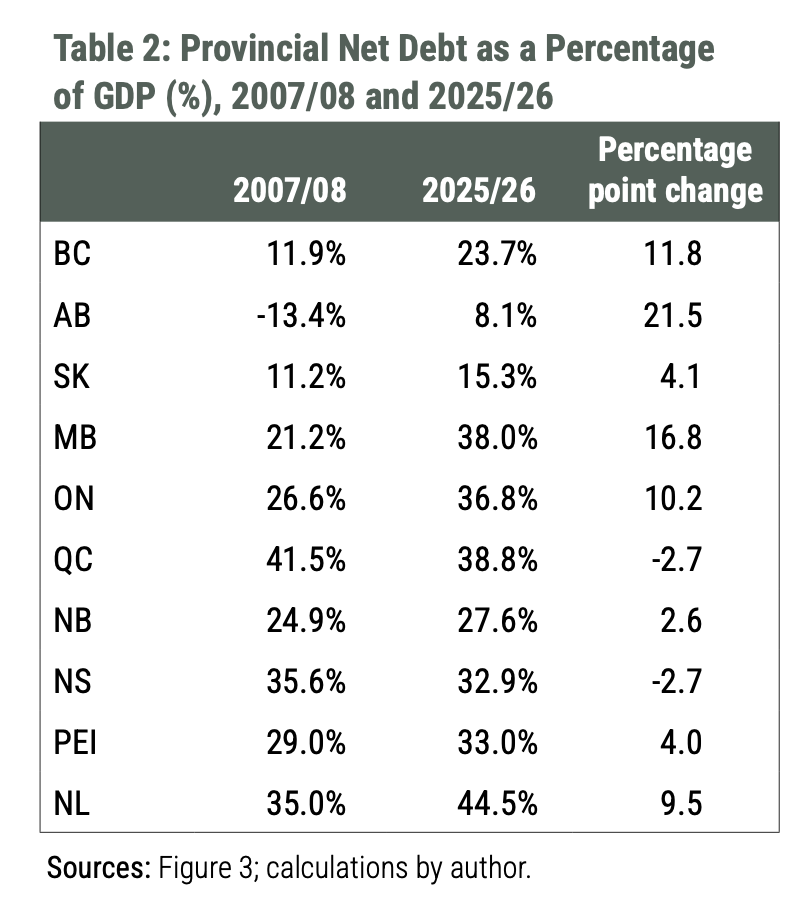
The political challenge is that the debt debate is national, while the burden is increasingly local. A federal dollar of debt is shared across the country, but it lands on top of provincial books that look nothing alike. That is why the same Canada-wide fiscal story reads as a heavy-burden problem in Manitoba and Newfoundland and Labrador, a scale problem in Ontario and Quebec, and a still-manageable but deteriorating trend in Alberta.
Information for this story was found via the sources and companies mentioned. The author has no securities or affiliations related to the organizations discussed. Not a recommendation to buy or sell. Always do additional research and consult a professional before purchasing a security. The author holds no licenses.