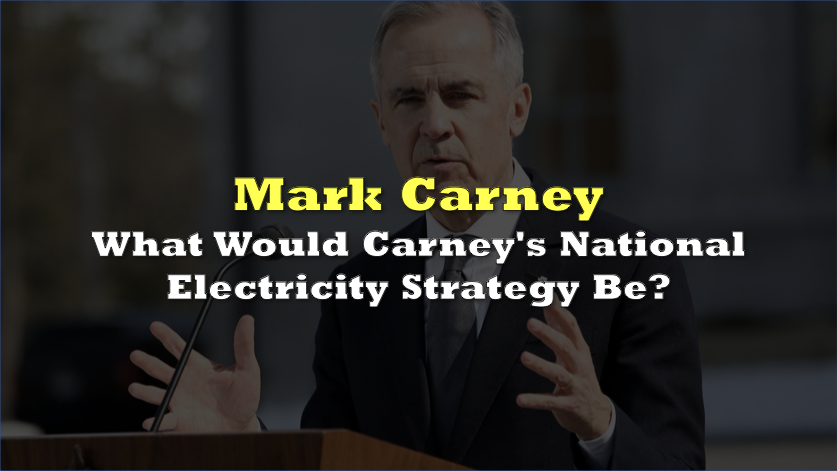

Prime Minister Mark Carney is expected Thursday to release details of a national electricity strategy aimed at expanding Canada’s power system, according to reporting on his schedule and source-based accounts.
Currently, the pledge of the government is to double the country’s electricity grid capacity by 2050 as power demand moves from a utility-planning issue into a broader economic constraint. Households, electric vehicles, industrial users, data infrastructure, and remote communities all require more reliable supply. For businesses, the question is not only whether power is clean, but whether it is available at a cost that supports investment.
That makes the electricity strategy a test of execution. The Canadian Press reported that Carney’s itinerary framed the announcement around clean, affordable, and reliable energy.
 Sponsored · Altamira Gold Corp.
The strategy also arrives after a delayed rollout. Carney had indicated in late March that the electricity plan would come soon, but the release stretched into May, according to The Canadian Press.
Nuclear and grid capital
Nuclear is expected to sit near the centre of Ottawa’s wider power strategy. Reuters reported in March that Energy Minister Tim Hodgson said Canada would soon release a comprehensive electricity and nuclear strategy, while telling investors they wanted “clarity,” “speed,” and “direction” before committing capital.
Canada has uranium resources, CANDU technology ambitions, proposed reactor projects, and rising demand for non-emitting baseload power. But nuclear projects require long timelines, political durability, financing certainty, and regulatory confidence. A federal strategy can improve the signal, but it cannot remove project risk by announcement. This is where investor lens is key.
In addition, transmission may be just as difficult. The Canadian Press reported that Canada’s power connections are still largely oriented north-south rather than east-west, limiting the ability of provinces to share electricity with each other.
The electricity announcement is also landing beside a separate federal-provincial energy negotiation. Reuters reported that Carney is expected Friday in Calgary to announce an industrial carbon-pricing agreement with Alberta, with the province’s effective carbon credit cost expected to rise toward $130 per metric ton by 2040.
That sequencing gives Ottawa a two-track message: build more clean power while trying to preserve industrial competitiveness in Canada’s highest-emitting province.
However, it also exposes the political difficulty. Alberta wants investment certainty and room for oil sands competitiveness. Ottawa wants a credible emissions framework tied to carbon capture goals.
For Carney, the electricity strategy’s first market test will not be the size of the 2050 ambition. It will be whether the plan identifies who pays, who permits, who builds, and how quickly new capacity can reach the customers that need it.
Information for this story was found via the sources and companies mentioned. The author has no securities or affiliations related to the organizations discussed. Not a recommendation to buy or sell. Always do additional research and consult a professional before purchasing a security. The author holds no licenses.