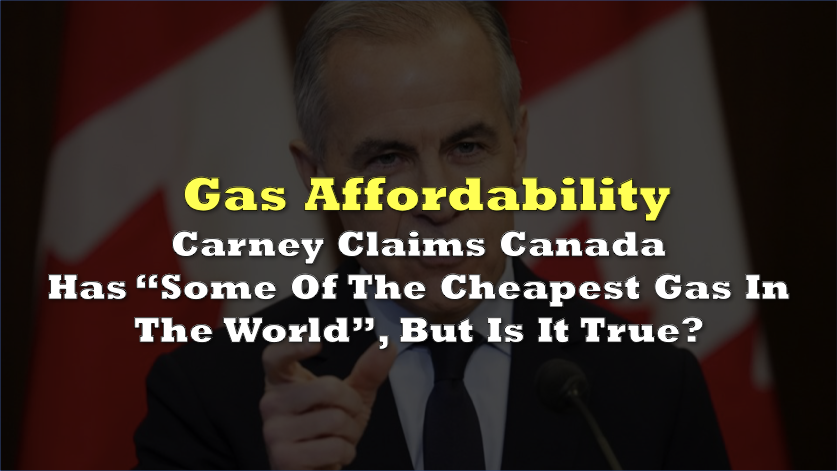

Prime Minister Mark Carney, in his speech explaining the country’s national electricity strategy, claimed that Canada has one of the “cheapest gas” in the world. However, that claim falls apart when measured against gasoline prices, yet becomes materially stronger when measured against wholesale natural gas.
The distinction matters because the word “gas” sits at the centre of two separate affordability debates. For drivers, it means the price posted outside a filling station. For electricity planners, it means a fuel that can backstop the grid when hydro, wind, solar, nuclear, and transmission are not enough. Carney’s problem is that the first meaning is the one voters see most often.
On the gasoline test, Canada does not look cheap. GlobalPetrolPrices listed Canada’s gasoline price at $2.13 per litre, or US$1.56 per litre, as of May 11, 2026. The same dataset put the global average at $1.46 per litre.
 Sponsored · Altamira Gold Corp.
Ottawa itself acknowledged pump-price pressure in April when it temporarily suspended the federal fuel excise tax on gasoline and diesel until September 7, 2026. The government said the move would cut regular gasoline bills by 10 cents per litre and diesel by 4 cents per litre.
The stronger defence is that Carney was speaking about natural gas in an electricity context. On that test, Canada has a real cost advantage. CAPP’s April 2026 natural gas market report cited futures pricing that put Alberta’s AECO benchmark at an expected $1.62 per GJ in 2026, compared with Henry Hub at $3.54 per MMBtu. The same report said Western Canada’s discount has been driven by oversupply and limited takeaway capacity.
That discount is not just a commodity-market detail. It is the economic logic behind giving gas-fired power a role in a larger electricity buildout. Cheap domestic gas can help support reliability while Canada tries to add enough power for industrial growth, electrification, AI data centres, and new manufacturing demand.
The government’s official announcement framed the National Electricity Strategy as a plan to double Canada’s grid capacity by 2050 and deliver reliable, affordable power. It said Ottawa would consult provinces, territories, Indigenous Peoples, utilities, and unions over the coming months on how to build that capacity “effectively and affordably.”
If Carney meant gasoline, the claim is false against current global price data. If he meant natural gas, the claim is broadly supported by Canadian benchmark pricing, though still imprecise without a date, benchmark, and comparison group.
However, Canada may have cheap natural gas, but voters are more likely to judge affordability from the pump, the power bill, and the tax line. That is where Carney’s energy pitch becomes vulnerable.
Information for this story was found via the sources and companies mentioned. The author has no securities or affiliations related to the organizations discussed. Not a recommendation to buy or sell. Always do additional research and consult a professional before purchasing a security. The author holds no licenses.